i Short answer
A basket trade groups several related instruments into a single combined position, allowing exposure to a broader theme at once.
Most South African retail brokers don't offer this directly as a standard, built-in feature.
📋 ON THIS PAGE
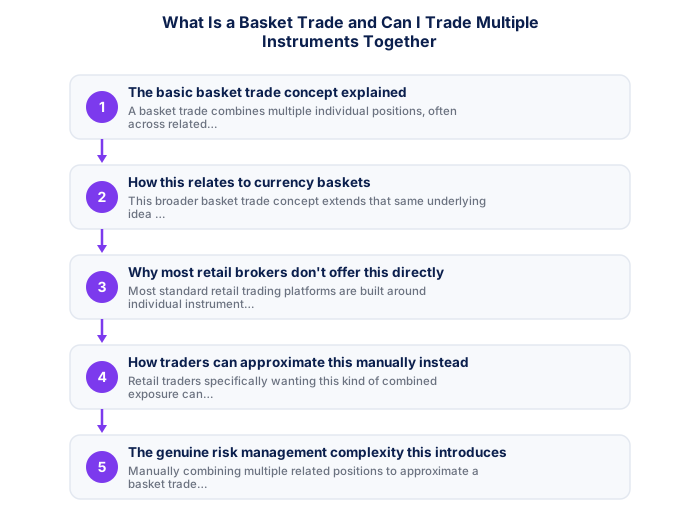
1. The basic basket trade concept explained
A basket trade combines multiple individual positions, often across related instruments sharing a common underlying theme, into what's treated as a single combined trade for analysis and risk management purposes, rather than managing each individual instrument as a completely separate, unrelated position.
Building consistent trading results in South Africa requires applying disciplined principles across all aspects of the trading process. Many of the challenges South African traders face - from load shedding interruptions to rand volatility around political events - are manageable with the right preparation and risk framework. Approaching each session with a written plan, defined risk parameters, and clear criteria for entry and exit transforms trading from reactive to systematic.
2. How this relates to currency baskets
This broader basket trade concept extends the same underlying idea behind currency baskets, grouping related exposures together, into an actual combined trading and risk management approach, rather than simply a reference index or comparison tool.
- FSCA-regulated broker verified at fsca.co.za
- Demo account tested for minimum 60 days
- Trading plan written: entry, exits, position sizing
- Risk per trade defined (1-2% of account)
- Backup internet connection tested for load shedding
- Tax implications understood
3. Why most retail brokers don't offer this directly
Most standard retail trading platforms are built around individual instrument positions rather than combined basket structures, meaning this functionality remains more common in institutional trading contexts than typical retail platforms.
4. How traders can approximate this manually instead
Retail traders wanting this kind of combined exposure can manually open several related individual positions simultaneously, similar to how day trading often involves managing multiple open positions, effectively achieving a similar combined effect without requiring dedicated basket-trade platform functionality.
| Item | Detail |
|---|---|
| Regulator | FSCA, fsca.co.za |
| Exchange control | SARB, resbank.co.za |
| Tax authority | SARS, sars.gov.za |
| JSE hours | 09:00-17:00 SAST Mon-Fri |
| Best forex session | 15:00-17:00 SAST |
| CGT annual exclusion | R50,000 (individuals) |
5. The genuine risk management complexity this introduces
Manually combining multiple related positions to approximate a basket trade introduces the same correlation risk considerations that apply across your entire account, requiring careful, combined risk assessment rather than treating each position as fully independent.
6. When this kind of combined approach might genuinely help
This approach might genuinely suit traders with a specific broader thematic view, for example, a view on overall US Dollar strength or weakness, expressed across several related currency pairs simultaneously rather than through a single pair alone.
Every South African trader who approaches the market with a structured plan, clear risk parameters, and disciplined execution starts each session from a position of strength that the majority of retail participants, who operate reactively and without documented rules, do not have. Building and maintaining this structural advantage requires consistent effort rather than exceptional talent, which means it is accessible to any trader willing to invest the time in proper preparation and honest self-assessment.
Correlated instruments in a basket don't provide genuine diversification.
Trading a basket of instruments can offer diversification if the instruments are genuinely uncorrelated. Instruments that tend to move together provide the appearance of diversification without the benefit.
South African traders have a natural analytical advantage on rand-paired currencies because they observe the domestic drivers of ZAR directly and continuously. The technical relationships between major currency pairs and the USD/ZAR, particularly the negative correlation between USD/ZAR and risk-on periods, become more predictable once you understand which component of USD/ZAR movement is driven by global USD strength and which is driven by SA-specific fundamental factors. Building this analytical separation into your daily market review produces more precise ZAR trading hypotheses than treating USD/ZAR as a single undifferentiated signal.
★ Why It Matters
Worth doing manually if your broker lacks a built-in basket feature: track your combined exposure across a themed group of trades (several USD pairs, for instance) in a simple spreadsheet. The underlying correlation risk exists whether or not your platform has a dedicated tool to show it to you.
✕ Common mistakes
- Assuming a basket trade removes correlation risk rather than concentrating it. Combining related instruments can actually increase, not reduce, combined exposure.
- Treating a themed group of trades as more diversified than it actually is. Related instruments often share the same underlying driver.
- Ignoring how a basket's combined risk compares to a single larger position. The risk math should be assessed for the basket as a whole.
Key Takeaways
- A basket trade groups several related instruments into a single combined position, though most South African retail brokers don't offer this directly.
- A basket trade groups several related instruments into a single combined position, allowing exposure to a broader theme at once.
- Most South African retail brokers don't offer this directly as a standard, built-in feature.
- The basic basket trade concept explained.
- How this relates to currency baskets.
See also: Why Has Bitcoin Fallen 45% From Its October 2025 Record High? and Which ETF Should a South African Beginner Actually Buy?.
Frequently asked follow-up questions
Do any South African brokers offer genuine basket trade functionality?
This is uncommon among typical retail-focused brokers. Checking your broker's platform features confirms what's genuinely available.
Is manually combining positions as effective as genuine basket functionality?
It can achieve a similar combined exposure effect, though it requires more manual position sizing and tracking effort compared to dedicated, automated basket functionality.
Does a basket trade reduce or increase my overall risk?
This depends entirely on whether the combined instruments are correlated or genuinely diversifying, rather than following any single universal pattern.
Can I apply a single combined stop-loss across a manually-built basket?
Most standard retail platforms require setting individual stop-losses per position rather than one combined stop across several positions, requiring careful individual management instead.
Is this concept relevant to share trading as well as forex?
Yes, the same underlying logic of combining related positions around a shared theme can apply to shares or other instrument categories, not just currency pairs.
