i Short answer
Commodity currencies, including the Australian Dollar, Canadian Dollar, and South African Rand, often show meaningful sensitivity to global commodity prices, given their economies' exposure to commodity exports.
📋 ON THIS PAGE
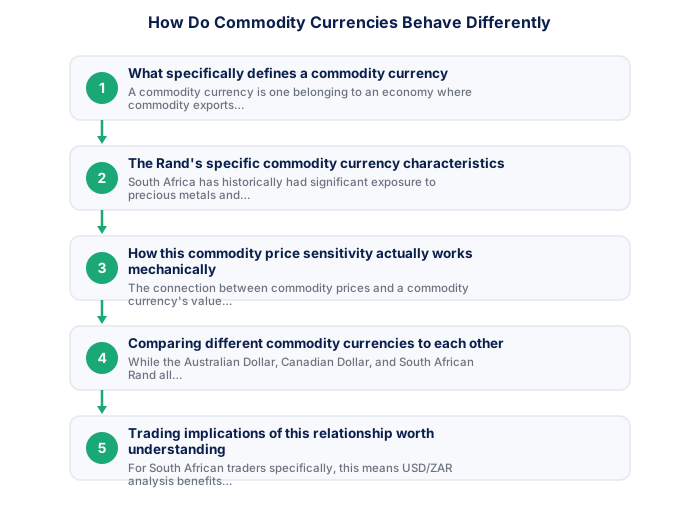
- What specifically defines a commodity currency
- The Rand's specific commodity currency characteristics
- How this commodity price sensitivity actually works mechanically
- Comparing different commodity currencies to each other
- Trading implications of this relationship worth understanding
- When this relationship weakens or breaks down
1. What defines a commodity currency
A commodity currency is one belonging to an economy where commodity exports, minerals, energy, or agricultural products, represent a significant share of export revenue and overall economic activity. This significant export exposure means commodity price movements can meaningfully affect the broader economy's trade balance, government revenue, and overall growth outlook, which in turn can influence the currency's value.
It's worth understanding this as a matter of degree rather than a strict category, since most economies have some commodity export exposure, what genuinely distinguishes a commodity currency is the scale of that exposure relative to the broader economy, significant enough that commodity price swings visibly show up in the currency's own behaviour over time.
| Currency | Primary Commodity Link |
|---|---|
| South African Rand (ZAR) | Gold, platinum group metals |
| Australian Dollar (AUD) | Iron ore, coal |
| Canadian Dollar (CAD) | Oil |
| Norwegian Krone (NOK) | Oil |
| New Zealand Dollar (NZD) | Dairy, agricultural exports |
2. The Rand's commodity currency characteristics
South Africa has historically had significant exposure to precious metals and mining more broadly, which has contributed to the Rand's reputation as a commodity-sensitive currency, alongside its broader emerging-market characteristics behind USD/ZAR's elevated volatility profile generally.
This means South African traders following USD/ZAR benefit from watching broader global commodity price trends, particularly gold and platinum, alongside the more directly currency-specific factors (SARB policy, political developments), since both contribute to the Rand's overall behaviour.
- FSCA-regulated broker verified at fsca.co.za
- Demo account tested for minimum 60 days
- Trading plan written: entry, exits, position sizing
- Risk per trade defined (1-2% of account)
- Backup internet connection tested for load shedding
- Tax implications understood
It's worth checking current mining sector data periodically rather than assuming this characteristic remains fixed indefinitely, since the relative importance of mining and commodity exports within the broader South African economy can shift gradually over years, worth being aware of if you're relying on this relationship for longer-term fundamental analysis.
3. How this commodity price sensitivity actually works mechanically
The connection between commodity prices and a commodity currency's value typically operates through several channels: rising commodity prices generally improve the relevant economy's trade balance and export revenue, supporting currency strength; commodity price trends can also influence broader investor sentiment toward the specific economy, affecting capital flows independent of the direct trade balance effect; and in some cases, commodity-exporting government revenue itself is directly tied to specific commodity prices, affecting fiscal outlook and broader economic confidence.
It's worth appreciating that these channels can sometimes work at different speeds, the trade balance effect tends to show up gradually over economic reporting cycles, while the sentiment and capital flow effect can shift considerably faster, worth keeping this distinction in mind when trying to interpret why a currency is or isn't responding to a given commodity price move as quickly as expected.
4. Comparing different commodity currencies to each other
While the Australian Dollar, Canadian Dollar, and South African Rand all share this general commodity-sensitivity characteristic, the specific commodities most relevant to each differ. The Australian Dollar shows particular sensitivity to iron ore and broader industrial metals, the Canadian Dollar to oil given Canada's significant oil export industry, and the Rand to precious metals, particularly gold and platinum.
This means tracking the specific commodity most relevant to whichever commodity currency you're trading, rather than assuming all commodity prices affect all commodity currencies identically, gives a more accurate, currency-specific analytical picture.
| Item | Detail |
|---|---|
| Regulator | FSCA, fsca.co.za |
| Exchange control | SARB, resbank.co.za |
| Tax authority | SARS, sars.gov.za |
| JSE hours | 09:00-17:00 SAST Mon-Fri |
| Best forex session | 15:00-17:00 SAST |
| CGT annual exclusion | R50,000 (individuals) |
It's worth building a simple personal reference note listing which specific commodities matter most for whichever commodity currencies you actually trade, rather than relying on memory, since mixing up which commodity drives which currency is an easy, avoidable mistake when analysing multiple commodity-sensitive pairs.
5. Trading implications of this relationship worth understanding
For South African traders, this means USD/ZAR analysis benefits from incorporating awareness of gold and broader precious metals price trends, alongside the more directly currency-specific fundamental factors that affect USD/ZAR, since neither consideration in isolation gives a complete picture of likely Rand direction.
Some traders use gold price trends as one input among several when forming a broader view on likely USD/ZAR direction, reflecting the kind of multi-factor fundamental analysis that works better than relying on any single fundamental driver in isolation.
It's worth treating gold price trends as background context that informs your broader view, rather than a standalone trading signal to act on directly, since the relationship, while genuine, operates with enough noise and delay that a rising gold price alone rarely justifies an immediate USD/ZAR trade without corroborating evidence from other analysis.
6. When this relationship weakens or breaks down
Like any correlation relationship, the commodity-currency relationship isn't a fixed, mechanical rule holding constant regardless of other circumstances. Periods of significant domestic political or economic stress, for example, can sometimes override the commodity-price relationship, with the Rand weakening despite favourable gold prices, if domestic factors are weighing more heavily on sentiment during that specific period.
Recognising this relationship as a generally useful, but not infallible, analytical input, the same epistemic humility that applies to any single analytical signal, supports more realistic, balanced fundamental analysis than treating the commodity-currency link as an absolute, mechanical rule.
The Rand, Australian Dollar, and Canadian Dollar all share sensitivity to commodity prices, given their economies' reliance on mineral and energy exports.
★ Why It Matters
A connection worth tracking if you trade ZAR: South Africa's own commodity exposure means the Rand sometimes moves in tandem with other commodity currencies like the Australian Dollar during broad global risk shifts, even without any South Africa-specific news driving it.
✕ Common mistakes
- Ignoring global commodity price trends when trading ZAR. Commodity-linked currencies share underlying sensitivity even without direct news.
- Treating all commodity currencies as behaving identically. Each economy's specific export mix creates meaningful differences.
- Not tracking Chinese demand data despite its relevance to commodity currencies. China's appetite for raw materials affects several commodity currencies simultaneously.
Key Takeaways
- Commodity currencies like the Australian Dollar and South African Rand often show sensitivity to global commodity prices, behaving differently from other majors.
- Commodity currencies, including the Australian Dollar, Canadian Dollar, and South African Rand, often show meaningful sensitivity to global commodity prices, given their economies' exposure to commodity exports.
- What defines a commodity currency.
- The Rand's commodity currency characteristics.
- How this commodity price sensitivity actually works mechanically.
See also: How Do I Invest in Gold in South Africa?.
Frequently asked follow-up questions
Is the Rand more commodity-sensitive than other emerging-market currencies?
This varies and depends on each specific emerging economy's own export composition. The Rand's sensitivity reflects South Africa's historical mining and precious metals exposure.
Does this relationship mean I should trade gold and USD/ZAR together?
Some traders do incorporate both into a related analytical approach, though this requires understanding the genuine, sometimes inconsistent relationship rather than assuming a fixed, mechanical link.
Are there commodity currencies beyond AUD, CAD, and ZAR worth knowing about?
Yes, various other emerging-market and resource-exporting economies have currencies showing similar commodity sensitivity, though AUD, CAD, and ZAR are among the most commonly discussed examples in general trading education.
