i Short answer
The Dollar Index (DXY) measures the US Dollar's value against a weighted basket of major currencies, predominantly the Euro.
It provides a broad gauge of overall Dollar strength, rather than reflecting its relationship to a single currency like EUR/USD does.
📋 ON THIS PAGE
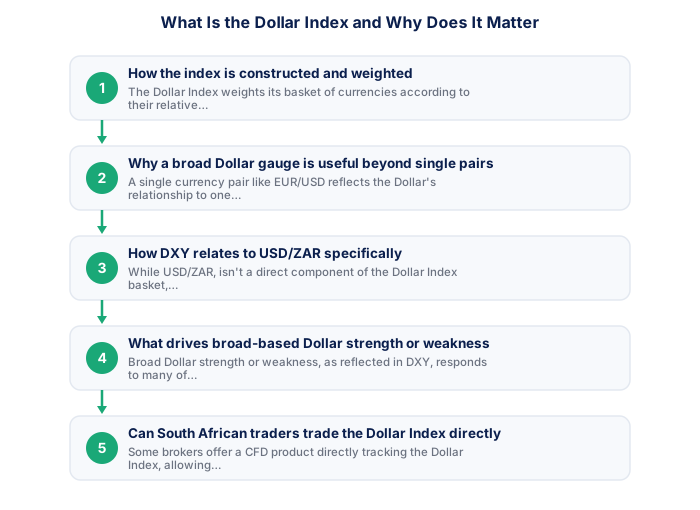
- How the index is constructed and weighted
- Why a broad Dollar gauge is useful beyond single pairs
- How DXY relates to USD/ZAR specifically
- What drives broad-based Dollar strength or weakness
- Can South African traders trade the Dollar Index directly
- Using DXY as a broader context tool, not a standalone signal
1. How the index is constructed and weighted
The Dollar Index weights its basket of currencies according to their relative trading significance against the Dollar, with the Euro carrying by far the largest weighting given EUR/USD's dominant trading volume. The index rises when the Dollar strengthens against this weighted basket overall, and falls when the Dollar weakens against the basket overall, even if it might be moving differently against any single specific currency within that basket.
It's worth checking the current, official weighting directly from the index provider rather than relying on a fixed historical figure, since while these weightings change infrequently, confirming the current composition matters for genuinely accurate interpretation.
2. Why a broad Dollar gauge is useful beyond single pairs
A single currency pair like EUR/USD reflects the Dollar's relationship to one specific other currency, which can sometimes be influenced as much by factors specific to that other currency (Eurozone-specific developments, for example) as by genuine, broad-based Dollar strength or weakness. The Dollar Index, by aggregating across multiple major currencies, helps isolate genuinely broad-based Dollar movement from movement that's actually more specific to just one particular counterpart currency.
This distinction matters practically: a trader wanting to understand whether the Dollar itself is broadly strengthening or weakening, separate from any single counterpart currency's specific dynamics, benefits from checking the Dollar Index directly rather than inferring this from any single pair's movement alone.
- FSCA-regulated broker verified at fsca.co.za
- Demo account tested for minimum 60 days
- Trading plan written: entry, exits, position sizing
- Risk per trade defined (1-2% of account)
- Backup internet connection tested for load shedding
- Tax implications understood
3. How DXY relates to USD/ZAR specifically
While USD/ZAR isn't a direct component of the Dollar Index basket, broad-based Dollar strength or weakness reflected in DXY often correlates, at least loosely, with similar directional pressure on USD/ZAR, given that broad Dollar dynamics tend to affect the Dollar's relationship with many other currencies, including emerging-market currencies like the Rand, even those outside the specific DXY basket.
This isn't a perfect, mechanical relationship, Rand-specific factors around USD/ZAR volatility drivers can override or compound with broader Dollar dynamics, but checking DXY alongside Rand-specific analysis gives useful additional context for South African traders specifically interested in USD/ZAR.
4. What drives broad-based Dollar strength or weakness
Broad Dollar strength or weakness, as reflected in DXY, responds to many of the same fundamental factors relevant to interest rates and currency prices generally. Federal Reserve monetary policy specifically tends to have an outsized effect on broad Dollar dynamics, given the Dollar's role as the world's primary reserve currency, alongside broader global risk sentiment, since the Dollar often strengthens broadly during periods of global risk aversion, reflecting its traditional safe-haven status.
It's worth following Federal Reserve policy specifically as your primary DXY-relevant research focus, discussed elsewhere on this site regarding interest rate decisions generally, since Fed policy expectations tend to be the single most significant driver of broad Dollar strength across this entire index.
| Item | Detail |
|---|---|
| Regulator | FSCA, fsca.co.za |
| Exchange control | SARB, resbank.co.za |
| Tax authority | SARS, sars.gov.za |
| JSE hours | 09:00-17:00 SAST Mon-Fri |
| Best forex session | 15:00-17:00 SAST |
| CGT annual exclusion | R50,000 (individuals) |
5. Can South African traders trade the Dollar Index directly
Some brokers offer a CFD product directly tracking the Dollar Index, letting traders take a position on broad Dollar strength or weakness directly, rather than through any single specific currency pair. Checking your specific broker's available instrument range clarifies whether this specific product is available to you, since not every broker offers Dollar Index CFDs as standard.
It's worth checking your specific broker's instrument list directly for DXY availability, since this specific index isn't universally offered across every retail CFD platform, worth confirming before assuming access.
6. Using DXY as a broader context tool, not a standalone signal
Many traders use DXY primarily as a broader context tool informing their analysis of specific currency pairs, rather than trading the index directly, checking whether DXY is showing a clear, broad Dollar trend that might inform or confirm the analysis being done on a specific pair like USD/ZAR or EUR/USD, similar in spirit to multi-timeframe and correlation-based confirmation approaches used more generally.
It's worth checking DXY specifically before interpreting any single Dollar-pair move, discussed elsewhere on this site regarding safe haven dynamics and broader risk sentiment, since this broader index helps you judge whether a specific pair's movement reflects genuine, broad Dollar strength or something more pair-specific.
The Dollar Index tracks the Dollar against a basket of major currencies. When the DXY rises, USD strengthens broadly, typically pushing USD/ZAR up. When it falls, EM currencies including the Rand often strengthen.
★ Why It Matters
Worth tracking alongside your own ZAR pairs: a broad DXY move sometimes explains a USD/ZAR move that looks, in isolation, like it's about something happening in South Africa, when it's actually a global Dollar story playing out the same way against most currencies simultaneously.
✕ Common mistakes
- Not tracking the Dollar Index alongside individual Dollar-paired analysis. This broader gauge provides useful context individual pairs alone don't capture.
- Treating DXY and EUR/USD as measuring the same thing. DXY reflects a weighted basket, not a single bilateral relationship.
- Ignoring DXY weighting specifics when interpreting its movement. The Euro's heavy weighting means DXY can be disproportionately influenced by EUR/USD specifically.
Key Takeaways
- The Dollar Index (DXY) measures the US Dollar's value against a basket of major currencies, providing a broad gauge of overall Dollar strength or weakness.
- The Dollar Index (DXY) measures the US Dollar's value against a weighted basket of major currencies, predominantly the Euro.
- It provides a broad gauge of overall Dollar strength, rather than reflecting its relationship to a single currency like EUR/USD does.
- How the index is constructed and weighted.
- Why a broad Dollar gauge is useful beyond single pairs.
Frequently asked follow-up questions
Is DXY the only Dollar strength index available?
It's the most widely referenced, though other similar Dollar strength gauges exist with slightly different currency basket compositions and weightings.
Does DXY include the South African Rand in its basket?
No, DXY's basket consists of major developed-market currencies. The Rand is not a direct component, though broad Dollar dynamics can still loosely influence USD/ZAR.
Can DXY movement contradict a specific pair's movement?
Yes, this can happen if factors specific to one particular counterpart currency dominate that specific pair's movement, even while broader Dollar dynamics elsewhere in the basket move differently.
