i Short answer
Most FSCA-regulated brokers accept EFT, debit and credit cards, and in some cases e-wallets, depending on the provider.
EFT is generally the simplest, fastest, and lowest-cost route, since it uses familiar domestic banking rails.
📋 ON THIS PAGE
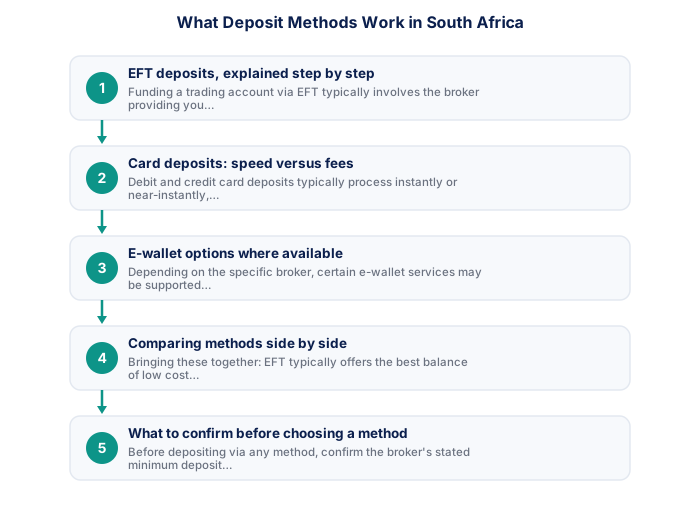
1. EFT deposits, explained step by step
Funding a trading account via EFT typically involves the broker providing you with specific banking details, sometimes a dedicated local collection or trust account, to transfer funds to from your own South African bank account, using your bank's standard online banking, mobile app, or in-branch transfer process exactly as you would for any other domestic payment. Once the broker's system confirms receipt of the transfer (often verified automatically through proof-of-payment matching or bank integration), your trading account balance is credited.
This process is typically free or very low-cost on the broker's side (your own bank may apply standard EFT fees depending on your banking package), and transfers commonly clear within a single business day, making it both the most cost-effective and one of the fastest deposit methods available to South African traders specifically funding regulated, ZAR-account-supporting brokers.
It's worth double-checking the reference number or payment description the broker asks you to include with the transfer, since this is often exactly what their automated matching system uses to identify and credit your specific deposit. Omitting or mistyping this detail is a common, easily avoidable reason an otherwise successful transfer takes longer than expected to actually reflect in your trading account.
| Method | Typical Speed | Typical Fees |
|---|---|---|
| EFT | Same day | None, or low |
| Card deposit | Instant | Sometimes applicable |
| E-wallet | Instant to same day | Varies by provider |
2. Card deposits: speed versus fees
Debit and credit card deposits typically process instantly or near-instantly, crediting your trading account within minutes rather than the hours or single business day that EFT might take, making cards an attractive option when you want to start trading immediately rather than waiting even a short period for an EFT to clear. This speed advantage, however, sometimes comes with a processing fee, either charged directly by the broker or reflected in a less favourable currency conversion rate if your card is denominated differently from your trading account.
It's also worth being aware that some South African banks apply specific restrictions or additional verification steps to card payments made to certain categories of overseas or financial services merchants, occasionally requiring you to confirm the transaction directly with your bank via SMS or app notification before it successfully processes, this is a standard fraud-prevention measure rather than anything broker-specific.
- SARB economic calendar checked for the week
- Next Eskom load shedding schedule reviewed
- GNU stability news reviewed
- Stats SA data releases noted
- Credit agency review dates checked
- US/global events that move EM risk noted
Choose FSCA-regulated broker
Verify the FSP number is current at fsca.co.za.
Submit FICA documents
SA ID, proof of address within 3 months, bank account proof.
Fund via EFT
Make the initial deposit from your SA bank account in ZAR.
Open demo account first
Practice on demo before activating your live account.
Start with minimum capital
Begin with an amount you can afford to lose while learning.
It's worth calculating the actual fee impact concretely for your typical deposit size before assuming card payments are simply 'the fast option worth paying for.' A modest-sounding percentage fee can represent a meaningful amount in Rand terms on a larger deposit, worth weighing consciously against how much the speed advantage genuinely matters for your specific situation.
3. E-wallet options where available
Depending on the specific broker, certain e-wallet services may be supported as a deposit (and often withdrawal) method, offering a potentially fast and convenient alternative to direct bank transfers or card payments. Availability of specific e-wallet options varies considerably between brokers, and not every regulated provider supports the same range of options, so this is worth checking directly against your specific broker's available payment methods page rather than assuming any particular e-wallet will be supported.
Where available, e-wallets can sometimes combine the speed advantage of card payments with potentially lower fees, though this varies by specific provider and e-wallet combination, comparing the actual fee and speed terms for your specific situation, rather than assuming e-wallets are universally better or worse than other methods, is the more useful approach.
| Event | Frequency | ZAR impact | Source |
|---|---|---|---|
| SARB MPC | 6x per year | High | resbank.co.za |
| Budget Speech | Annual (February) | Very high | treasury.gov.za |
| Credit reviews | Annual each agency | Very high | Agency sites |
| Stats SA CPI | Monthly | Medium | statssa.gov.za |
| Eskom stage | As needed | Low-medium | eskomsepush.com |
- SA context provides genuine informational edge
- ZAR pairs accessible via FSCA brokers in ZAR accounts
- Rand volatility creates larger intraday ranges
- 6 SARB meetings/year create regular macro setups
- Higher geopolitical risk than G10 pairs
- Load shedding creates unique operational disruptions
- SA rand liquidity thinner than major G10 pairs
- SA-specific news requires constant local monitoring
It's worth checking withdrawal support specifically, not just deposit support, for any e-wallet you're considering, since some brokers accept a given e-wallet for funding an account but don't support withdrawals back through the same channel, worth confirming both directions before relying on this method as your primary funding approach.
4. Comparing methods side by side
Bringing these together: EFT typically offers the best balance of low cost and reasonable speed (commonly clearing within one business day) and is generally the recommended default for South African traders without an urgent need for instant funding. Card deposits offer the fastest crediting (often instant) at the cost of a potential processing fee, making them suitable when speed genuinely matters more than minimising cost. E-wallets, where supported, can offer a middle ground, though specific terms vary enough between brokers and providers that direct comparison for your specific situation is worthwhile.
For most traders making regular, planned deposits rather than urgent, time-sensitive ones, EFT's combination of low cost and reasonable reliability makes it the practical default choice, reserving card deposits for situations where the speed premium genuinely justifies any associated fee.
It's worth revisiting this comparison periodically rather than defaulting permanently to whichever method you first chose, since broker fee structures and processing times can change over time, and a method that was clearly the best choice when you first opened your account may no longer represent the optimal balance of cost and speed for your current situation.
5. What to confirm before choosing a method
Before depositing via any method, confirm the broker's stated minimum deposit amount for that specific method (some brokers set different minimums for different payment types), any explicit deposit fees charged by the broker itself, and, importantly, whether withdrawals are restricted to returning via the same method up to the deposited amount, which is standard practice across regulated brokers and worth factoring into your planning, particularly if you're depositing a large amount via a method with withdrawal limitations.
It's also worth confirming processing time expectations directly with the broker if the published general timeframes seem ambiguous for your specific situation, rather than assuming a generic stated timeframe applies precisely to every individual transaction regardless of timing, amount, or your account's verification status.
6. Avoiding brokers requesting unusual payment methods
A meaningful warning sign worth taking seriously is any broker insisting on unusual, hard-to-trace payment methods as the only available option, for example, requiring deposits exclusively via cryptocurrency with no conventional banking alternative offered, or directing you to transfer funds to a personal individual's bank account rather than a clearly identified corporate or trust account associated with the licensed broker entity.
Legitimate, FSCA-regulated brokers serving South African clients typically offer conventional, traceable payment methods (EFT from your own named bank account, recognised card payment processing) as standard options, precisely because regulatory compliance around anti-money-laundering and fund segregation requires this kind of traceable, properly structured payment infrastructure, an insistence on unconventional, hard-to-trace alternatives as the only option is a meaningful red flag worth investigating before proceeding with any deposit.
Local EFT deposits and withdrawals run through the infrastructure overseen by PASA (the Payments Association of South Africa), which is part of why Rand-denominated transfers between South African bank accounts tend to clear faster than international wire transfers.
EFT is the most common and usually lowest-cost deposit method for South African traders. Card deposits may be faster but can carry conversion fees, particularly for accounts denominated in USD.
★ Why It Matters
Something worth checking precisely: ask your specific broker whether EFT deposits are credited on confirmation or only once the funds genuinely clear in their account, this distinction has caught traders off guard when they assumed a deposit was available to trade with immediately.
✕ Common mistakes
- Choosing a deposit method without comparing relative costs. EFT is often the lowest-cost option compared to cards or e-wallets.
- Not checking whether your specific bank supports your broker's preferred method. Compatibility issues can cause unexpected delays.
- Depositing via a method not in your own name. This frequently fails compliance checks regardless of intent.
Key Takeaways
- EFT, debit/credit cards, and select e-wallets are the main deposit methods for South African traders. Compare speed, fees, and what to check first.
- Most FSCA-regulated brokers accept EFT, debit and credit cards, and in some cases e-wallets, depending on the provider.
- EFT is generally the simplest, fastest, and lowest-cost route, since it uses familiar domestic banking rails.
- EFT deposits, explained step by step.
- Card deposits: speed versus fees.
See also: What Happens If I Deposit More Than I Intended? and What Is a Joint Trading Account and Can I Open One in South Africa?.
Frequently asked follow-up questions
Is EFT always free?
The broker side is often free or low-cost, though your own bank may apply standard EFT fees depending on your specific banking package, worth checking your own bank's fee structure separately.
Can I use a friend or family member's card or bank account to deposit?
This is generally discouraged and sometimes explicitly disallowed by regulated brokers, since payment methods are typically expected to be registered in the account holder's own name as part of standard compliance and fraud-prevention practice.
How do I know if a deposit has actually been credited?
Most platforms show updated account balance immediately upon successful crediting, and you should also receive a confirmation notification or email from the broker once the deposit has been processed.
