i Short answer
An account statement summarises your trading activity, balance changes, and fees over a specific period.
It's an essential record for performance review, dispute resolution, and tax declaration purposes.
📋 ON THIS PAGE
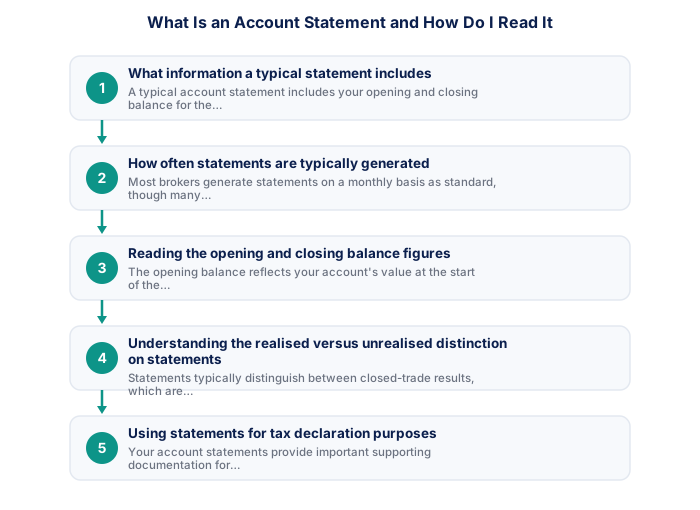
- What information a typical statement includes
- How often statements are typically generated
- Reading the opening and closing balance figures
- Understanding the realised versus unrealised distinction on statements
- Using statements for tax declaration purposes
- Keeping your own records beyond broker statements
1. What information a typical statement includes
A typical account statement includes your opening and closing balance for the period, a detailed list of individual trades executed including entry and exit prices, any deposits or withdrawals processed, and fees or charges applied, including spread costs and any overnight financing discussed elsewhere regarding rollover.
It's worth reviewing this document line by line at least once, rather than only glancing at the summary totals, since the individual trade and fee entries give you a genuine, itemised picture of exactly where your costs are actually coming from, information that's easy to lose sight of when only checking your overall account balance day to day.
2. How often statements are typically generated
Most brokers generate statements on a monthly basis as standard, though many platforms also allow generating statements covering custom date ranges on demand, useful for reviewing specific periods or preparing documentation for a particular purpose.
It's worth generating a custom-range statement specifically whenever you're doing a deeper strategy review or preparing tax documentation, rather than relying solely on the default monthly cycle, since aligning the statement period to your own actual analysis or reporting needs gives more directly useful figures than working around a fixed monthly boundary that may not match your specific purpose.
- South African ID or valid passport
- Proof of residential address dated within 3 months
- Proof of bank account ownership
- Selfie or photo for biometric verification (some brokers)
- Source of funds declaration if depositing above threshold
Choose FSCA-regulated broker
Verify the FSP number is current at fsca.co.za.
Submit FICA documents
SA ID, proof of address within 3 months, bank account proof.
Fund via EFT
Make the initial deposit from your SA bank account in ZAR.
Open demo account first
Practice on demo before activating your live account.
Start with minimum capital
Begin with an amount you can afford to lose while learning.
3. Reading the opening and closing balance figures
The opening balance reflects your account's value at the start of the statement period, while the closing balance reflects the value at the end, with the difference between these two figures, adjusted for any deposits or withdrawals, representing your genuine trading profit or loss for that specific period.
It's worth double-checking this calculation yourself occasionally, rather than trusting the summary figure blindly, simply subtracting any net deposits from the raw balance change gives you your genuine trading result for the period, a useful habit for building comfort with your own account statement rather than relying entirely on the platform's presentation of it.
4. Understanding the realised versus unrealised distinction on statements
Statements typically distinguish between closed-trade results, which are final and realised, and any currently open positions, which remain unrealised and could still change in value after the statement period ends.
This distinction is worth keeping firmly in mind when comparing statements across different periods, since a strong-looking closing balance partly reflects unrealised gains on positions still open at that specific moment, gains that remain genuinely uncertain until those positions are actually closed, rather than being a locked-in, final result the way realised figures are.
| Rejection reason | Fix |
|---|---|
| Address proof older than 3 months | Get a recent utility bill or bank statement |
| Name mismatch between documents | Use documents with exactly matching full name |
| Poor quality scan | Retake with good lighting, all corners visible |
| PO Box address | Brokers require physical residential address only |
5. Using statements for tax declaration purposes
As discussed in detail elsewhere regarding declaring trading income on your tax return, your account statements provide important supporting documentation for accurately calculating and declaring your genuine trading profit or loss, making it worthwhile to retain these records systematically rather than relying solely on your broker's own record retention.
It's worth downloading and saving these statements as you go, rather than assuming you can simply request historical records whenever tax season arrives. Some platforms retain full historical statement access indefinitely, but others limit how far back you can generate or access older records, worth confirming directly with your specific broker.
6. Keeping your own records beyond broker statements
As discussed throughout this site's psychology content regarding the value of a personal trading journal, maintaining your own parallel records beyond official broker statements provides an additional, more detailed layer of documentation, including your own reasoning and analysis for each trade that official statements don't typically capture.
Fees, overnight financing, and currency conversion are easily overlooked.
Cross-checking your monthly account statement against your trading journal catches discrepancies. Overnight financing charges and currency conversion costs are easy to overlook if you only skim the headline P&L.
★ Why It Matters
Worth cross-referencing specifically every month: your statement's recorded figures against your own independently kept trading journal, small discrepancies are rare but worth catching early, and this habit also reinforces your own journal discipline as a useful side effect.
✕ Common mistakes
- Skimming the statement without checking the fee breakdown specifically. This section often reveals cumulative costs easy to underestimate trade by trade.
- Treating monthly statement review as optional. Regular review reinforces both record-keeping and journal discipline.
- Discarding old statements rather than keeping them for tax and dispute purposes. These records matter more than they seem until they're actually needed.
Key Takeaways
- An account statement summarises your trading activity, balance changes, and fees over a period, providing an essential record for review and tax purposes.
- An account statement summarises your trading activity, balance changes, and fees over a specific period.
- It's an essential record for performance review, dispute resolution, and tax declaration purposes.
- What information a typical statement includes.
- How often statements are typically generated.
Frequently asked follow-up questions
How long should I keep my trading statements?
Retaining several years of statements is generally advisable for tax and record-keeping purposes; checking current SARS guidance on record retention periods provides specific current requirements.
Can I download statements in different formats?
Most platforms offer statements in common formats like PDF, suitable for both reading directly and retaining as permanent records.
Does my statement show the specific reason for each fee charged?
Most statements itemise fees by category, though checking your specific broker's fee schedule alongside the statement provides full context for any specific charge you want to understand.
Will my statement reconcile exactly with my own manual calculations?
It generally should, assuming accurate record-keeping on both sides; any discrepancy is worth investigating directly with your broker's support team.
Can I request a statement covering my entire trading history at once?
Many platforms support this kind of complete request, though very long historical ranges may require contacting support directly rather than using standard self-service tools.
