i Short answer
Copy trading automatically replicates another trader's positions directly in your own account in real time.
It carries real financial risk if the copied trader performs poorly, since their losses become your losses proportionally.
📋 ON THIS PAGE
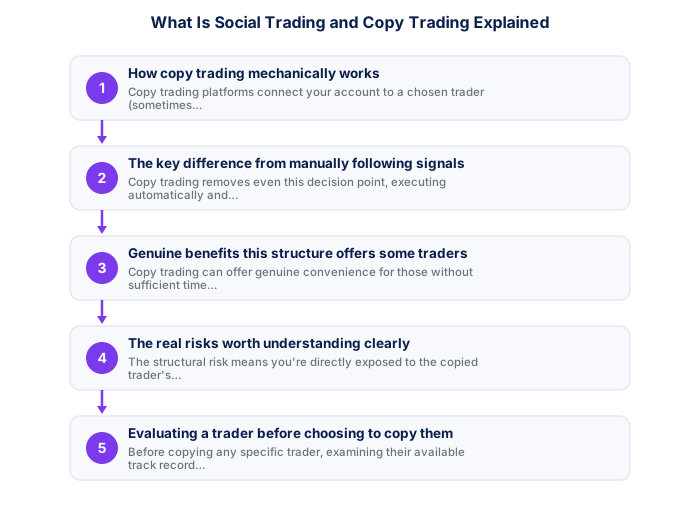
1. How copy trading mechanically works
Copy trading platforms connect your account to a chosen trader (sometimes called a "signal provider" or "strategy provider"), automatically replicating their trades in your own account proportionally to your allocated capital, without requiring your manual confirmation for each individual trade. When the copied trader opens or closes a position, your account automatically mirrors this action, typically scaled to a proportion of your account relative to theirs.
This proportional scaling is worth understanding precisely before committing capital, since it means the actual position sizes and resulting risk in your account depend on the relationship between your allocated capital and the copied trader's own account size, not simply a direct one-to-one replication of their trades. A trader with a much larger account than yours may be taking positions that, once scaled down proportionally, still represent a meaningfully different risk profile in your own smaller account.
2. The key difference from manually following signals
Manually following social media signals still involves you personally deciding whether to act on each specific signal. Copy trading removes even this decision point, executing automatically and immediately without requiring your active confirmation, making the underlying structural risk even more direct and immediate, since there's no manual review step before each trade executes in your account.
See also: Are Free Trading Tools as Good as Paid Ones?
See also: What Is a Broker's Order Execution Speed?
This absence of a manual checkpoint is precisely what makes copy trading feel convenient, and precisely what removes the one safeguard that manual signal-following at least offers: a moment, however brief, where you could notice a signal doesn't fit your own risk tolerance or current circumstances and simply not act on it.
- FSCA-regulated broker verified at fsca.co.za
- Demo account tested for minimum 60 days
- Trading plan written: entry, exits, position sizing
- Risk per trade defined (1-2% of account)
- Backup internet connection tested for load shedding
- Tax implications understood
3. Genuine benefits this structure offers some traders
Copy trading can offer genuine convenience for those without sufficient time to actively trade themselves, tied to fitting trading around a full-time job, or those specifically seeking diversified exposure to multiple different traders' strategies simultaneously, similar in spirit to diversifying across multiple instruments, just applied across multiple human traders rather than instruments directly.
This convenience is genuine, but it's worth being honest about what it actually trades away in exchange: control over individual trade decisions, and the ability to apply your own judgement about whether a specific trade genuinely fits your circumstances at that moment, even if the copied trader's broader track record is generally sound.
4. The real risks worth understanding clearly
This structural risk means you're directly exposed to the copied trader's specific decision-making, risk management discipline (or lack thereof), and any sudden change in their strategy or behaviour, without the kind of independent oversight or veto point that manual signal-following at least theoretically provides. A copied trader experiencing a significant drawdown or abandoning sound risk management during a difficult period directly and immediately transmits this same outcome to your own account.
It's worth explicitly considering what happens if the copied trader's account is itself using leverage and risk levels that don't match your own risk tolerance. Even a trader with a genuinely strong long-term track record may take on risk during any given period that would feel uncomfortable, or be financially inappropriate, if you fully understood and had personally chosen it yourself rather than inheriting it automatically through the copy relationship.
| Item | Detail |
|---|---|
| Regulator | FSCA, fsca.co.za |
| Exchange control | SARB, resbank.co.za |
| Tax authority | SARS, sars.gov.za |
| JSE hours | 09:00-17:00 SAST Mon-Fri |
| Best forex session | 15:00-17:00 SAST |
| CGT annual exclusion | R50,000 (individuals) |
5. Evaluating a trader before choosing to copy them
Before copying any specific trader, examining their available track record for genuine length and consistency (rather than a short, potentially fortunate recent period), their displayed risk metrics including maximum drawdown, and ideally some understanding of their general strategy approach, supports a more informed copying decision than choosing based purely on recent, possibly unsustainable returns.
It's worth being specifically sceptical of impressively high recent returns shown without a correspondingly long track record or clear drawdown history alongside them. A short period of strong performance is exactly the kind of result that can occur through normal statistical variance or elevated risk-taking that hasn't yet produced a corresponding loss, rather than necessarily reflecting a genuinely sound, sustainable approach.
6. Does copy trading genuinely help you learn to trade yourself
Copy trading, by its very design, doesn't build your own independent analytical or decision-making skill, since the decisions are being made entirely by someone else. Traders specifically wanting to develop their own genuine trading skill should view copy trading as a fundamentally different activity from learning to trade independently, rather than a stepping stone toward that separate goal.
Signal following provides the trade idea but you execute it yourself.
Copy trading automatically replicates a chosen trader's positions. Signal following provides the same trade ideas but requires you to execute them manually, introducing timing differences.
★ Why It Matters
Worth checking before copying anyone: their maximum historical drawdown, not just their headline return. A trader with an impressive return built on a strategy that occasionally suffers a 50% drawdown is a very different proposition to copy than one with a smoother, more moderate track record.
✕ Common mistakes
- Assuming copy trading removes the need for your own risk oversight. Their losses become your losses proportionally, requiring ongoing attention.
- Not verifying a copied trader's track record independently. Platform-displayed statistics deserve the same scrutiny as any other performance claim.
- Allocating too large a portion of capital to a single copied trader. This concentrates risk on one person's specific approach and current form.
Key Takeaways
- Copy trading automatically replicates another trader's positions in your account, offering convenience but carrying genuine risk if the copied trader performs poorly.
- Copy trading automatically replicates another trader's positions directly in your own account in real time.
- It carries real financial risk if the copied trader performs poorly, since their losses become your losses proportionally.
- How copy trading mechanically works.
- The key difference from manually following signals.
Frequently asked follow-up questions
Can I stop copying a trader at any time?
Yes, most platforms allow disconnecting from a copied trader at any point, though any currently open copied positions may need separate handling depending on the specific platform's policy.
Does copy trading guarantee I'll profit if the copied trader profits?
Generally proportionally yes for the copied trades themselves, though platform fees and potential execution timing differences can create some variance from the copied trader's exact percentage returns.
Is copy trading available through South African FSCA-regulated brokers?
Some FSCA-regulated brokers do offer copy trading functionality. Checking your specific broker's available features clarifies this for your situation.
