i Short answer
The 2% rule caps risk per trade at 2% of account balance, a widely cited guideline within the broader 1-2% range.
It's a sensible starting point, not a fixed, universally optimal number for every trader and account size.
📋 ON THIS PAGE
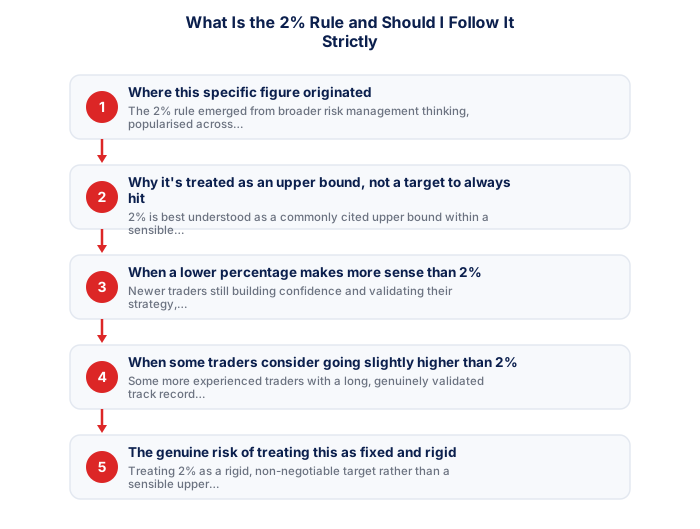
- Where this specific figure originated
- Why it's treated as an upper bound, not a target to always hit
- When a lower percentage makes more sense than 2%
- When some traders consider going slightly higher than 2%
- The genuine risk of treating this as fixed and rigid
- Choosing your own appropriate figure within this guideline
1. Where this specific figure originated
The 2% rule emerged from broader risk management thinking, popularised across trading and investing education generally, reflecting a figure that balances allowing meaningful position sizes against limiting the speed at which a string of consecutive losses, a normal part of statistical variance, could meaningfully damage an account.
It's worth understanding this as a widely-adopted convention rather than a mathematically derived optimal figure, discussed elsewhere on this site regarding risk of ruin calculations specifically, the 2% guideline emerged from practical trading wisdom and does connect meaningfully to the underlying mathematics, even though it isn't itself a precisely calculated optimum for every situation.
2. Why it's treated as an upper bound, not a target to always hit
In position sizing calculations generally, 2% is best understood as a commonly cited upper bound within a sensible range, rather than a fixed target every trader should aim to use on every single trade. Many experienced traders use considerably less than this maximum, reserving 2% only for their highest-conviction, most carefully validated setups.
It's worth internalising this framing explicitly, treating 2% as a ceiling you rarely approach, rather than a target you consistently aim for, tends to produce more genuinely conservative, sustainable risk management than defaulting to the maximum on every single trade.
- FSCA-regulated broker verified at fsca.co.za
- Demo account tested for minimum 60 days
- Trading plan written: entry, exits, position sizing
- Risk per trade defined (1-2% of account)
- Backup internet connection tested for load shedding
- Tax implications understood
3. When a lower percentage makes more sense than 2%
Newer traders still building confidence and validating their strategy, traders managing multiple simultaneous positions with correlation risk, and traders in early account-growth stages often benefit from a more conservative figure like 0.5-1%, rather than defaulting to the full 2% simply because it's commonly cited.
It's worth being honest with yourself about which of these situations genuinely applies to your own circumstances, discussed elsewhere on this site regarding realistic starting capital, a newer trader still building confidence and consistency often benefits from starting meaningfully below this upper bound.
4. When some traders consider going slightly higher than 2%
Some more experienced traders with a long, genuinely validated track record occasionally use slightly higher percentages for specific, exceptionally high-conviction setups, though this remains a less common, more advanced practice generally discouraged for traders still developing foundational discipline and genuine edge verification.
It's worth being genuinely cautious about this consideration, since it applies only to traders with extensively verified, long-term edge, discussed elsewhere on this site regarding sample size requirements, not to traders who simply feel confident based on limited recent experience.
| Item | Detail |
|---|---|
| Regulator | FSCA, fsca.co.za |
| Exchange control | SARB, resbank.co.za |
| Tax authority | SARS, sars.gov.za |
| JSE hours | 09:00-17:00 SAST Mon-Fri |
| Best forex session | 15:00-17:00 SAST |
| CGT annual exclusion | R50,000 (individuals) |
5. The genuine risk of treating this as fixed and rigid
Treating 2% as a rigid, non-negotiable target rather than a sensible upper guideline can lead to consistently risking more than your specific situation, strategy maturity, or account size genuinely warrants. The figure exists to give a sensible ceiling, not to suggest that anything below it is somehow suboptimal or insufficiently aggressive.
It's worth reviewing your own risk percentage periodically against your evolving circumstances, discussed elsewhere on this site regarding recalculating position sizing regularly, rather than fixing this figure once at the outset and never reconsidering whether it still genuinely fits your current situation.
6. Choosing your own appropriate figure within this guideline
Choosing your own specific risk percentage, informed by your strategy's genuinely validated track record, your current account size and broader financial situation, and your own personal risk tolerance, generally produces a more appropriately calibrated figure than mechanically applying 2% simply because it's the most commonly cited number.
The 2% rule limits each trade's risk to 2% of account equity. It's a reasonable starting point that allows a string of losses without account devastation. Experienced traders with a verified edge sometimes adjust it deliberately.
★ Why It Matters
Worth calculating directly: your own personal risk-of-ruin figure at 1%, 2%, and 3% per trade using your actual win rate. This lets you choose a number genuinely suited to your own strategy and risk tolerance rather than adopting 2% simply because it's the most commonly repeated figure.
✕ Common mistakes
- Treating this guideline as a fixed, universally optimal rule. The right number depends on your specific strategy's statistics and risk tolerance.
- Not adjusting risk percentage as your account size or strategy confidence changes. A static rule may not remain appropriate indefinitely.
- Assuming strict adherence alone guarantees long-term survival. This guideline is a sensible starting point, not a complete risk management system on its own.
Key Takeaways
- The 2% rule caps risk per trade at 2% of account balance, a widely cited guideline rather than a fixed, universally optimal number for every trader.
- The 2% rule caps risk per trade at 2% of account balance, a widely cited guideline within the broader 1-2% range.
- It's a sensible starting point, not a fixed, universally optimal number for every trader and account size.
- Where this specific figure originated.
- Why it's treated as an upper bound, not a target to always hit.
Frequently asked follow-up questions
Is risking less than 2% per trade ever a mistake?
No, a more conservative figure is a perfectly reasonable, often advisable choice, particularly for newer traders or those still validating their strategy's genuine edge.
Should every trade use the same risk percentage?
Many traders do use a consistent figure for simplicity and discipline, though some vary slightly based on setup conviction, provided this is done according to predetermined, disciplined criteria rather than impulsively.
Does the 2% rule account for correlation risk?
Not directly. The 2% rule addresses individual trade risk, while correlation risk requires separate, additional consideration at the overall account level.
