i Short answer
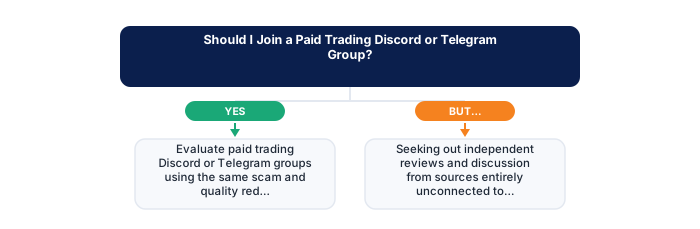
Evaluate paid trading Discord or Telegram groups using the same scam and quality red flags as for mentors and communities generally.
Requiring payment alone doesn't indicate genuine educational value or legitimacy.
📋 ON THIS PAGE
- Why payment alone proves nothing about genuine quality
- What genuinely good paid groups might offer beyond free alternatives
- The specific signal-selling concern
- Checking for a free trial or sample content before committing
- Reading genuine, independent reviews carefully
- A practical evaluation checklist before joining and paying
1. Why payment alone proves nothing about genuine quality
The simple fact that a group charges for membership says nothing inherently about whether it provides genuine educational value, Some paid groups genuinely offer worthwhile content and community, while others exist primarily to generate subscription revenue with limited genuine substance behind the paywall.
It's worth applying the same evaluation standard to a paid group that you would to any other trading educator discussed throughout this site, verifiable credentials, substantive rather than hype-driven content, balanced discussion of risk, the presence of a price tag doesn't exempt a group from this same scrutiny.
2. What genuinely good paid groups might offer beyond free alternatives
Genuinely valuable paid groups might offer more structured educational content, smaller, more curated membership supporting higher-quality discussion, direct access to experienced traders for questions, or specific tools and resources that justify the membership cost beyond what's freely available through the broader trading community.
It's worth being specific with yourself about which of these genuine benefits you're actually paying for before joining, a clear sense of the specific value you expect helps you honestly assess afterward whether the group actually delivered it.
- FSCA-regulated broker verified at fsca.co.za
- Demo account tested for minimum 60 days
- Trading plan written: entry, exits, position sizing
- Risk per trade defined (1-2% of account)
- Backup internet connection tested for load shedding
- Tax implications understood
3. The specific signal-selling concern
Paid groups centred primarily around providing trade signals or calls for members to follow carry the same fundamental skill-development concern as social media signals. Paying for signals doesn't build your own independent analytical capability, regardless of how much the membership costs.
It's worth applying the exact same test discussed elsewhere on this site regarding signal services generally, asking whether the group's content teaches you to make independent decisions or simply gives you decisions to follow reveals which category a specific paid group genuinely falls into.
4. Checking for a free trial or sample content before committing
Many legitimate paid groups offer some form of free trial period or publicly visible sample content, allowing you to assess genuine quality before committing financially. Being wary of groups insisting on immediate, full payment without any opportunity to evaluate the actual content quality beforehand reflects sound, cautious decision-making.
It's worth treating the absence of any trial or sample as a meaningful data point in itself, a group confident in its own genuine value generally has little reason to avoid letting prospective members see a representative sample before committing to payment.
| Item | Detail |
|---|---|
| Regulator | FSCA, fsca.co.za |
| Exchange control | SARB, resbank.co.za |
| Tax authority | SARS, sars.gov.za |
| JSE hours | 09:00-17:00 SAST Mon-Fri |
| Best forex session | 15:00-17:00 SAST |
| CGT annual exclusion | R50,000 (individuals) |
5. Reading genuine, independent reviews carefully
Seeking out independent reviews and discussion from sources entirely unconnected to the group's own marketing, including, where possible, the kind of broader trading community discussion, provides more reliable insight than relying solely on testimonials the group itself has selected and published.
6. A practical evaluation checklist before joining and paying
Before paying for any specific group, confirm whether it emphasises genuine education over pure signal-following, check for any free trial or sample content, research independent reviews, and stay appropriately sceptical of guaranteed-results marketing. This supports a more informed membership decision.
A trial period and independently verifiable results are good signs.
Paid trading groups make performance claims that deserve independent verification. A trial period and a track record verifiable outside the group itself are the strongest positive signs.
★ Why It Matters
Worth checking before paying: ask to see the group's message history from a recent losing week, not just their highlight-reel wins. Groups confident in their genuine value are usually willing to show this, ones relying purely on recent wins to sell memberships tend to deflect.
✕ Common mistakes
- Joining based on recent results shared in marketing material. Request to see a recent losing week's discussion, not just curated wins.
- Assuming payment implies legitimacy or quality. Cost has little bearing on the genuine value of a group's content.
- Not checking whether the group teaches process or simply provides signals. Signal-dependent groups build less lasting, transferable skill.
- Adopting group consensus without independent personal analysis. Group dynamics can override otherwise sound individual judgement.
How do I know if my broker is trustworthy?
Check that the broker holds a current FSCA FSP licence at fsca.co.za, keeps client funds segregated, is transparent about spreads and fees, and has accessible support. Independent reviews on platforms the broker does not control provide additional verification.
Key Takeaways
- Evaluate paid groups using the same scam and quality red flags discussed elsewhere, since payment alone doesn't indicate genuine educational value.
- Evaluate paid trading Discord or Telegram groups using the same scam and quality red flags as for mentors and communities generally.
- Requiring payment alone doesn't indicate genuine educational value or legitimacy.
- Why payment alone proves nothing about genuine quality.
- What genuinely good paid groups might offer beyond free alternatives.
See also: What Are Common Trading Education Scams to Avoid?.
Frequently asked follow-up questions
Is a more expensive group automatically higher quality?
No, price alone isn't a reliable quality indicator, similar to the broader course and mentor pricing discussion elsewhere; independent evaluation matters more than cost.
Should I be suspicious of lifetime membership offers?
These can sometimes pressure quick decisions. Evaluating genuine content quality first, regardless of the specific pricing structure offered, remains important.
Can I get a refund if a paid group turns out to be low quality?
This depends entirely on the specific group's stated refund policy; checking this before paying, and understanding your consumer protections, is worthwhile.
