i Short answer
Outcome bias leads traders to judge a decision's quality purely by its eventual result, rather than by whether the underlying process and reasoning were genuinely sound at the time.
📋 ON THIS PAGE
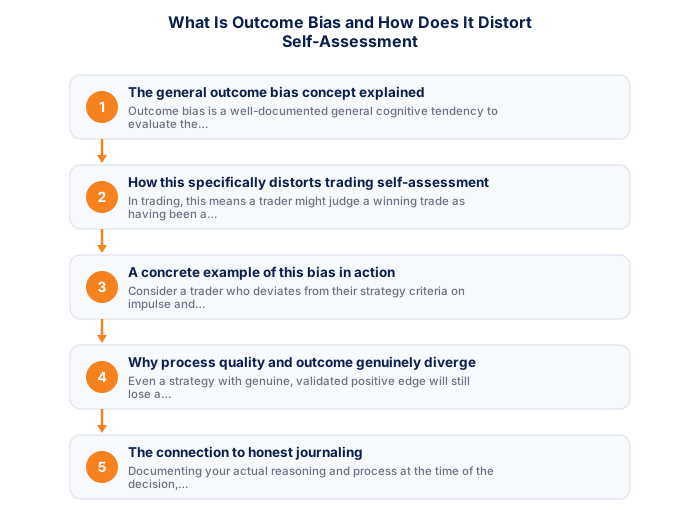
1. The general outcome bias concept explained
Outcome bias is a well-documented general cognitive tendency to evaluate the quality of a past decision based on how it ultimately turned out, rather than based on the genuine information, reasoning, and process available at the actual moment the decision was made.
It's worth recognising this as a genuinely well-documented pattern across many decision-making contexts, not unique to trading, poker players, investors, and decision-makers generally show this same tendency to judge past decisions primarily by how they turned out rather than by the quality of reasoning behind them.
2. How this specifically distorts trading self-assessment
In trading, this means a trader might judge a winning trade as having been a "good decision" purely because it won, even if the underlying reasoning was genuinely poor or violated their own predetermined criteria, while judging a losing trade as a "bad decision" even when the underlying process was actually genuinely sound.
See also: What Is the Gambler's Fallacy in Trading?
It's worth checking your own trading journal specifically for this pattern, noticing whether your self-assessment language shifts based on outcome, praising your own reasoning after wins and criticising identical reasoning after losses, reveals this bias operating in your own genuine self-evaluation.
- Emotional state is neutral
- Yesterday's results not influencing today
- Trading plan is open and reviewed
- Loss limit for today defined and accepted
- Phone notifications silenced
- Backup connectivity confirmed
- Written rules eliminate in-the-moment decisions
- Journalling creates a feedback loop for improvement
- Pre-session checks reduce emotionally-driven entries
- Regular breaks prevent compounding mistakes
- Building discipline requires active daily effort
- Losses immediately test emotional stability
- No external accountability in retail trading
- Social pressure to perform can override rules
3. A concrete example of this bias in action
Consider a trader who deviates from their strategy criteria on impulse and happens to win. Outcome bias would lead them to view this deviation favourably purely due to the result, potentially reinforcing exactly the undisciplined overtrading behaviour that the deviation actually represents, regardless of this particular favourable outcome.
It's worth working through a few examples from your own actual trading history using this same framework, separating the genuine quality of your decision from its eventual outcome for several past trades builds the habit of evaluating these two things independently.
4. Why process quality and outcome genuinely diverge
Even a strategy with genuine, validated positive edge will still lose a meaningful proportion of individual trades, while even a fundamentally unsound approach can occasionally win by chance, meaning outcome alone, especially from a single trade, provides limited genuine information about decision quality.
It's worth internalising this mathematically, not just conceptually, discussed elsewhere on this site regarding win rate and expectancy, a strategy with genuine statistical edge still produces losing trades regularly, meaning a losing outcome on any individual trade tells you very little about whether that specific decision was actually sound.
5. The connection to honest journaling
Documenting your actual reasoning and process at the time of the decision, before knowing the eventual outcome, provides a more genuine basis for later assessment than relying on memory after already knowing how the trade actually turned out.
It's worth structuring your journal entries specifically to record your reasoning and process before you know the outcome, rather than reconstructing your reasoning afterward, since retrospective reconstruction is particularly vulnerable to being unconsciously shaped by whatever the outcome eventually was.
6. Building process-focused self-assessment instead
Specifically asking whether your predetermined checklist criteria, were genuinely met at the time of decision, independent of the eventual result, supports more accurate, outcome-bias-resistant self-assessment over time.
The pattern underneath is loss aversion: a loss registers more strongly than an equivalent gain, which distorts what feels reasonable.
Outcome bias causes traders to judge the quality of a decision by its result rather than by whether the process was sound. The same correctly executed trade can appear as either a success or a mistake depending on which way price moved.
★ Why It Matters
Worth testing on your own journal directly: review a sample of past trades while deliberately covering up the final profit or loss column first, judging only the entry reasoning and process visible at the time, traders often rate their own past decisions quite differently once the outcome is hidden from view.
✕ Common mistakes
- Judging a decision's quality purely by how the trade turned out. A sound decision can still lose money without anything having gone wrong.
- Not reviewing past trades with the outcome deliberately hidden first. This specific technique reveals how outcome knowledge skews self-assessment.
- Praising a poorly reasoned trade simply because it happened to win. This reinforces a flawed process under the cover of a good result.
- Criticising a well-reasoned trade simply because it happened to lose. This punishes sound process based purely on normal statistical variance.
Key Takeaways
- Outcome bias leads traders to judge a decision's quality purely by its result, rather than by whether the underlying process and reasoning were genuinely sound.
- Outcome bias leads traders to judge a decision's quality purely by its eventual result, rather than by whether the underlying process and reasoning were genuinely sound at the time.
- The general outcome bias concept explained.
- How this specifically distorts trading self-assessment.
- A concrete example of this bias in action.
Frequently asked follow-up questions
Does this mean I should ignore trading outcomes entirely?
No, outcomes matter for overall strategy evaluation across a large sample. The concern is specifically using any single outcome to judge that individual decision's process quality.
How can I separate process assessment from outcome when reviewing my journal?
Reviewing your documented reasoning written before the outcome was known, before looking at the actual result, helps maintain this important separation during review.
Is outcome bias related to the gambler's fallacy?
They're related but distinct; the gambler's fallacy concerns assuming independent events are connected, while outcome bias specifically concerns judging decision quality by result rather than process.
Can outcome bias affect how I view other traders' decisions too?
Yes, this same bias can distort how you assess others' trading decisions, not just your own.
Does experience reduce susceptibility to outcome bias?
Not automatically. This is a general human cognitive tendency, making deliberate, structured self-assessment practices valuable regardless of experience level.
