i Short answer
Recency bias leads traders to overweight recent events and outcomes relative to longer-term patterns and historical data.
This distorts both strategy evaluation and ongoing risk perception.
📋 ON THIS PAGE
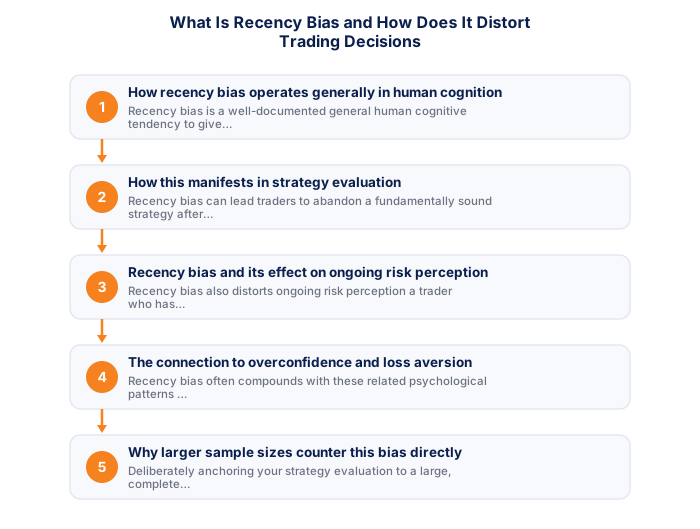
- How recency bias operates generally in human cognition
- How this manifests specifically in strategy evaluation
- Recency bias and its effect on ongoing risk perception
- The connection to overconfidence and loss aversion discussed elsewhere
- Why larger sample sizes counter this bias directly
- Practical techniques to counter recency bias
1. How recency bias operates generally in human cognition
Recency bias is a well-documented general human cognitive tendency to give disproportionate weight to recent information and experiences compared to older information, even when the older information is, statistically speaking, equally or more relevant to a given decision. This isn't unique to trading, it affects judgement across many domains, but it carries particular significance for trading decisions specifically.
It's worth recognising why this bias makes evolutionary sense as a general cognitive shortcut, recent events genuinely often carry more relevant information about current conditions in many everyday contexts, the bias becomes problematic specifically in trading precisely because recent results are frequently just normal statistical variance rather than genuinely informative signal.
2. How this manifests specifically in strategy evaluation
Recency bias can lead traders to abandon a fundamentally sound strategy after a recent string of losses that actually reflects normal statistical variance, rather than genuine strategy failure, simply because these recent losses feel more psychologically salient than the strategy's longer-term, more favourable historical performance.
It's worth checking your own strategy confidence explicitly against your actual, longer-term statistics rather than your recent felt impression, discussed elsewhere on this site regarding sample size requirements, a strategy's true, underlying quality doesn't genuinely shift based on its last several trades alone.
- Emotional state is neutral
- Yesterday's results not influencing today
- Trading plan is open and reviewed
- Loss limit for today defined and accepted
- Phone notifications silenced
- Backup connectivity confirmed
- Written rules eliminate in-the-moment decisions
- Journalling creates a feedback loop for improvement
- Pre-session checks reduce emotionally-driven entries
- Regular breaks prevent compounding mistakes
- Building discipline requires active daily effort
- Losses immediately test emotional stability
- No external accountability in retail trading
- Social pressure to perform can override rules
3. Recency bias and its effect on ongoing risk perception
Recency bias also distorts ongoing risk perception, a trader who has recently experienced a significant loss may become excessively risk-averse even when current market conditions don't genuinely warrant this caution, while a trader who has recently experienced a string of wins may become insufficiently cautious, connecting directly to the overconfidence bias, even though recent results alone don't reliably predict future risk levels.
It's worth being especially cautious of both directions this bias can pull you, a recent calm period can create a false sense that markets have become generally less risky, while a recent volatile period can create excessive caution beyond what's genuinely warranted going forward.
4. The connection to overconfidence and loss aversion
As, recency bias often compounds with these related psychological patterns, recent wins can trigger both recency bias and overconfidence simultaneously, while recent losses can trigger both recency bias and the loss-averse, overly cautious reaction, together producing an even stronger distortion than either bias would produce alone.
It's worth mapping these connections explicitly for your own psychological awareness, recognising how recency bias specifically feeds into and amplifies these other well-documented patterns helps you address the underlying tendency more comprehensively than treating each bias as entirely separate.
5. Why larger sample sizes counter this bias directly
Deliberately anchoring your strategy evaluation to a large, complete historical sample rather than recent results alone directly counters recency bias's natural pull toward overweighting whatever has happened most recently, since a large sample mathematically dilutes the influence any single recent period can have on your overall assessment.
It's worth actively reviewing your full trading history periodically, not just your most recent results, discussed elsewhere on this site regarding trading journal review generally, deliberately looking at your complete, longer record helps counterbalance the natural pull toward weighting recent events too heavily.
6. Practical techniques to counter recency bias specifically
Practical techniques include regularly reviewing your complete trading journal, rather than just recent entries, when evaluating your strategy's genuine performance; explicitly calculating rolling statistics across different time windows to see how recent results compare to your longer-term average; and consciously asking yourself whether a specific decision is being driven by genuinely new, relevant information or simply by the psychological salience of recent events.
Recency bias causes recent events to feel more representative than the longer record. A losing streak feels like strategy failure and a winning streak feels like mastery, both distortions corrected by reviewing the full sample.
★ Why It Matters
Something worth checking : compare your stated confidence level in your strategy this week against your full multi-month track record, a confidence level that swings significantly based on just the last few trades, rather than tracking your genuine long-term statistics, is recency bias visibly at work.
✕ Common mistakes
- Not comparing your stated confidence level against your actual long-term statistics. A significant gap between the two reveals recency bias clearly.
- Overweighting the most recent market conditions when assessing a strategy's validity. Recent conditions are one data point, not the full picture.
- Abandoning a strategy after a short recent stretch of underperformance. This often reflects recency bias rather than genuine strategy failure.
Key Takeaways
- Recency bias leads traders to overweight recent events relative to longer-term patterns, distorting strategy evaluation and risk perception over time.
- Recency bias leads traders to overweight recent events and outcomes relative to longer-term patterns and historical data.
- This distorts both strategy evaluation and ongoing risk perception.
- How recency bias operates generally in human cognition.
- How this manifests specifically in strategy evaluation.
See also: How Do I Deal With Losing Streaks Without Losing Confidence?.
Frequently asked follow-up questions
Is recency bias the same as overconfidence bias?
They're related but distinct; recency bias specifically concerns overweighting recent information generally, while overconfidence bias, concerns overestimating your own skill and underestimating risk.
Can experienced traders still be affected by recency bias?
Yes, this is a general human cognitive tendency rather than something eliminated through experience alone; ongoing, deliberate countermeasures remain valuable regardless of experience level.
How large a sample is needed to meaningfully counter this bias?
The same general guidance discussed elsewhere regarding genuine edge verification, often citing 50-100 or more trades, applies here for building a sufficiently sound, less recency-biased evaluation.
