i Short answer
Recognising impatience as a genuine threat to disciplined criteria adherence, and finding productive alternatives to active screen-watching, helps manage this without resorting to forced trades.
📋 ON THIS PAGE
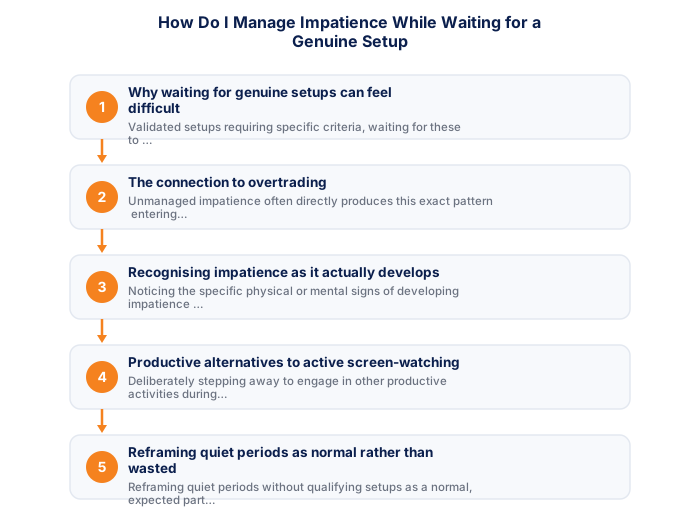
1. Why waiting for genuine setups can feel genuinely difficult
Validated setups requiring specific criteria, waiting for these to develop can feel difficult, particularly when actively monitoring markets, since the natural inclination toward action can create discomfort during periods without a qualifying opportunity present.
It's worth accepting this difficulty as a genuine, expected part of disciplined trading rather than a personal shortcoming, the discomfort of waiting is a real, universal experience for traders following genuine criteria, not a sign that something about your approach or temperament is uniquely flawed.
South African traders who backtest their strategies should use historical data that includes periods of rand volatility and SA-specific events such as budget speeches, credit rating decisions, and periods of high load shedding. A strategy that performs well on global historical data but was not tested against SA-specific market conditions may behave differently when applied to ZAR instruments. Including at least one cycle of SARB rate changes and one period of political uncertainty in your historical test set provides a more realistic assessment of performance.
2. The connection to overtrading
As, unmanaged impatience often directly produces this exact pattern, entering trades that don't genuinely meet your predetermined criteria simply because waiting felt uncomfortable, rather than because the specific opportunity warranted action.
It's worth catching this specific moment, when a marginal setup starts feeling 'close enough,' as your clearest opportunity to intervene, that subtle rationalisation is usually the last step before an actual criteria-violating entry, worth treating as your final, best chance to pause before the trade actually happens.
- Quantifiable rules remove subjectivity
- Backtestable on historical data
- Works consistently when edge is genuine
- Clear entry/exit criteria reduce hesitation
- Past performance does not guarantee future results
- Risk of overfitting to historical data
- Market regimes change, edges decay
- Requires discipline through drawdown periods
- Price and volume patterns
- Works on any liquid instrument
- Faster to learn basics
- Ignores fundamental context
- Economic and financial data
- Better for longer timeframes
- Deeper knowledge required
- Ignores entry precision
3. Recognising impatience as it actually develops
Noticing the specific physical or mental signs of developing impatience, restlessness, repeatedly refreshing charts, beginning to rationalise marginal setups as acceptable, provides an early warning before this feeling translates into an actual undisciplined decision.
It's worth keeping a simple, private note of your own specific signs, since these vary between individuals, some traders notice a particular restlessness in their body, others notice a specific pattern of thoughts, knowing your own personal signature makes this pattern considerably easier to catch early and consistently.
- Written entry/exit rules with zero ambiguity
- Backtested on minimum 3 years of data
- Walk-forward tested on out-of-sample data
- SA-specific events included in test period
- Maximum drawdown within personal tolerance
- 100+ live demo trades with consistent performance
4. Productive alternatives to active screen-watching
Deliberately stepping away to engage in other productive activities during quiet periods, rather than continuing to watch charts without a genuine qualifying setup present, reduces the cumulative exposure to this specific impatience-building dynamic.
It's worth having a few specific, ready alternatives decided in advance, rather than trying to think of something productive to do in the actual moment impatience strikes, a predetermined list, reviewing your journal, working on other analysis, a genuinely unrelated activity, gives you somewhere concrete to redirect your attention immediately.
| Win rate | 1:1 RR | 1.5:1 RR | 2:1 RR |
|---|---|---|---|
| 40% | Losing | Break even | Profitable |
| 50% | Break even | Profitable | Profitable |
| 55% | Profitable | Profitable | Profitable |
| 60% | Profitable | Profitable | Profitable |
5. Reframing quiet periods as genuinely normal rather than wasted
Reframing quiet periods without qualifying setups as a normal, expected part of disciplined trading, rather than wasted time requiring some kind of compensating action, supports a healthier overall relationship with patience.
It's worth actively tracking how much of your overall trading time genuinely consists of these quiet, waiting periods, seeing the concrete proportion can help normalise this reality, since many traders underestimate just how much of disciplined trading genuinely involves patient waiting rather than active execution.
6. Building patience as a deliberate, practised skill over time
Ongoing skill development trading involves, treating patience itself as a skill you're deliberately practising and improving over time, rather than a fixed personal trait you either have or lack, supports continued development in this specific area.
Behavioural research calls this loss aversion, and it explains why holding a losing position feels easier than closing it.
Noticing the specific physical signs of developing impatience, like repeatedly refreshing charts, and reframing quiet periods as normal helps treat patience as a skill worth developing.
★ Why It Matters
Worth trying directly: schedule a specific, separate activity for your trading session's quiet periods in advance, rather than just 'waiting and watching', traders who actively fill the gap tend to force fewer impatient trades than those who sit staring at a flat chart.
✕ Common mistakes
- Lowering entry standards just to have something to do. This defeats the purpose of having criteria in the first place.
- Sitting and staring at a flat chart with no other activity planned. An unfilled gap tends to produce forced, impatient trades.
- Treating impatience as something to simply push through. Recognising it as a real risk factor, not just a feeling, helps manage it more effectively.
- Not having a backup activity prepared for quiet periods. A planned alternative reduces the temptation to force a trade.
Key Takeaways
- Recognising impatience as a genuine threat to disciplined criteria adherence, and finding productive alternatives to active screen-watching, helps manage this.
- Recognising impatience as a genuine threat to disciplined criteria adherence, and finding productive alternatives to active screen-watching, helps manage this without resorting to forced trades.
- Why waiting for genuine setups can feel genuinely difficult.
- The connection to overtrading (see overtrading).
- Recognising impatience as it actually develops.
Frequently asked follow-up questions
Is feeling some impatience while waiting for setups completely normal?
Yes, this is a common, understandable experience. The concern is specifically when unmanaged impatience translates into actual undisciplined trading decisions.
Does day trading make this challenge worse than longer-term trading styles?
Often yes, given the more active monitoring day trading, typically involves, though longer-timeframe traders can experience their own version of this challenge over longer waiting periods.
Can setting price alerts help manage this specific challenge?
Yes, these can reduce the need for continuous active monitoring, allowing you to step away while still being notified of genuinely relevant developments.
Should I trade smaller positions just to feel like I'm doing something during quiet periods?
This isn't generally advisable, since this reflects exactly the impatience-driven, undisciplined pattern this piece addresses rather than genuine strategy-based action.
Does experience eventually make waiting for setups feel easier?
Many traders do report this becoming somewhat easier with experience and demonstrated trust in their own process, though this generally requires deliberate, ongoing practice.
