i Short answer
The disposition effect describes the well-documented tendency to sell winning positions too early while holding losing positions too long.
This undermines the favourable risk-reward profile sound trading generally requires.
📋 ON THIS PAGE
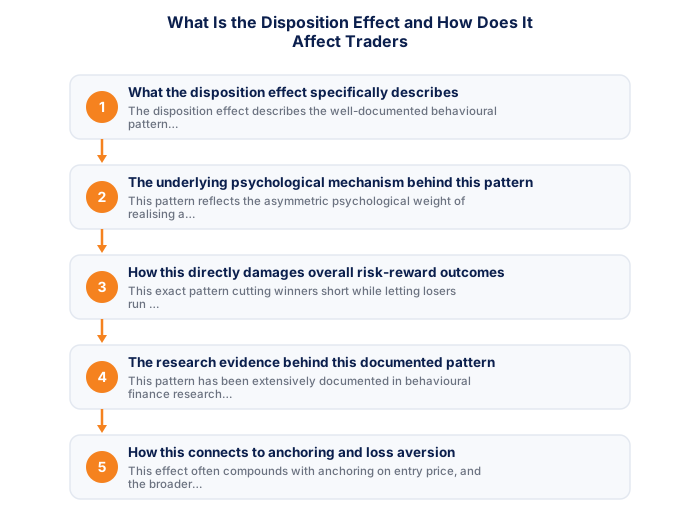
- What the disposition effect specifically describes
- The underlying psychological mechanism behind this pattern
- How this directly damages overall risk-reward outcomes
- The research evidence behind this documented pattern
- How this connects to anchoring and loss aversion
- Practical structural safeguards against this effect
1. What the disposition effect specifically describes
The disposition effect describes the well-documented behavioural tendency where traders and investors disproportionately close winning positions too early while holding losing positions far longer than their strategy warrants. The name comes from the idea that investors have a psychological disposition toward certain kinds of outcomes, specifically, a preference for realising gains and an aversion to realising losses.
It was formally identified and named by Shefrin and Statman in 1985, drawing on Kahneman and Tversky's earlier prospect theory work. What made it significant as a research finding wasn't just that it described a pattern some traders noticed intuitively, it's that the pattern was documented systematically across large datasets of real investor behaviour, suggesting it reflects something genuinely embedded in how humans experience financial outcomes.
See also: My Broker Merges Brands: What Happens to My Account?
For trading, the effect's practical consequence is straightforward but damaging: it systematically inverts the risk-reward profile. A trader exhibiting strong disposition effect tendencies will accumulate many small wins and a smaller number of large losses, the opposite of the 'cut losses short, let winners run' principle that most trading frameworks advocate.
2. The underlying psychological mechanism behind this pattern
The mechanism underlying this pattern reflects the asymmetric way gains and losses feel psychologically. Prospect theory demonstrated that losses feel roughly twice as painful as equivalent gains feel pleasurable, meaning a R1,000 loss produces approximately twice the emotional impact of a R1,000 gain. This asymmetry creates a powerful pull toward avoiding the realization of a loss, even when holding the position makes no strategic sense.
When a position is profitable, there's psychological pressure to lock in that good feeling before the market takes it back. The unrealised gain feels fragile, vulnerable to reversal, and converting it to cash converts the uncertainty into a confirmed positive. This is the mechanism that drives premature exit from winners.
- FSCA-regulated broker verified at fsca.co.za
- Demo account tested for minimum 60 days
- Trading plan written: entry, exits, position sizing
- Risk per trade defined (1-2% of account)
- Backup internet connection tested for load shedding
- Tax implications understood
For losing positions, the psychology reverses. As long as a position isn't closed, the loss is unrealised, it exists on screen but hasn't been 'confirmed.' Holding on preserves the possibility that the position might recover, which feels better than accepting a certain loss. This is what makes traders hold losers past stop-loss levels, average down without strategic justification, and rationalise extended holding of clearly failing positions.
3. How this directly damages overall risk-reward outcomes
The disposition effect directly produces the worst possible outcome from a risk-reward perspective: small gains and large losses. If your winning trades average R400 profit because you exit early, but your losing trades average R900 loss because you hold hoping for recovery, your risk-reward ratio is 0.44, a level where you'd need to be right more than 70% of the time just to break even.
This is precisely why many traders with high win rates still lose money overall. A 65% win rate sounds impressive, but if the average winner is half the size of the average loser, the mathematics of the strategy are negative regardless of how often you're right about direction. The disposition effect is one of the most direct mechanisms by which a statistically positive setup becomes a losing strategy in practice.
The insidious aspect is that each individual decision feels justifiable in the moment. Exiting a winner feels like responsible profit protection. Holding a loser feels like patient commitment to a thesis. Both feel more defensible than mechanically following rules that seem to ignore the specific situation. But the cumulative effect of these individually justifiable decisions is systematically negative.
4. The research evidence behind this documented pattern
Behavioural finance research has documented the disposition effect across different market participants, asset classes, and cultures, suggesting it reflects something fundamental about human psychological responses to financial uncertainty rather than a mistake made only by inexperienced traders. Professional fund managers, institutional traders, and retail investors all show some version of this pattern, though the effect tends to be stronger in less experienced participants.
Studies examining brokerage account data at scale, hundreds of thousands of actual trades, consistently find that investors are substantially more likely to sell a position that has gained than one that has lost, when controlling for other factors. This statistical pattern is stable across market conditions and holds even when the specific dynamics of each situation would suggest the opposite action.
| Item | Detail |
|---|---|
| Regulator | FSCA, fsca.co.za |
| Exchange control | SARB, resbank.co.za |
| Tax authority | SARS, sars.gov.za |
| JSE hours | 09:00-17:00 SAST Mon-Fri |
| Best forex session | 15:00-17:00 SAST |
| CGT annual exclusion | R50,000 (individuals) |
The strength of the effect varies between individuals and can be reduced through specific interventions, most notably, predetermined exit rules that take decision-making out of the in-the-moment psychological state. This is part of why mechanical trading rules exist: they were developed partly as explicit countermeasures to biases like the disposition effect.
5. How this connects to anchoring and loss aversion
The disposition effect compounds with anchoring, the tendency to give disproportionate weight to a reference price such as your entry level. When a position is in loss, the entry price becomes an anchor that makes exiting feel like 'locking in a loss relative to where I started.' This framing is psychologically compelling but financially irrelevant, the position's current value is the same whether the entry was higher or lower.
Loss aversion, the broader principle underlying prospect theory, provides the emotional fuel for the effect. Because losses hurt more than equivalent gains feel good, the psychological cost of accepting a realised loss is higher than it would be under a purely rational accounting of the situation. Avoiding that psychological cost by not closing the losing position feels like a way of making the pain go away, even though it typically amplifies the eventual financial consequence.
Together, anchoring and loss aversion create a self-reinforcing trap. The further a losing position moves against you, the more painful closing it becomes, and the more appealing it is to hold hoping for a recovery to the anchor price, even as the position becomes an increasingly large drag on your overall account.
6. Practical structural safeguards against this effect
Predetermined, automated stop-loss and take-profit orders set at the time of entry are the most direct structural countermeasure against the disposition effect. When your exits are defined by a rule applied before the emotional context of a live position exists, you remove the in-the-moment decision that the bias acts on. The exit happens automatically, regardless of how exiting feels at that particular moment.
Reviewing your own journal for the ratio of average winning trade size to average losing trade size is the clearest diagnostic tool. A ratio where the average loss is significantly larger than the average winner despite a high win rate is a direct signal of disposition effect operating in your trading. Seeing this pattern in your own data provides more compelling evidence for addressing it than any general description of the bias.
Setting a rule that explicitly addresses the exit decision, for example, that no position may be closed on a profit target lower than 1.5 times its stop-loss distance, mechanically constrains the premature winner-exit tendency. Rules like this feel arbitrary when applied to individual trades but produce better statistical outcomes than discretionary judgment when applied consistently across a significant sample.
✕ Common mistakes
- Selling winning positions too early while holding losing positions too long. This well-documented tendency directly undermines favourable risk-reward profiles.
- Not calculating your own average holding time for winners versus losers. This specific comparison in your journal often reveals the effect directly.
- Treating this pattern as a personality quirk rather than a measurable, addressable bias. Recognising it as a specific, common pattern helps in actively countering it.
- Ignoring how the disposition effect compounds with loss aversion generally. These related biases often reinforce each other in practice.
Key Takeaways
- The disposition effect describes the tendency to sell winning positions too early while holding losing positions too long, undermining favourable risk-reward.
- The disposition effect describes the well-documented tendency to sell winning positions too early while holding losing positions too long.
- This undermines the favourable risk-reward profile sound trading generally requires.
- What the disposition effect specifically describes.
- The underlying psychological mechanism behind this pattern.
Frequently asked follow-up questions
Is the disposition effect the same as loss aversion?
They're closely related. Loss aversion is the broader underlying psychological tendency, while the disposition effect specifically describes its observable manifestation in actual trading and investment behaviour.
Can experienced, professional traders also show this pattern?
Yes, research has documented this pattern across various trader and investor types, including professionals, making this a genuinely common tendency rather than something limited to beginners.
Does using predetermined exit orders fully eliminate this effect?
This significantly reduces the discretionary decision-making this effect operates through, though awareness of the underlying tendency remains valuable regardless.
Can reviewing my own trading journal reveal this pattern in my own behaviour?
Yes, comparing your actual average win size against your average loss size can reveal whether this pattern affects your own trading.
Does this effect apply equally to all asset classes?
This has been documented across various markets and instrument types, suggesting it reflects a broadly applicable psychological tendency rather than being specific to any single asset class.
