i Short answer
Opportunity cost is the value of the next-best alternative forgone when choosing one option over another.
Applied to trading capital, this means considering what else that money could achieve, like paying down debt or building an emergency fund.
📋 ON THIS PAGE
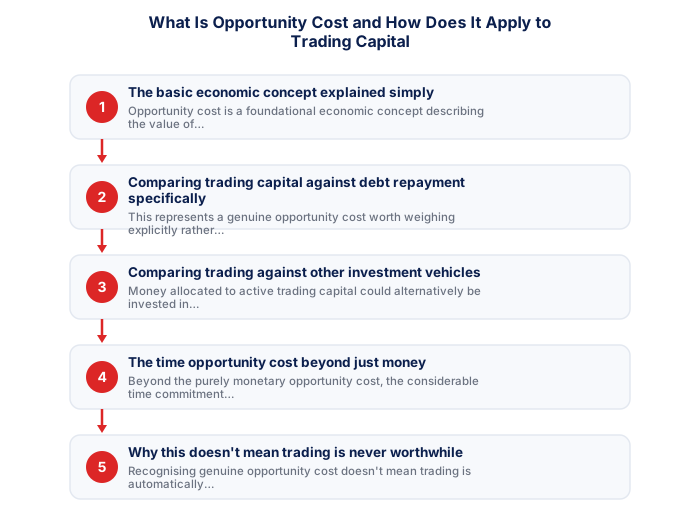
- The basic economic concept explained simply
- Comparing trading capital against debt repayment specifically
- Comparing trading against other investment vehicles
- The time opportunity cost beyond just money
- Why this doesn't mean trading is never worthwhile
- A practical framework for making this comparison yourself
1. The basic economic concept explained simply
Opportunity cost is a foundational economic concept describing the value of whatever you give up by choosing one option over the alternatives available to you. Every decision involving scarce resources like money or time carries this hidden cost, even when no explicit, visible figure is attached to the choice itself.
It's worth applying this concept explicitly to your own trading capital decisions, every Rand allocated to trading is simultaneously a Rand not available for any alternative use, worth genuinely weighing this trade-off rather than treating trading capital as existing in isolation from your broader financial picture.
See also: How Do I Complete the SARS ITR12 for Trading Income?
See also: Should I Use the Kelly Criterion for Position Sizing?
2. Comparing trading capital against debt repayment specifically
Money allocated to discretionary trading capital could instead pay down existing debt, particularly high-interest debt where the guaranteed interest savings often exceed the realistic expected returns from trading. This represents a genuine opportunity cost worth weighing explicitly rather than overlooking.
It's worth calculating this comparison concretely using your own actual debt interest rates, comparing your specific, guaranteed debt interest cost against your trading strategy's realistic, verified expected return, discussed elsewhere on this site regarding setting realistic profit targets, gives a genuinely informed basis for this decision.
- FSCA-regulated broker verified at fsca.co.za
- Demo account tested for minimum 60 days
- Trading plan written: entry, exits, position sizing
- Risk per trade defined (1-2% of account)
- Backup internet connection tested for load shedding
- Tax implications understood
- Predictable cost per trade
- Widens less during news
- Better for news traders
- Slightly wider average
- Very low in calm markets
- Widens during high-impact news
- Lower average cost
- Better for swing traders
3. Comparing trading against other investment vehicles
Money allocated to active trading capital could alternatively be invested in other vehicles, for example, a diversified investment portfolio or retirement savings vehicle, that, while not offering the particular appeal trading holds for some people, might offer more favourable risk-adjusted returns for someone without a genuine, demonstrated trading edge or genuine interest in actively trading.
It's worth researching typical long-term returns for diversified investment vehicles genuinely available to you, comparing these established, historically-documented figures against your own trading strategy's honest expected return gives useful perspective on this specific trade-off.
4. The time opportunity cost beyond just money
Beyond the purely monetary opportunity cost, the considerable time commitment trading requires also carries its own opportunity cost, time that could alternatively be spent on other income-generating activities, skill development, or simply personal and family time.
It's worth calculating your genuine time investment in trading explicitly, discussed elsewhere on this site regarding realistic weekly time budgets, and considering honestly what else that time could otherwise support, whether career development, other income streams, or simply personal wellbeing.
| Item | Detail |
|---|---|
| Regulator | FSCA, fsca.co.za |
| Exchange control | SARB, resbank.co.za |
| Tax authority | SARS, sars.gov.za |
| JSE hours | 09:00-17:00 SAST Mon-Fri |
| Best forex session | 15:00-17:00 SAST |
| CGT annual exclusion | R50,000 (individuals) |
5. Why this doesn't mean trading is never worthwhile
Recognising genuine opportunity cost doesn't mean trading is automatically the wrong choice. For traders with genuinely demonstrated edge, or genuine personal interest and enjoyment in the activity itself beyond pure financial return, trading may represent a perfectly reasonable use of discretionary capital and time, even accounting for what's being given up by not choosing the alternatives above.
The point isn't that opportunity cost makes trading inherently unwise, but that acknowledging it explicitly, rather than ignoring it, supports a more honest, complete picture when deciding how to allocate your own specific resources.
6. A practical framework for making this comparison yourself
A practical framework involves explicitly listing your realistic alternatives, debt repayment with its specific interest rate, other investment vehicles with their typical expected returns, or simply increased savings, alongside your own honest, realistic assessment of trading's expected value, then making a deliberate, informed allocation decision rather than defaulting to trading without this explicit comparison.
It's worth revisiting this comparison periodically rather than making the decision once and never reconsidering it, your own circumstances, debt levels, and trading results all genuinely evolve over time, worth checking whether your original allocation decision still makes sense given your current situation.
The mathematics of recovery from drawdown is fundamental knowledge for any trader managing risk. A 10% drawdown requires an 11% gain to recover. A 25% drawdown requires a 33% gain. A 50% drawdown requires a 100% gain. A 75% drawdown requires a 300% gain to return to the starting equity level. This asymmetric relationship between losses and recovery is why controlling drawdown is mathematically more valuable than maximising returns. A trader who generates consistent 20% annual returns without a drawdown exceeding 15% will outperform a trader generating 40% returns but periodically experiencing 50% drawdowns, not just on a risk-adjusted basis but in absolute capital terms over a multi-year compounding period. Building a trading system around drawdown control as the primary objective, with returns as the secondary outcome, reflects the true mathematics of capital growth correctly.
Comparing your returns to a simple index ETF is a relevant honest check.
Trading capital deployed actively carries an opportunity cost. Honestly comparing your actual returns to a simple JSE or global index ETF is a worthwhile check that many active traders skip.
★ Why It Matters
Worth calculating: what your trading capital would be worth today if instead it had simply gone into a basic interest-bearing account over the same period. Comparing your actual trading return against this genuine, simple benchmark is a clarifying exercise many traders avoid doing.
✕ Common mistakes
- Ignoring opportunity cost when deciding how much capital to allocate to trading. This consideration should factor into the broader capital allocation decision.
- Assuming trading capital has no cost simply because it isn't actively losing money. Capital sitting idle or underperforming still carries a real opportunity cost.
- Treating opportunity cost as irrelevant once capital is already allocated to trading. It remains a relevant ongoing consideration, not just a one-time decision factor.
Key Takeaways
- Opportunity cost is the value of the next-best alternative forgone, relevant when comparing trading capital against other uses like debt repayment or saving.
- Opportunity cost is the value of the next-best alternative forgone when choosing one option over another.
- Applied to trading capital, this means considering what else that money could achieve, like paying down debt or building an emergency fund.
- The basic economic concept explained simply.
- Comparing trading capital against debt repayment specifically.
See also: Can I Retire Early in South Africa?.
Frequently asked follow-up questions
Does opportunity cost mean I shouldn't trade at all?
Not necessarily, it simply means weighing trading's value, including any genuine personal interest or skill-development benefit, against realistic alternatives explicitly, rather than assuming trading is automatically the best use of available capital.
How do I calculate opportunity cost precisely?
Precise calculation can be complex given uncertain future returns across alternatives; a reasonable comparison against typical, well-understood alternatives like debt interest rates is often more practical than attempting precise calculation.
Is this concept relevant to time as well as money?
Yes, the time trading requires carries its own opportunity cost worth considering alongside the purely monetary dimension.
