i Short answer
Trading income is declared on your ITR12 as either revenue (taxed as normal income) or capital gains, depending on how SARS classifies your trading activity based on factors like frequency and intent.
The relevant sections are typically "Local Business, Trade and Professional Income" for revenue treatment, or the Capital Gains Tax schedule for capital treatment, with supporting schedules for foreign income if you trade offshore instruments.
📋 ON THIS PAGE
- Understanding which section of the ITR12 applies to you
- The revenue versus capital gains distinction in practice
- What documentation you need before you start
- Declaring income from offshore or foreign-denominated trading
- Common mistakes that trigger SARS queries
- When to get professional help with this specific section
1. Understanding which section of the ITR12 applies to you
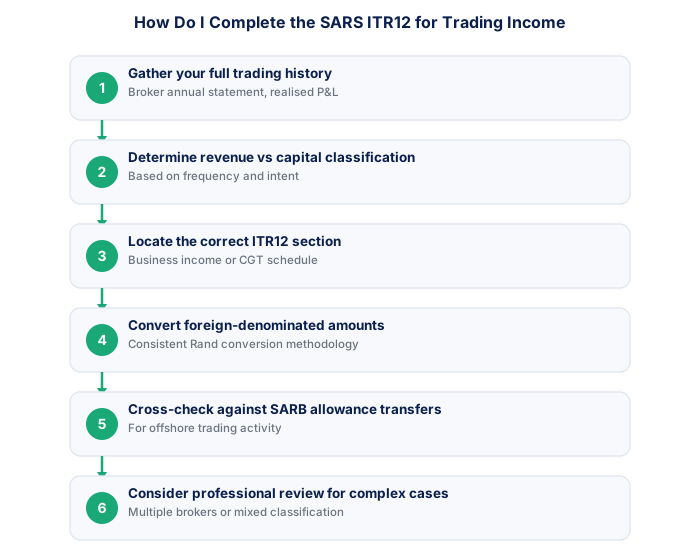
The ITR12 does not have a dedicated "trading income" line item, which is part of why this process confuses so many traders filing for the first time. Instead, where your trading profit goes on the return depends on how SARS classifies the activity itself, specifically whether it is treated as revenue (ordinary income) or as a capital gain.
If your trading is classified as revenue, generally the case for frequent, active trading conducted with a profit-seeking intention, the profit is declared under local business or trade income, and taxed at your marginal income tax rate alongside your salary or other earnings. If it is classified as a capital gain, generally more applicable to longer-term, less frequent positions, it is declared separately on the Capital Gains Tax schedule, which applies a lower effective tax rate through the inclusion rate mechanism.
SARS does not automatically receive your trading profits from your broker. You must declare all trading income on your annual ITR12. Non-disclosure attracts interest, penalties, and potential audit.
For related context, see Two-Pot withdrawal implications, Two-Pot system adds a specific interaction.
See also: How Does SARS Tax Cryptocurrency Gains in South Africa?
See also: Can I Trade Forex or Shares in a Tax-Free Savings Account SA?
2. The revenue versus capital gains distinction in practice
SARS does not apply a fixed rule like "hold for less than a year means revenue." Instead, several factors are weighed together: how frequently you trade, whether trading is a primary or secondary income source, your stated intention when entering positions, and the overall pattern of your account activity over the tax year.
Active CFD and forex traders, particularly those trading daily or weekly with leverage, are typically treated as conducting a trade, meaning revenue treatment applies. This surprises some traders who assumed capital gains treatment would automatically apply simply because they were trading their "own money" rather than running a formal business.
- Download annual trade statement from broker
- Identify all profits and losses with dates
- Determine revenue vs capital gains classification
- Calculate provisional tax liability for both periods
- File ITR12 within the SARS filing season deadline
- Keep all supporting documentation for 5 years
- Capital gains: lower effective rate
- R50,000 annual CGT exclusion
- CGT losses offset future gains
- Only 40% of gain included in taxable income
- Revenue: full marginal rate up to 45%
- No annual exclusion for revenue income
- Must register as provisional taxpayer
- SARS scrutiny on active traders
| Classification | Where Declared | Typically Applies When |
|---|---|---|
| Revenue | Local Business, Trade and Professional Income | Frequent, active trading |
| Capital Gains | Capital Gains Tax schedule | Longer-term, less frequent positions |
3. What documentation you need before you start
Before completing this section of the ITR12, gather your full trading history for the tax year: your broker's annual statement or transaction history, showing realised profit and loss on closed positions, any dividends or financing charges applied to your account, and records of deposits and withdrawals if requested.
Most FSCA-regulated brokers can generate an annual tax summary statement on request, which considerably simplifies this process compared to manually reconciling individual trade confirmations. Requesting this early in tax season, rather than the week before the filing deadline, avoids unnecessary pressure if the broker takes a few days to prepare it.
4. Declaring income from offshore or foreign-denominated trading
If you trade through an offshore broker, or trade instruments denominated in a foreign currency even through a local broker, additional considerations apply. SARS requires foreign income and gains to be converted to Rand using an appropriate exchange rate methodology, either the actual rate on each transaction date or an average rate for the period, applied consistently.
This is also where your use of the Single Discretionary Allowance or Foreign Investment Allowance can become relevant to your broader tax picture, since SARS may cross-reference declared trading activity against recorded outward fund transfers when assessing returns.
| Factor | Revenue trading | Capital gains |
|---|---|---|
| Tax rate | Up to 45% marginal | Effective 18% max |
| Taxable amount | 100% of profit | 40% of gain |
| Annual exclusion | None | R50,000 per year |
| Losses | Offset against income | Offset against capital gains only |
5. Common mistakes that trigger SARS queries
A frequent error is inconsistency between years, declaring trading profit as capital gains one year and as revenue the next without a genuine change in trading pattern to justify it. SARS systems flag this kind of inconsistency, and an unexplained switch invites a request for further information.
Another common issue is simply omitting smaller trading accounts entirely, on the assumption that modest profit is not worth declaring. All trading income is technically reportable regardless of size, and the administrative risk of an incomplete return generally outweighs the effort of including a smaller account.
6. When to get professional help with this specific section
Straightforward cases, a single local broker account with clearly revenue-pattern trading, are often manageable without professional assistance, particularly using SARS eFiling's guided sections. More complex situations are worth a consultation with a tax practitioner who has specific experience with trading income.
This particularly applies if you trade across multiple brokers, mix revenue and capital-treatment activity in the same tax year, or have any offshore trading component, since getting the classification wrong in these situations carries genuine downstream cost if SARS later reassesses the return.
South African traders face a tax environment that is more nuanced than most international trading guides acknowledge. SARS classifies trading income based on the totality of facts rather than a single bright-line test. The key factors include trading frequency, position holding periods, the sophistication of the approach, whether trading represents a primary or significant secondary income source, and whether the trader has demonstrated a consistent profit-seeking intent. Two traders with identical profit amounts can receive different tax treatment depending on these broader contextual factors. Maintaining a detailed trading journal that documents intent, strategy, and approach from the outset creates contemporaneous evidence that supports your preferred classification if SARS ever raises a query. Annual review with a registered tax practitioner who has experience in trading income matters is the most reliable approach as your activity evolves.
★ Why It Matters
Worth confirming directly with a tax practitioner if your trading pattern has genuinely changed year to year, since a shift from occasional to frequent trading can legitimately move you from capital gains to revenue treatment, and documenting that shift clearly is far easier than explaining it after a SARS query arrives.
✕ Common mistakes
- Assuming all trading profit automatically qualifies for capital gains treatment. Active, frequent trading is more commonly classified as revenue and taxed at your marginal rate.
- Switching classification between tax years without a genuine change in trading pattern. Inconsistent treatment is a common trigger for a SARS query or audit.
- Not requesting an annual tax summary from your broker early. Reconstructing a full year of trades manually close to the filing deadline is avoidable admin stress.
- Leaving small or secondary trading accounts undeclared. All trading income is technically reportable, regardless of the amount involved.
Does my broker automatically report my profits to SARS?
Most FSCA-regulated brokers do not automatically report individual trading profits to SARS. You are responsible for declaring all trading income on your annual ITR12. SARS increasingly receives financial flow data from banks, which can flag undeclared activity.
Can I deduct trading losses against my salary income?
Revenue-classified trading losses may be offset against other income, subject to SARS ring-fencing rules. Capital losses can only offset capital gains. Confirm your specific situation with a registered tax practitioner.
Key Takeaways
- Trading income is declared on your ITR12 as either revenue (taxed as normal income) or capital gains, depending on how SARS classifies your trading activity based on factors like frequency and intent.
- Understanding which section of the ITR12 applies to you.
- The revenue versus capital gains distinction in practice.
- What documentation you need before you start.
- Declaring income from offshore or foreign-denominated trading.
Frequently asked follow-up questions
Do I need to declare trading losses too?
Yes, trading losses are declared alongside profits, and depending on classification, revenue losses may be deductible against other income while capital losses are ring-fenced against future capital gains.
What happens if I file the wrong classification?
SARS may query the return and request supporting documentation to justify the classification used; a genuine, well-documented error is generally correctable, though it can trigger a more detailed review of subsequent years.
Can I amend a previous year's ITR12 if I classified trading income incorrectly?
Yes, SARS allows a Request for Correction within a limited period after assessment, though amendments to prior years should generally be done with professional guidance given the compounding effect on subsequent years' figures.
