i Short answer
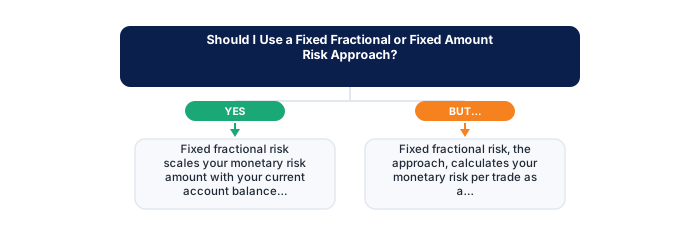
Fixed fractional risk scales your monetary risk with your current account balance as it grows or shrinks; fixed amount risk stays the same regardless.
Most traders benefit from the fixed fractional approach for genuine long-term sustainability.
📋 ON THIS PAGE
- How fixed fractional risk works in practice
- How fixed amount risk works in practice
- Why fixed fractional protects better during drawdowns
- Why fixed amount can become disproportionate after account growth
- Situations where fixed amount might still make sense
- The practical recommendation for most traders
1. How fixed fractional risk works in practice
Fixed fractional risk, the approach, calculates your monetary risk per trade as a consistent percentage of your current account balance, recalculated for every trade as your balance naturally changes through accumulated wins and losses. As your account grows, your monetary risk per trade grows proportionally; as it shrinks, your monetary risk shrinks correspondingly.
It's worth actually implementing this recalculation as a consistent, scheduled habit, discussed elsewhere on this site regarding periodic position sizing reviews, rather than recalculating inconsistently or only when you happen to remember, a genuinely fixed fractional approach depends on this regular recalculation actually happening.
| Feature | Fixed Fractional | Fixed Amount |
|---|---|---|
| Risk per trade | Percentage of current balance | Fixed Rand amount |
| Adjusts with account growth | Yes, automatically | No, stays static |
| Protection during drawdowns | Better, shrinks with losses | Can become disproportionate |
| Simplicity | Requires recalculation | Simpler to apply |
2. How fixed amount risk works in practice
Fixed amount risk instead sets a constant monetary figure, for example, always risking exactly R200 per trade, regardless of how your account balance subsequently changes through trading activity. This monetary figure remains static until you deliberately decide to adjust it, rather than automatically recalculating with each trade the way fixed fractional risk does.
It's worth understanding why this constant figure appeals to some traders despite its mathematical drawbacks, the predictability of always knowing your exact Rand risk per trade, without needing to recalculate anything, offers a simplicity that some traders genuinely value, particularly earlier in their development.
- D = Drawdown as decimal (e.g. 0.25 = 25%)
- 25% drawdown = needs 33% to recover
- 50% drawdown = needs 100% to recover
- 75% drawdown = needs 300% to recover
3. Why fixed fractional protects better during drawdowns
Fixed fractional risk provides a genuine protective benefit during losing streaks, as your account balance declines, your monetary risk per trade automatically declines too, meaning each subsequent trade risks a smaller absolute amount, naturally slowing the rate of further capital depletion compared to a fixed amount approach that would continue risking the same absolute figure regardless of how much the account has already declined.
It's worth calculating a concrete example for your own account to see this protective effect clearly, comparing how each approach would have handled an actual historical losing streak from your own trading journal makes this mathematical benefit considerably more tangible than the abstract principle alone.
- Position size calculated before every entry
- Stop-loss defined from chart structure before entry
- Total open risk below 5% of account at any time
- No adding to losing positions under any circumstances
- Trading paused if monthly drawdown reaches 10%
- Stops never moved further away once position is open
4. Why fixed amount can become disproportionate after account growth
Conversely, if your account grows substantially, a fixed amount approach means your risk percentage relative to this larger balance actually shrinks over time, potentially becoming overly conservative relative to your account's new, larger size, while fixed fractional risk automatically scales up proportionally, maintaining consistent relative risk exposure regardless of how much your account has grown.
South African traders using leveraged instruments should build their risk management framework around the principle that no single trade should be capable of significantly damaging their overall trading capital. This means calculating position size position sizes before every trade rather than after entry, keeping stop-losses at levels determined by chart structure rather than by the amount you are willing to lose, and reviewing your risk per trade ratio regularly as your account grows or shrinks.
| Drawdown | Recovery needed | At 20%/yr | At 10%/yr |
|---|---|---|---|
| 10% | 11.1% | 7 months | 14 months |
| 25% | 33.3% | 19 months | 38 months |
| 50% | 100.0% | 4+ years | 7+ years |
| 75% | 300.0% | Never at 10%/yr | Never at 10%/yr |
5. Situations where fixed amount might still make sense
Some traders specifically prefer fixed amount risk during particular phases, for example, deliberately choosing not to increase risk amount immediately after a winning streak, to avoid the kind of premature, overconfident risk escalation this bias can produce, even though this means temporarily accepting a smaller relative risk percentage than the standard fixed fractional approach would suggest.
It's worth being deliberate and explicit if you choose this approach for this specific reason, treating it as a conscious, temporary choice tied to a specific rationale, rather than simply defaulting to fixed amount out of habit or unfamiliarity with the fractional alternative.
6. The practical recommendation for most traders
For most traders, the fixed fractional approach provides better long-term sustainability and statistical properties, making it the generally recommended default. Traders specifically wanting the deliberate conservatism fixed amount can provide during particular phases can consider this as an occasional, deliberate variation rather than abandoning fixed fractional risk as their primary, ongoing approach.
Fixed Rand amounts don't adjust and can become too large over time.
Fixed fractional sizing, like 1-2% per trade, scales automatically as the account grows or shrinks. A fixed Rand amount doesn't adjust and can become disproportionately large after account growth.
★ Why It Matters
Something worth modelling for yourself directly: simulate both approaches against your own actual trade history, fixed fractional risk compounds losses down faster during a losing streak (since the risk amount shrinks too), which some traders find psychologically harder despite its mathematical soundness.
✕ Common mistakes
- Choosing an approach without testing it against your own actual trade history. The mathematically sound option isn't always the psychologically comfortable one.
- Switching between approaches inconsistently mid-strategy. This makes it difficult to evaluate either approach's genuine effect on results.
- Assuming one approach is universally superior regardless of personal psychology. The right choice depends partly on your own comfort with the resulting size variation.
Key Takeaways
- Fixed fractional risk scales with your account balance, while fixed amount risk stays constant; most traders benefit from the fixed fractional approach.
- Fixed fractional risk scales your monetary risk with your current account balance as it grows or shrinks; fixed amount risk stays the same regardless.
- Most traders benefit from the fixed fractional approach for genuine long-term sustainability.
- How fixed fractional risk works in practice.
- How fixed amount risk works in practice.
See also: How Do Investment Stokvels Work, and Can a Stokvel Buy Shares?.
Frequently asked follow-up questions
Can I switch between these two approaches over time?
Yes, some traders deliberately use fixed amount temporarily during specific phases, discussed in this piece, before returning to fixed fractional as their primary ongoing approach.
Does fixed fractional risk mean my position size changes every single trade?
Yes, technically your exact monetary risk amount recalculates with each trade based on current balance, though the percentage itself, typically remains consistent.
Is one approach required by any specific regulation?
No, this is a personal risk management choice rather than a regulatory requirement; the recommendation discussed in this piece reflects sound practice rather than any mandatory rule.
