i Short answer
A limit order specifies a particular price at which you want a trade to execute; a market order executes immediately at the best currently available price.
📋 ON THIS PAGE
1. How a limit order specifically works
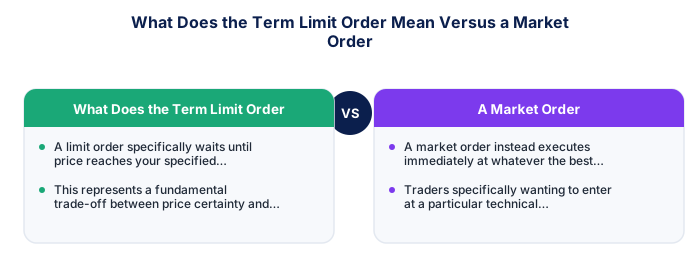
A limit order, one type of pending order, waits until price reaches your specified level before executing, meaning you know in advance the exact price your trade will fill at, though there's no guarantee price will actually reach this level at all.
It's worth remembering this order type guarantees price, not execution, price never reaching your specified level simply means the order remains unfilled indefinitely, or until it expires, worth planning for this genuine possibility rather than assuming a limit order will always eventually fill.
| Factor | Market Order | Limit Order |
|---|---|---|
| Execution certainty | Guaranteed (at available price) | Not guaranteed: may not fill |
| Price certainty | None: fills at best available | Set by you: fills at your price or better |
| Slippage risk | Yes: especially in fast markets | No: you control the price |
| Speed | Immediate | Whenever price reaches your level |
| Best for | Exiting urgently, highly liquid pairs | Planned entries, specific levels |
| Risk in illiquid markets | High: wide spreads can cost dearly | Low: you don't overpay |
| Used by scalpers | Yes: speed matters | Less common: slows entry |
| Used by swing traders | Sometimes | Often: patient, level-based entries |
2. How a market order specifically works
A market order instead executes immediately at whatever the best currently available price happens to be at the moment of submission, prioritising certainty of execution over price precision, meaning you're guaranteed to enter or exit, but not guaranteed the exact specific price you might have hoped for.
It's worth being especially mindful of this order type during genuinely volatile conditions, since the guaranteed execution a market order provides comes specifically at the cost of price certainty, exactly when that price certainty may matter most.
- FSCA-regulated broker verified at fsca.co.za
- Demo account tested for minimum 60 days
- Trading plan written: entry, exits, position sizing
- Risk per trade defined (1-2% of account)
- Backup internet connection tested for load shedding
- Tax implications understood
3. The key trade-off between these two approaches
This is a fundamental trade-off between price certainty and execution certainty. A limit order guarantees your specific price if it fills at all, while a market order guarantees execution but with some price uncertainty, tied to slippage, particularly during volatile conditions.
It's worth thinking of this trade-off as fundamental and unavoidable, rather than something a better platform or broker could somehow eliminate, every order type on every platform ultimately involves balancing these same two competing priorities in some form.
4. When traders typically prefer limit orders
Traders specifically wanting to enter at a particular technical level, tied to support and resistance, or who aren't in a hurry and prefer price precision over immediate execution, often favour limit orders for this kind of planned, patient entry approach.
It's worth combining this order type with the pending order concept discussed elsewhere on this site, since a limit order set at a specific future price effectively lets your predetermined analysis execute automatically, without requiring your continuous presence.
| Item | Detail |
|---|---|
| Regulator | FSCA, fsca.co.za |
| Exchange control | SARB, resbank.co.za |
| Tax authority | SARS, sars.gov.za |
| JSE hours | 09:00-17:00 SAST Mon-Fri |
| Best forex session | 15:00-17:00 SAST |
| CGT annual exclusion | R50,000 (individuals) |
5. When traders typically prefer market orders
Traders specifically needing immediate execution, closing a position quickly in response to breaking news, or simply wanting to enter a position right away without waiting for a specific price, typically favour market orders given this priority on certainty of execution.
It's worth being honest with yourself about whether genuine urgency justifies this trade-off for any specific trade, rather than defaulting to market orders purely out of habit or impatience, when price certainty genuinely doesn't matter for your specific strategy.
6. How this relates to slippage
Market orders are generally more exposed to slippage given their priority on immediate execution over exact price, while limit orders, by definition, either fill at your specified price or don't fill at all, avoiding this particular form of price uncertainty entirely.
A market order fills immediately at the current market price.
A limit order fills at your specified price or better, protecting you from worse fills. A market order fills immediately at the current price, useful for speed but with no price guarantee.
★ Why It Matters
Worth knowing: a limit order guarantees your price but not your fill. During fast-moving conditions it can simply never execute at all if price never returns to your specified level. This trade-off is worth weighing deliberately against a market order's certainty of execution but not of price.
✕ Common mistakes
- Using market orders by default without considering limit orders' benefits. Limit orders offer price certainty market orders don't.
- Not understanding that a limit order can simply expire unfilled. Plan for this possibility rather than assuming guaranteed execution.
- Choosing order type without considering current market volatility. The right choice can depend on how fast-moving conditions currently are.
Key Takeaways
- A limit order specifies a particular price for execution, while a market order executes immediately at the best currently available price.
- A limit order specifies a particular price at which you want a trade to execute; a market order executes immediately at the best currently available price.
- How a limit order specifically works.
- How a market order specifically works.
- The key trade-off between these two approaches.
Frequently asked follow-up questions
Can I convert a limit order into a market order if I change my mind?
This typically requires cancelling the existing limit order and placing a new market order instead, rather than directly converting one order type into another.
Does a limit order ever experience any form of slippage?
Generally no in the traditional sense, since it either fills exactly at your specified price or doesn't fill at all, though some brokers may have specific policies worth checking.
Which order type is better for beginners to use by default?
Many educators suggest beginners become comfortable with both, choosing based on the specific situation rather than defaulting to one exclusively.
Can I use a limit order to take profit on an existing position?
Yes, this is functionally similar to a take-profit order, specifying a target price for closing a profitable position.
Does using a market order always mean accepting worse pricing?
Not necessarily. During stable, liquid conditions, market orders often fill very close to the displayed price, with meaningful slippage being more specifically associated with volatile or illiquid conditions.
