i Short answer
FOMO leads traders to chase price moves already significantly in progress without genuine, predetermined analysis.
This often results in entry near the move's eventual exhaustion rather than its genuine beginning.
📋 ON THIS PAGE
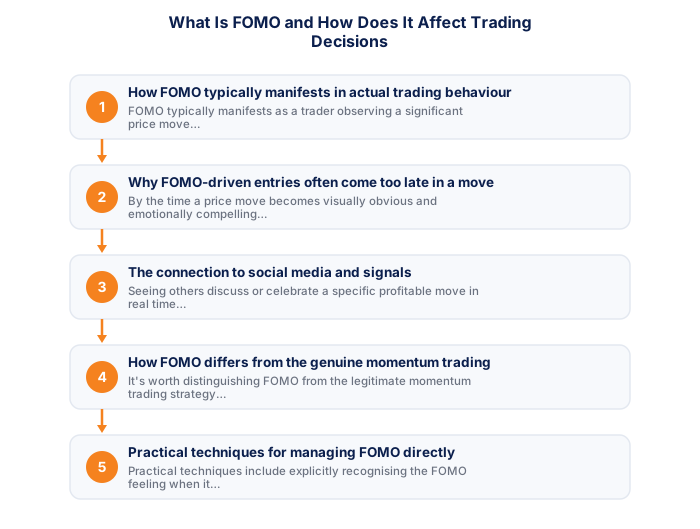
1. How FOMO typically manifests in actual trading behaviour
FOMO typically manifests as a trader observing a significant price move already well underway, perhaps seeing a currency pair, having already moved substantially in one direction, and feeling a strong urge to enter immediately, simply to participate in what looks like an obviously profitable opportunity, without the kind of disciplined criteria-checking.
The underlying feeling driving this urge is worth naming specifically: it's less about believing the trade is genuinely sound and more about the discomfort of imagining having missed out on an obvious win. That distinction matters, because a trade entered to relieve discomfort rarely gets the same careful scrutiny a trade entered through your normal, disciplined process would receive.
2. Why FOMO-driven entries often come too late in a move
By the time a price move becomes visually obvious and emotionally compelling enough to trigger genuine FOMO, the move has often already captured much of its available momentum, meaning FOMO-driven entries frequently occur close to the point where the move begins exhausting or reversing, rather than near its genuine, earlier beginning when a disciplined, criteria-based entry would more typically have occurred.
This timing problem compounds itself in a particularly unhelpful way: a FOMO entry that immediately reverses tends to produce an even stronger emotional reaction than a normal losing trade would, since the trader is left having chased a move, missed its profitable portion entirely, and then absorbed a loss on top of that, a combination that can itself trigger further undisciplined decisions in an attempt to recover quickly.
- Emotional state is neutral
- Yesterday's results not influencing today
- Trading plan is open and reviewed
- Loss limit for today defined and accepted
- Phone notifications silenced
- Backup connectivity confirmed
- Written rules eliminate in-the-moment decisions
- Journalling creates a feedback loop for improvement
- Pre-session checks reduce emotionally-driven entries
- Regular breaks prevent compounding mistakes
- Building discipline requires active daily effort
- Losses immediately test emotional stability
- No external accountability in retail trading
- Social pressure to perform can override rules
3. The connection to social media and signals
Seeing others discuss or celebrate a specific profitable move in real time, especially through social media signals, can significantly amplify FOMO, creating social pressure compounding the purely individual psychological discomfort of watching a move happen without participating, making this a particularly potent combination worth recognising explicitly.
It's worth noticing that what's being shared publicly is almost always the winning trades, rarely the losses or the missed calls, which creates a skewed impression of how often that particular signal source or trader actually gets things right. Seeing a steady stream of apparent wins from others can make FOMO feel more justified than a more complete, honest picture of that source's actual track record would support.
4. How FOMO differs from genuine momentum trading
It's worth distinguishing FOMO from the legitimate momentum trading strategy. Genuine momentum trading involves predetermined, criteria-based rules for identifying and entering strong moves, while FOMO involves an emotionally-driven, undisciplined reaction to a move that simply looks compelling in the moment, without this kind of predetermined, criteria-based foundation.
A useful test for telling the two apart in your own trading: could you have written down your entry reasoning in the same specific terms before seeing this particular move happen, or only after watching it unfold and feeling pulled in? Momentum trading's criteria exist independently of any specific instrument's current behaviour; FOMO's 'reasoning' is generated by, and specific to, the move already being observed.
5. Practical techniques for managing FOMO directly
Practical techniques include explicitly recognising the FOMO feeling when it arises and treating its presence itself as a signal for caution rather than urgency; sticking to predetermined strategy criteria regardless of how compelling a specific moving instrument currently appears; and stepping away briefly from active chart-watching when FOMO feels particularly strong, allowing the emotional intensity to settle before making any decision.
Some traders find it helpful to keep a short, standing list of their actual entry criteria visible while watching markets, specifically so that a FOMO impulse can be checked against something concrete and predetermined, rather than relying on memory alone in a moment when emotional pressure is already working against clear thinking.
6. Reframing missed opportunities constructively
Reframing missed opportunities as a normal, accepted cost of disciplined trading, recognising that no strategy captures every single profitable move, and that consistently chasing FOMO-driven entries typically produces worse overall results than patiently waiting for genuine, criteria-meeting setups, supports a healthier psychological relationship with the inevitable experience of watching some moves happen without your direct participation.
Behavioural research calls this loss aversion, and it explains why holding a losing position feels easier than closing it.
A criteria-based entry triggers at the right point based on your rules.
FOMO entries chase moves after they've already happened significantly. A criteria-based entry triggers at the right moment based on your specific, predetermined rules, with risk management applied consistently.
★ Why It Matters
Worth checking specifically in your own journal: the average outcome of trades entered after price had already moved significantly, versus trades entered at your strategy's genuine planned level, comparing these two categories directly tends to be more persuasive than any general advice about avoiding FOMO.
✕ Common mistakes
- Entering after price has already moved significantly on a setup. This often means entering near a move's exhaustion, not its genuine beginning.
- Treating every missed move as a personal failure rather than disciplined behaviour. A missed trade outside your criteria reflects discipline, not a mistake.
- Chasing a move to 'catch up' after initially sitting it out. This compounds one missed opportunity into a second, often worse decision.
- Not logging FOMO-driven trades separately to track their actual cost. Without this tracking, the pattern's real impact is easy to underestimate.
Key Takeaways
- FOMO, the fear of missing out, leads traders to chase moves already in progress without genuine analysis, often entering near the move's eventual exhaustion.
- FOMO leads traders to chase price moves already significantly in progress without genuine, predetermined analysis.
- This often results in entry near the move's eventual exhaustion rather than its genuine beginning.
- How FOMO typically manifests in actual trading behaviour.
- Why FOMO-driven entries often come too late in a move.
Frequently asked follow-up questions
Is FOMO unique to trading, or a broader psychological pattern?
FOMO is a broadly documented psychological pattern beyond trading specifically, though it manifests with particular financial consequence within trading contexts given the real capital at stake.
Can experienced traders still experience FOMO?
Yes, this bias isn't limited to beginners. Even experienced traders can experience FOMO, though developed discipline helps manage its influence on actual behaviour.
Does avoiding FOMO mean missing out on genuinely good opportunities?
Sometimes, yes, but broader expectancy depends on disciplined, criteria-based trading overall, not on capturing every single individual profitable move.
