i Short answer
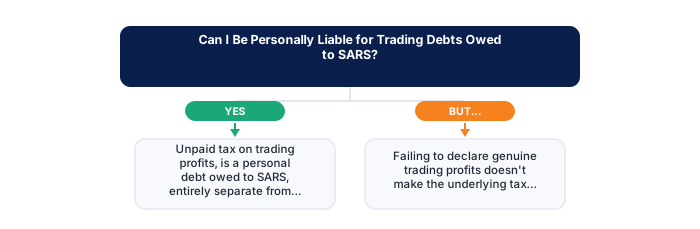
Yes. Unpaid tax on trading profits is a personal debt owed to SARS, entirely separate from your trading account itself.
SARS pursues recovery through its normal collection channels regardless of your trading account's current balance, or whether you've long since withdrawn the profits in question.
📋 ON THIS PAGE
1. Why this debt is personal, not tied to a specific account
The moment trading profit is earned, the tax owed on it becomes a personal liability under South African tax law. That liability exists independently of the trading account it came from, independently of whether the account still holds that capital, and independently of any subsequent losses that might offset it in a future tax year.
This is worth internalising specifically because it counters an intuitive but mistaken assumption: that a trading account's current balance somehow represents the maximum SARS can claim. The tax obligation attaches to you personally as a natural person or as a sole trader, depending on how your trading activity is structured, not to the account or the platform you trade through.
SARS does not automatically receive your trading profits from your broker. You must declare all trading income on your annual ITR12. Non-disclosure attracts interest, penalties, and potential audit.
The personal nature of this liability also means it isn't limited by the ring-fencing that might apply in other commercial contexts. Where a registered company creates some separation between business liabilities and personal liabilities, sole trader and individual trading income creates no such separation, SARS's claim is directly against you as an individual.
For South African traders who are employed and also trading, the complexity increases slightly. Employment income and trading income are both personal income, and SARS assesses them together. Trading losses in one period may offset trading profits in another, but the interaction between employment income and trading income involves nuances that a registered tax practitioner can manage more reliably than general guidance.
2. What happens if you don't declare trading profits
Not declaring profit doesn't make the tax obligation disappear, it delays when SARS assesses and collects it, and that delay almost always costs more than the original amount would have. Interest accrues from the original due date, and penalties for non-disclosure can be substantial, particularly if SARS determines the non-disclosure was deliberate rather than inadvertent.
It's worth thinking of this delay as actively working against you rather than neutrally. Every month an undeclared liability sits unaddressed increases the interest component and reduces the options available for managing the obligation. Early engagement almost always produces better outcomes than late engagement.
- Download annual trade statement from broker
- Identify all profits and losses with dates
- Determine revenue vs capital gains classification
- Calculate provisional tax liability for both periods
- File ITR12 within the SARS filing season deadline
- Keep all supporting documentation for 5 years
- Capital gains: lower effective rate
- R50,000 annual CGT exclusion
- CGT losses offset future gains
- Only 40% of gain included in taxable income
- Revenue: full marginal rate up to 45%
- No annual exclusion for revenue income
- Must register as provisional taxpayer
- SARS scrutiny on active traders
SARS's data-matching and verification capabilities have expanded considerably and they receive information from multiple sources including broker reports, bank transaction data, and third-party data providers. The assumption that trading profits aren't visible to SARS unless specifically disclosed is not a reliable basis for tax planning.
The practical consequence of this is that proactive declaration is not just the legally required approach, it's genuinely the most economically rational one. The penalties for non-disclosure, combined with accumulated interest, typically produce a substantially larger total obligation than the original tax liability would have been if declared on time.
3. SARS recovery powers and mechanisms
SARS has several tools for recovering confirmed tax debt: formal demands, interest charges, penalties, and in serious or persistent cases, legal collection action including judgments. When a SARS debt is confirmed through an assessment, the agency can pursue recovery across your broader financial assets, not just assets connected to the original trading activity.
This broader reach is worth understanding clearly, since it removes any comfort that might come from assuming a trading debt is somehow contained within the trading account. SARS's collection powers apply to your general assets, bank accounts, property, investment accounts, to the extent necessary to satisfy a confirmed tax debt.
The SARS enforcement process escalates in stages, and early engagement at each stage typically produces better outcomes than waiting for escalation to the next level. An initial assessment that's disputed through proper channels has different outcomes than one that's ignored and allowed to become a judgment debt.
South African tax law also gives SARS the authority to collect confirmed debt from third parties who hold assets on your behalf in certain circumstances. This is a less common scenario for individual retail traders, but it underscores that the scope of SARS's recovery powers is broad enough to treat seriously rather than assume limited.
4. The provisional tax connection
Traders generating meaningful trading income are often required to register as provisional taxpayers and make periodic estimated payments throughout the tax year rather than settling the full obligation at year-end assessment. This system is designed precisely to prevent large, lump-sum tax debts from accumulating.
It's worth checking your provisional taxpayer status proactively rather than waiting to be told, particularly once your trading income reaches a level where the obligation becomes meaningful. The thresholds for provisional taxpayer registration are specific and change from time to time, a registered tax practitioner can confirm whether your situation requires registration.
| Factor | Revenue trading | Capital gains |
|---|---|---|
| Tax rate | Up to 45% marginal | Effective 18% max |
| Taxable amount | 100% of profit | 40% of gain |
| Annual exclusion | None | R50,000 per year |
| Losses | Offset against income | Offset against capital gains only |
Underestimating provisional tax payments creates its own interest exposure, independent of the underlying tax liability. SARS charges interest on underpayments of provisional tax even when the full annual liability is eventually settled, making accurate estimation throughout the year materially cheaper than large corrections at year-end.
For traders whose income fluctuates significantly between periods, provisional tax estimation involves genuine uncertainty that's worth managing deliberately rather than treating as an afterthought. Keeping accurate records of realised trading income throughout the year, rather than reconstructing it retrospectively, is the foundation of reliable provisional tax estimation.
5. Interest and penalties on unpaid amounts
Interest accrues from the date the tax was originally due, and SARS can add further penalties for late payment or non-disclosure. A delayed or underpaid tax liability tends to grow faster than most people expect because interest compounds on the outstanding amount throughout the delay period.
This compounding effect is worth taking seriously precisely because it can feel abstract until you see it calculated concretely. A liability that would have been manageable when first incurred can become considerably more burdensome after a year or two of accumulated interest, and the longer the delay, the less favourable the comparison between original liability and total obligation.
Penalties for non-disclosure differ from interest in that they represent an additional amount above the principal and interest, assessed as a percentage of the unpaid tax. The distinction matters because the penalty component can sometimes be reduced through formal negotiation or voluntary disclosure, whereas accumulated interest is generally fixed based on the outstanding amount and time elapsed.
Keeping accurate records of your trading activity throughout the year is the most direct protection against both the interest and penalty risks. Clear records enable accurate initial declaration, make disputes manageable if SARS challenges your returns, and provide the documentation base for any voluntary disclosure engagement if earlier periods need to be corrected.
6. Practical steps if you already owe SARS for trading profits
If you suspect you owe SARS for previously undeclared or underpaid trading profits, approaching them proactively, ideally through a registered tax practitioner, almost always produces better outcomes than waiting for SARS to initiate contact. The voluntary disclosure programme exists specifically to enable this kind of engagement with reduced penalty implications.
A registered tax practitioner can also help you manage SARS's voluntary disclosure programme if the amounts involved are significant. This programme offers a structured pathway to regularise prior periods with more predictable outcomes than an unmanaged SARS audit, and a practitioner with experience in this process can help you approach it in the most favourable way.
SARS interest on unpaid trading-related tax compounds from the original assessment date, not from whenever the debt has been acknowledged or engaged with. This timing detail has meaningful practical consequences: the longer a known liability goes unaddressed, the larger the interest component becomes relative to the original principal, making earlier engagement consistently more economical than later engagement.
A broader piece of practical advice: establishing a proper tax record-keeping system from the start of your trading activity, rather than reconstructing it retrospectively when an assessment arrives, is the most effective way to manage SARS obligations as a trader. Platforms typically provide transaction histories and account statements, retaining these contemporaneously is substantially easier than reconstructing them under time pressure during an assessment.
✕ Common mistakes
- Assuming small profits won't be noticed. Banks increasingly share large transfer data with SARS.
- Delaying declaration and letting interest compound. SARS interest accrues from the original assessment date, not from whenever it's discovered.
- Mixing up income tax and capital gains treatment. Misclassifying profits can easily lead to under-declaration.
- Not keeping account statements for tax purposes. Without records, reconstructing a tax history later gets a lot harder.
Key Takeaways
- Yes, unpaid tax on trading profits is a personal debt to SARS, separate from your trading account itself, and SARS can pursue recovery through normal channels.
- Unpaid tax on trading profits is a personal debt owed to SARS, entirely separate from your trading account itself.
- SARS pursues recovery through its normal collection channels regardless of your trading account's current balance, or whether you've long since withdrawn the profits in question.
- Why this debt is personal, not tied to a specific account.
- What happens if you don't declare trading profits.
See also: Is Forex Trading a Pyramid Scheme in South Africa?.
Frequently asked follow-up questions
Can SARS access my trading account directly?
SARS doesn't directly access a trading account the way it might query a bank account during formal collection proceedings, but it can pursue broader legal collection action against your overall assets and income if a confirmed debt stays unpaid.
Does closing my trading account remove any tax liability?
No, closing an account has zero bearing on tax already owed on profits genuinely earned while it was active.
Should I consult a tax practitioner if I'm unsure about past trading income declarations?
Yes, given the genuine complexity and the potential financial consequences covered throughout this piece, professional advice is generally money well spent here.
Can I set up a payment plan with SARS if I can't pay a trading-related tax debt all at once?
SARS generally does offer payment arrangement options for taxpayers who genuinely can't settle a confirmed debt immediately. Engaging proactively to discuss it beats simply not paying and hoping it goes away.
Does emigrating from South Africa eliminate a previously incurred SARS trading debt?
No, a confirmed tax debt generally stays owed regardless of subsequent emigration, and SARS retains various legal mechanisms for pursuing recovery even after someone has left the country.
