i Short answer
Market manipulation involves deliberately distorting prices through deceptive practices like spreading false information or coordinated trading.
This is a serious offence, but retail traders engaging in normal, individual trading are extremely unlikely to encounter this accusation.
📋 ON THIS PAGE
- What actually constitutes market manipulation legally
- Why this typically targets larger, coordinated activity
- Common misconceptions among retail traders about this risk
- The genuine risk specifically around signal groups and pump schemes
- How regulators actually detect and investigate this conduct
- Staying clearly on the right side of this line
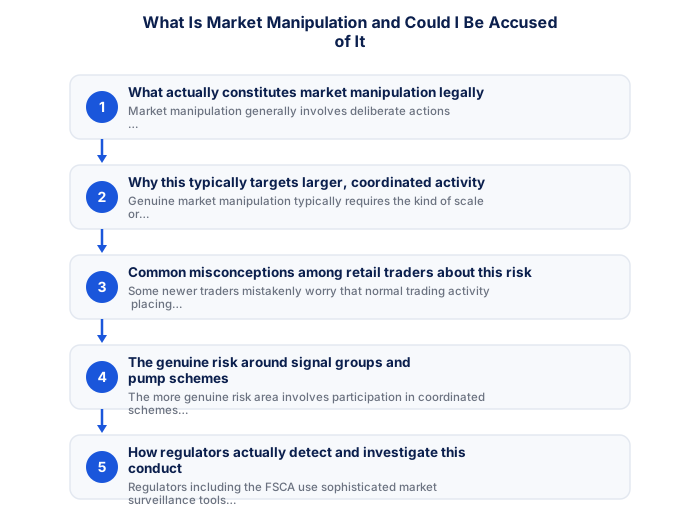
1. What actually constitutes market manipulation legally
Market manipulation generally involves deliberate actions specifically intended to create a false or misleading impression of market activity or price levels, such as spreading false information to influence prices, executing trades designed to create artificial price movement rather than reflecting genuine supply and demand, or coordinating with others to manipulate prices collectively for shared benefit.
It's worth understanding this legal definition precisely rather than a vague general impression, market manipulation specifically involves deliberate, artificial distortion of price or trading activity, worth distinguishing clearly from simply trading based on your own genuine analysis or view, however that view happened to develop.
2. Why this typically targets larger, coordinated activity
Genuine market manipulation typically requires the kind of scale or coordination capable of actually moving prices meaningfully, a single retail trader placing normal-sized trades through a standard FSCA-regulated broker simply doesn't have the market influence to constitute manipulation in any legally meaningful sense, since their individual activity doesn't genuinely distort broader market pricing.
It's worth appreciating why this scale requirement matters practically for your own reassurance, discussed elsewhere on this site regarding realistic trading concerns, genuine market manipulation typically requires resources and coordination far beyond what an individual retail trader's normal activity could ever represent.
- FSCA-regulated broker verified at fsca.co.za
- Demo account tested for minimum 60 days
- Trading plan written: entry, exits, position sizing
- Risk per trade defined (1-2% of account)
- Backup internet connection tested for load shedding
- Tax implications understood
3. Common misconceptions among retail traders about this risk
Some newer traders mistakenly worry that normal trading activity, placing trades based on their own analysis, even frequently, as with day trading and scalping, could somehow constitute manipulation. This concern is generally unfounded for ordinary retail trading conducted through a standard, regulated broker account, since manipulation specifically requires deceptive intent and genuine market-moving capability, neither of which apply to typical individual retail trading activity.
It's worth correcting this misconception explicitly for your own peace of mind, ordinary retail trading decisions, however large relative to your own personal account, essentially never approach the scale genuinely capable of constituting market manipulation in forex or major index markets.
4. The genuine risk specifically around signal groups and pump schemes
The more genuine risk area involves participation in coordinated schemes designed to manipulate prices, for example, organised "pump and dump" schemes in certain less liquid markets, where a group deliberately coordinates buying to artificially inflate price before selling to less-informed participants who bought based on the artificial momentum. Knowingly participating in this kind of coordinated, deceptive scheme, rather than simply following a signal innocently, is what creates genuine legal exposure.
It's worth being genuinely cautious here specifically, since this is where retail traders can, even unknowingly, become involved in something problematic, discussed elsewhere on this site regarding evaluating trading communities and signal services, coordinated schemes deliberately designed to move thinly-traded instruments do carry genuine legal risk for participants.
| Item | Detail |
|---|---|
| Regulator | FSCA, fsca.co.za |
| Exchange control | SARB, resbank.co.za |
| Tax authority | SARS, sars.gov.za |
| JSE hours | 09:00-17:00 SAST Mon-Fri |
| Best forex session | 15:00-17:00 SAST |
| CGT annual exclusion | R50,000 (individuals) |
5. How regulators actually detect and investigate this conduct
Regulators including the FSCA use sophisticated market surveillance tools specifically designed to detect unusual trading patterns potentially indicating manipulation, typically focused on identifying coordinated activity or patterns inconsistent with genuine market participation, rather than scrutinising individual retail traders' normal, independent trading decisions.
It's worth understanding that regulatory detection tools focus specifically on identifying coordinated, unusual trading patterns at scale, worth appreciating this as another reason why ordinary, independent retail trading activity essentially never triggers this kind of scrutiny.
6. Staying clearly on the right side of this line
For the overwhelming majority of retail traders, simply trading based on your own genuine analysis through a regulated broker, keeps you entirely clear of any manipulation concern. The relevant caution specifically involves avoiding knowing participation in coordinated schemes explicitly designed to deceive other market participants, the same broader caution worth applying to signal groups and unrealistic trading schemes generally.
It's also worth knowing that any FSCA-regulated broker operating in South Africa is bound by POPIA (the Protection of Personal Information Act), which governs how your personal and financial data must be collected, stored, and protected.
Retail traders' positions are far too small to manipulate liquid forex markets. However, understanding what counts as manipulation, such as wash trading or spoofing, is worth knowing even at retail scale.
★ Why It Matters
Worth knowing for peace of mind: the regulatory threshold for manipulation concerns coordinated, deliberate attempts to distort price for personal gain, normal individual retail trading, even active or frequent trading, sits nowhere near this threshold regardless of position size position size.
✕ Common mistakes
- Confusing aggressive but legitimate trading with manipulative behaviour. These are genuinely distinct, with manipulation requiring deceptive intent.
- Not understanding what specifically distinguishes manipulation from normal market participation. Intent and coordination are the key differentiating factors.
- Assuming position size alone could trigger manipulation concerns. Size alone, without deceptive practices, doesn't meet this threshold.
Key Takeaways
- Market manipulation involves deliberately distorting prices through deceptive practices, a serious offence retail traders are extremely unlikely to encounter accidentally.
- Market manipulation involves deliberately distorting prices through deceptive practices like spreading false information or coordinated trading.
- This is a serious offence, but retail traders engaging in normal, individual trading are extremely unlikely to encounter this accusation.
- What actually constitutes market manipulation legally.
- Why this typically targets larger, coordinated activity.
See also: Should I Trade Based on Social Media Tips and Signals? and Is Forex Trading a Pyramid Scheme in South Africa?.
Frequently asked follow-up questions
Can frequent trading alone be considered manipulation?
No, trading frequency alone, doesn't constitute manipulation; the defining factor is deceptive intent and genuine market-distorting capability, not simply activity volume.
Should I worry about this if I follow a trading signal group?
Generally not if you're simply following signals innocently; the genuine concern is specifically knowing participation in a scheme designed to deceive others, discussed in this piece.
Does the FSCA investigate individual retail traders for this?
This is extremely uncommon for ordinary retail trading activity; FSCA surveillance typically focuses on larger-scale or coordinated patterns rather than individual, independent retail trading decisions.
Could posting about my own trades on social media ever count as manipulation?
Generally not if you're simply sharing your own genuine views or results honestly; the concern arises with deliberately false claims made with intent to influence others' trading for your own benefit.
Is manipulation easier to commit in less liquid markets?
Yes, lower-liquidity markets generally require less capital or coordination to move prices artificially, which is part of why certain smaller or thinly-traded instruments attract more regulatory attention regarding this specific risk.
