ℹ Short answer
There is no crypto box on the ITR12. A disposal treated as capital goes in the capital gains section; one treated as revenue goes in local business income. Mining and staking rewards go in as income at the rand value on the day received. Which classification applies is decided by your behaviour, not by what you tick.
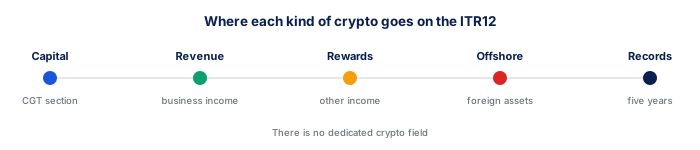
1. Where crypto actually goes on the ITR12
SARS has not created a dedicated crypto field, which is the first thing that confuses people filing for the first time. Crypto is reported through the existing structure according to what the transaction was. A disposal you treat as capital goes into the capital gains section, where you enter proceeds, base cost and the resulting gain or loss for each disposal. A disposal you treat as revenue goes into local business, trade and professional income, or into other income depending on how the activity is structured. Mining rewards, staking rewards and airdrops go in as income in the year received. If you hold crypto on an offshore platform you must also complete the foreign income section, and the question about holding foreign assets must be answered honestly even where nothing was disposed of. Getting the section right matters more than people expect, because a gain declared in the wrong place is a gain SARS has to query, and a query becomes a verification.
2. How SARS decides capital or revenue
The distinction is worth real money: a capital gain for an individual is included at 40% and taxed at your marginal rate, giving a maximum effective rate of 18%, while revenue is taxed at your full marginal rate up to 45%. SARS applies the same intention test it applies to shares. The facts that count are how long you held, how frequently you transacted, whether you borrowed to buy, whether you have a pattern of short holds, what you did with the proceeds, and what you said at the time. Someone who bought in 2019, held through two cycles and sold once has a strong capital argument. Someone who made four hundred trades across six platforms does not, whatever they would prefer. You classify it on the return, and SARS is entitled to disagree on the facts. The classification is also not a free choice you can switch each year: claiming revenue in a losing year and capital in a winning one is exactly the pattern that invites scrutiny.
3. Base cost and the matching problem
Base cost is what you paid plus the costs of acquiring and disposing, expressed in rand at the date of each transaction. The complication is that almost nobody buys in one tranche. If you bought at R180,000, R340,000 and R620,000 and then sold a third of your holding, which tranche did you sell? South African practice generally follows specific identification where you can prove it, and a weighted average where you cannot, but the method must be applied consistently rather than chosen per disposal to produce the better answer. Conversion is the other trap: a purchase made in dollars on an offshore platform has a rand base cost fixed at the exchange rate on that day, not at today's rate. Reconstructing all of that from exchange statements three years later is the single most common reason people under-declare without intending to.
4. Crypto to crypto is a disposal
This is the omission that appears most often, and it is the most expensive. Swapping bitcoin for ethereum is a disposal of the bitcoin at its rand value on that date, with a gain or loss to account for, followed by an acquisition of the ethereum at that same value. Converting to a stablecoin is the same thing. Moving between your own wallets is not a disposal, but moving into a liquidity pool or a wrapped version of an asset usually is. The practical effect is that an active year can produce hundreds of taxable events with no rand ever leaving your bank account, and a tax liability substantially larger than the amount you withdrew. People discover this on audit rather than on filing.
5. What records SARS expects to see
The requirement is to retain records for five years from the date the return was submitted, and for crypto that means more than a screenshot. For each transaction SARS expects the date, the type, the quantity, the rand value at that date, the platform or wallet it occurred on, the counterparty where there is one, and the source of the funds used. An exchange CSV export is a starting point, not a complete record, particularly if you have used more than one platform or have moved assets to self-custody. Anyone transacting with any frequency should export as they go rather than reconstruct at year end, because the platforms change their export formats, close accounts, and in two notable South African cases simply ceased to exist with the records inside them.
6. What CARF changed
The Crypto-Asset Reporting Framework has participating jurisdictions exchanging crypto platform data automatically, in the same way the Common Reporting Standard already does for bank accounts. The practical consequence for a South African is that SARS increasingly receives information about offshore platform activity without having to ask for it, and without you knowing which year it arrives. The old calculation, in which offshore platform activity was effectively invisible, no longer holds. For anyone who has not declared historical activity, the voluntary disclosure programme exists and produces a materially better outcome than being found, because it removes the understatement penalty where the disclosure is genuinely voluntary and complete.
7. Losses, and why they are scrutinised
A capital loss offsets capital gains in the same year and carries forward indefinitely against future capital gains. It cannot be set against your salary. A revenue loss can be set against other income, including salary, which makes it far more valuable and is precisely why SARS examines a revenue classification that appears for the first time in a year of losses. If your pattern of activity genuinely supports revenue treatment, it supported it in the profitable years too, and declaring it consistently is what makes the loss claim stand up. Ring-fencing rules can also apply to a trade that produces repeated losses, which deny the set-off until the activity produces a profit.
★ Why It Matters
Crypto is the area where SARS has moved fastest and taxpayers have moved slowest. CARF now delivers offshore platform data automatically, which means the gap between what you declared and what SARS can see is closing without you being told. Getting the classification and the records right is cheaper now than explaining them later.
Where to take this next: the How SARS taxes crypto gains covers the mechanics in detail.
✕ Common mistakes
- Forgetting that crypto to crypto is a disposal. No rand moves, nothing feels like a sale, and the tax is identical to selling and buying back.
- Switching between capital and revenue by year. Claiming revenue in a loss year and capital in a gain year is the pattern SARS looks for.
- Reconstructing records at filing time. Platforms change export formats and close accounts. Export as you go.
- Assuming offshore means invisible. CARF exchanges platform data automatically between participating jurisdictions.
Frequently asked follow-up questions
Do I have to declare crypto I have not sold?
Not as a disposal, because holding is not a disposal. You do have to answer the foreign assets question on the return if the holding is on an offshore platform, and you declare mining or staking rewards in the year you receive them whether or not you sold.
Is swapping one coin for another taxable?
Yes. It is a disposal of what you gave up at its rand value on that date, even though no rand moved and nothing felt like a sale.
Can I decide whether it is capital or revenue?
You classify it on the return and SARS can disagree on the facts. Holding period, frequency and borrowing are what decide it, not the label you choose.
What if I never declared past crypto gains?
The voluntary disclosure programme produces a far better outcome than being found, particularly now that CARF gives SARS offshore platform data automatically.
How long must I keep records?
Five years from the date the return was submitted, and longer where an assessment is under dispute.
