i Short answer
A margin calculator determines the exact deposit required to open and maintain a position given your chosen leverage ratio.
This helps confirm your available free margin is sufficient before placing a trade, avoiding rejected orders.
📋 ON THIS PAGE
- The basic margin calculation explained
- Inputs a margin calculator typically needs
- Checking this against your current free margin
- Why this matters particularly with multiple open positions
- Margin calculators and the effect of changing your leverage setting
- Using this tool proactively rather than reactively
- Margin requirements after the September 2026 rate increase
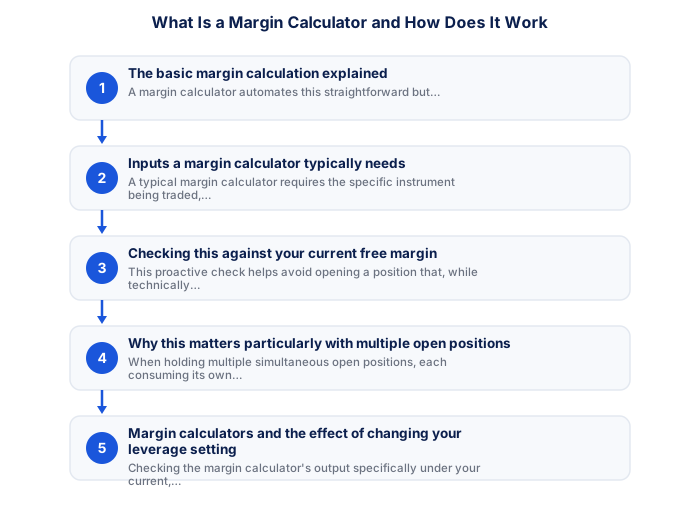
1. The basic margin calculation explained
Required margin for a position equals its total notional value divided by the leverage ratio applied. A margin calculator automates that arithmetic, simple in principle but easy to get wrong by hand, taking your intended position size and chosen leverage as inputs and returning the exact required margin in your account's base currency.
2. Inputs a margin calculator typically needs
A typical margin calculator needs the instrument you're trading, your intended position size position size (lot size), and the leverage ratio that applies to your account or that instrument. Enter those and it returns the exact required margin, no manual calculation needed.
3. Checking this against your current free margin
Comparing the calculator's output against your account's currently available free margin confirms whether you actually have room to open the position without immediately edging toward the margin call threshold. This check helps you avoid opening a position that's technically permitted but leaves uncomfortably little buffer for normal market movement.
4. Why this matters particularly with multiple open positions
When you're holding several positions at once, each tying up its own share of required margin, working out the margin for any new position against your already-reduced free margin becomes especially important, so you don't inadvertently overextend your account's total margin usage across everything combined.
5. Margin calculators and the effect of changing your leverage setting
Changing your leverage ratio directly changes the calculator's output for any given position size: higher leverage lowers the required margin, lower, more conservative leverage raises it. Check the calculator under your current, actual leverage setting rather than assuming an earlier calculation still holds after a leverage change, that avoids confusion from stale figures.
6. Using this tool proactively rather than reactively
Using a margin calculator before you place a trade, rather than after your platform rejects the order for insufficient margin, makes for a smoother, more deliberate workflow. It's part of the same predetermined-planning discipline this site covers elsewhere, working out constraints ahead of time instead of discovering them at the point of execution.
Many of these calculations become more robust when paired with a volatility measure like the Average True Range (ATR), which adjusts automatically to current market conditions rather than relying on a fixed assumption that may no longer fit.
A margin calculator tells you the required margin before you enter a position, and your remaining free margin after. Knowing both before committing prevents margin calls from unexpected position costs.
★ Why It Matters
Worth doing once: calculate margin for one trade by hand using the formula, then compare it to the calculator's output. Understanding the mechanics once makes you faster at sanity-checking the calculator's results afterward, instead of trusting it blindly.
✕ Common mistakes
- Trusting calculator output without understanding the underlying formula. A basic manual check once builds useful intuition for sanity-checking results going forward.
- Not accounting for your account's actual base currency in the calculation. Currency mismatches can produce a misleading margin figure.
- Assuming margin requirements are identical across different instrument types. They vary by instrument and by broker.
- Calculating margin without checking your actual available free margin afterward. Sufficient margin for one trade doesn't guarantee room for others simultaneously.
There is also an embeddable version: the margin calculator widget can sit on your own site in one line of HTML.
Margin requirements after the September 2026 rate increase
A margin calculator converts a position size into the deposit a broker will lock up to open it. The formula is simple, notional value divided by leverage, but two things changed in 2026 that affect how the answer should be read.
The first is the rate environment. The Reserve Bank raised the repo rate to 7.25% on 23 September, taking prime to 10.75%, and the Monetary Policy Committee described the decision as a response to a large and persistent global supply shock. Higher local rates raise the financing cost on leveraged rand positions, which does not change the margin requirement itself but does change what holding the position costs.
The second is volatility. Brokers routinely raise margin requirements on instruments ahead of high-impact events, and a period with an active rate cycle produces more such events. A margin figure calculated today may not be the figure applied the day before an MPC announcement, which for the rest of 2026 means 19 November.
The practical implication is to calculate margin with a buffer rather than to the last rand. A position that uses almost all available margin at the normal requirement can breach the stop-out level purely because the broker raised the requirement, without the price moving at all.
Free margin is the figure worth watching more closely than the requirement itself. It is what remains to absorb an adverse move, and a margin level approaching the broker's stop-out threshold means the next ordinary fluctuation closes the position.
| SARB decision, 2026 | Repo rate |
|---|---|
| January | 6.75% |
| March | 6.75% |
| May | 7.00% |
| July | 7.00%, held on a 4-2 split |
| 23 September | 7.25%, unanimous |
| 19 November | Next scheduled meeting |
See also: What Is a Heat Map Tool and How Do Traders Use It?.
Frequently asked follow-up questions
Is margin calculation different for different instruments?
Yes. Margin requirements and applicable leverage vary by instrument category, shares and forex, for example, often carry different leverage policies, so it's worth calculating per instrument rather than assuming one figure applies everywhere.
Does my trading platform usually show required margin automatically?
Most platforms display this during order placement, though a standalone calculator is handy for planning before you even get to the order screen.
Can insufficient margin prevent me from opening a position entirely?
Yes. Most platforms reject an order outright if your available free margin isn't enough to cover the required margin for that position size.
Does a stop-loss protect me from margin calls?
A stop-loss reduces loss risk but does not guarantee protection against margin calls during gap moves. Monitor your margin level continuously and size positions conservatively relative to your account balance.
Could this cost me more than my deposit?
Retail clients at licensed brokers are generally protected. The exposure appears where the broker is offshore or where you are classified as professional. Leverage against margin in practice covers it in full.
