i Short answer
Leverage is the ratio determining how much market exposure your capital can control; for example, 1:30 leverage means R1 of capital can control R30 of position.
Margin is the actual monetary deposit your broker requires, calculated by dividing your intended position size by the leverage ratio.
📋 ON THIS PAGE
1. The mathematical relationship explained clearly
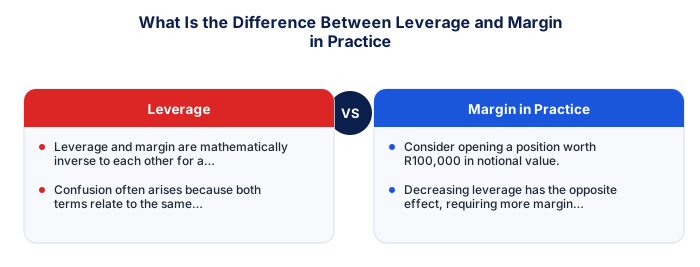
Leverage and margin are mathematically inverse to each other for a given position size, higher leverage means lower required margin, since the ratio increases how much exposure each unit of your capital controls, reducing the absolute deposit needed. This inverse relationship means the two terms, while related, describe genuinely different things: leverage is a ratio describing capital efficiency, while margin is an actual currency amount describing capital requirement.
It's worth internalising this inverse relationship until it feels genuinely automatic, higher leverage means lower required margin for the same position size, and vice versa, worth being able to move fluidly between these two related figures without confusion.
See also: Should I Use the Kelly Criterion for Position Sizing?
2. A worked example showing both concepts together
Consider opening a position worth R100,000 in notional value. At 1:50 leverage, the required margin would be R2,000 (R100,000 divided by 50). At 1:20 leverage, the same R100,000 position would require R5,000 margin instead. The leverage ratio determines the calculation; the margin figure is the actual result of that calculation for your specific position size.
| Leverage ratio | Position size | Required margin |
|---|---|---|
| 1:50 | R100,000 | R2,000 |
| 1:20 | R100,000 | R5,000 |
It's worth working through this same calculation using your own actual account leverage and a position size you might genuinely trade, seeing your own concrete numbers reinforces the relationship more effectively than a hypothetical example alone.
- P = Position size in lots
- R = ZAR amount at risk (1-2% of account)
- S = Stop distance in pips from entry
- V = Pip value per lot for this instrument
Set account risk %
Define maximum capital at risk per trade, typically 1-2%.
Measure stop distance
Find your stop-loss level on the chart before calculating size.
Calculate pip value
Use the instrument-specific pip value for your lot size.
Compute position size
Position size = (ZAR at risk) / (stop pips x pip value).
Confirm free margin
Ensure required margin fits within your available free margin.
4. How changing one setting affects the other
Increasing your account's leverage setting reduces the margin required for any given position size, freeing up more of your account balance as available free margin. Decreasing leverage has the opposite effect, requiring more margin for the same position size and leaving less available free margin for other positions.
It's worth recalculating your position sizing explicitly whenever you adjust your leverage setting, discussed elsewhere on this site regarding changing leverage after account opening, since this single change ripples through your required margin calculations for every subsequent trade.
5. Which concept matters more for everyday risk management
For position sizing calculations, leverage matters primarily as an input affecting how much margin a given position consumes, while your actual risk management discipline should be anchored to your risk percentage and stop-loss distance, rather than to the leverage ratio itself, which doesn't directly determine your risk exposure the way position size and stop-loss distance do.
It's worth appreciating why leverage, not margin, deserves your primary attention for genuine risk management, discussed throughout this site's risk management content, since leverage determines your actual amplified exposure, while margin simply reflects the accounting mechanics of that exposure.
- Confirm account equity
- Calculate 1-2% risk in ZAR
- Identify stop-loss level from chart
- Measure stop distance in pips
- Look up pip value for instrument
- Compute position size
- Verify required margin fits free margin
6. Using both concepts correctly in trading conversation
Using these terms precisely, leverage as the ratio, margin as the resulting deposit requirement, supports clearer communication when discussing trading with others, reading broker documentation, or following trading education content, avoiding the kind of confusion that imprecise terminology can otherwise introduce into your own understanding of these closely related but genuinely distinct concepts.
Position sizing is the single most controllable variable in a trading system, and beginners consistently underweight it relative to entry and exit methodology. A strategy with a modest edge but disciplined position sizing will outperform a high-quality strategy with poor position sizing over any meaningful sample of trades. The core principle is that position size should be determined by the account risk tolerance and the stop-loss distance on the specific trade, not by a fixed lot count. This means position size varies from trade to trade depending on the chart structure of each setup. South African traders should incorporate a position sizing calculation into their pre-trade checklist as a non-negotiable step, completed before order entry on every trade without exception, regardless of how confident they feel about the particular setup.
Higher leverage means lower margin required, and higher amplified risk.
Leverage is the multiplier that determines how large a position you control relative to your deposit. Margin is the specific amount held as collateral by the broker. Higher leverage means lower margin required but higher amplified risk.
★ Why It Matters
Worth calculating directly for a position you currently hold or are considering: your required margin in Rand terms given your actual account leverage, then ask yourself honestly whether that committed amount, if entirely lost, would change anything about your near-term financial situation.
✕ Common mistakes
- Confusing the leverage ratio with the actual margin amount required. These are related but distinct figures in the sizing calculation.
- Not calculating required margin precisely before committing to a position. A clear number helps assess whether a potential total loss would genuinely matter to you.
- Assuming higher leverage always means a worse outcome regardless of position sizing. Disciplined sizing can manage risk even at higher leverage ratios.
- Treating margin requirement as the full measure of a trade's risk. The position's total value, not just the margin, determines actual exposure.
Does this change my margin call risk?
The stop limits the loss on that trade. Whether the account survives depends on total equity against margin, which a single stop does not control. margin calculator page covers it in full.
Can I lose more than my deposit with leverage?
Most FSCA-regulated brokers provide negative balance protection, capping your loss at your deposited amount. Confirm whether your specific broker offers this before trading with leverage.
Key Takeaways
- Leverage is the ratio determining how much exposure your capital controls, while margin is the actual deposit required to open that leveraged position.
- Leverage is the ratio determining how much market exposure your capital can control; for example, 1:30 leverage means R1 of capital can control R30 of position.
- Margin is the actual monetary deposit your broker requires, calculated by dividing your intended position size by the leverage ratio.
- The mathematical relationship explained clearly.
- A worked example showing both concepts together.
See also: How Do Investment Stokvels Work, and Can a Stokvel Buy Shares?.
Frequently asked follow-up questions
Does higher leverage always mean higher risk?
Higher leverage allows larger position sizes for the same capital, which can increase risk if position sizing discipline isn't maintained, though leverage itself doesn't directly determine risk without considering position size and stop-loss distance together.
Can I have margin without leverage?
Unleveraged trading (1:1) still technically involves margin equal to the full position value, though this is functionally equivalent to simply paying the full amount upfront.
Is margin the same as my account balance?
No, margin is the specific amount allocated to a particular open position; your account balance is your total funds, part of which may be used as margin while the remainder is free margin.
