i Short answer
Trading simulators often replay historical data at accelerated speed for compressed practice, while demo accounts track live, real-time market conditions.
These serve complementary but genuinely distinct purposes.
📋 ON THIS PAGE
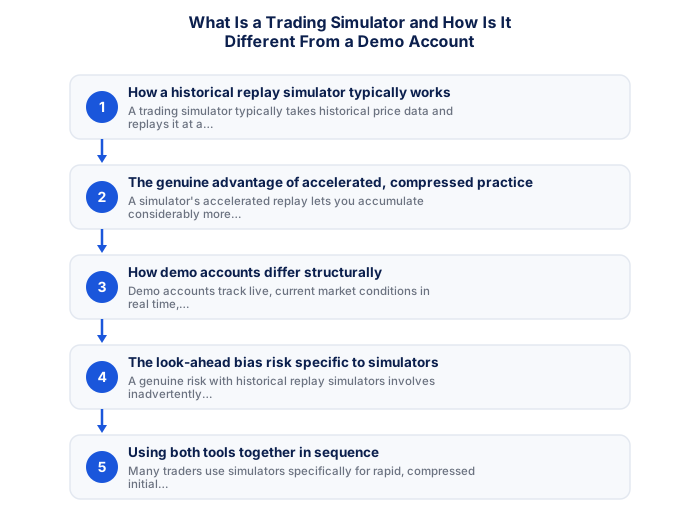
1. How a historical replay simulator typically works
A trading simulator typically takes historical price data and replays it at a chosen speed, sometimes much faster than real time, allowing you to practise making trading decisions as this historical data unfolds bar by bar, without needing to wait for genuinely real-time market movement to actually occur.
It's worth appreciating why this genuinely differs from simply reviewing historical charts afterward, replaying price action bar by bar, without seeing what happens next, forces you to make the same real-time decisions a live trader would, rather than the considerably easier task of analysing a chart you've already seen the outcome of.
2. The genuine advantage of accelerated, compressed practice
A simulator's accelerated replay lets you accumulate considerably more practice repetitions within a given amount of actual time than waiting for genuinely real-time market conditions would allow, potentially compressing some portion of the broader pattern-recognition building process.
See also: Are Free Trading Tools as Good as Paid Ones?
It's worth using this compressed timeframe deliberately to accumulate the kind of repeated, varied exposure that builds genuine pattern recognition, discussed elsewhere on this site regarding learning technical analysis, months of market conditions compressed into hours of focused practice accelerates this specific skill development considerably.
- 100+ demo trades completed with consistent rules
- Positive expectancy over full demo sample
- Every demo trade documented in journal
- Written trading plan: entry, exit, position sizing
- FSCA-regulated broker chosen and FSP verified
- Starting capital is genuinely disposable
- Backup connectivity tested
Open a demo
Choose an FSCA-regulated broker. Start with R50,000-R100,000 virtual capital.
Write trading rules
Define entry criteria, stop-loss method, and position sizing in writing.
Trade 2-3 months
Complete at least 50-100 trades across varied market conditions.
Journal everything
Record rationale, emotion, and outcome for every trade.
Evaluate objectively
Move to live only when consistent rule-following meets your benchmark.
3. How demo accounts differ structurally
Demo accounts track genuinely live, current market conditions in real time, providing practice that includes the actual current volatility, spread conditions, and genuine emotional weight of watching a real-time position develop, which a purely historical, accelerated simulator can't fully replicate.
It's worth appreciating why this structural difference matters for different learning goals, a demo account's live, real-time nature makes it better suited to practising platform mechanics and current market engagement, while a simulator's historical replay suits rapid, repeated strategy testing across varied past conditions.
4. The look-ahead bias risk specific to simulators
Similar to overfitting and look-ahead bias risks in backtesting, a genuine risk with historical replay simulators involves inadvertently knowing or half-remembering what actually happened historically during the period being replayed, subtly distorting your simulated decisions in ways that wouldn't be possible with genuinely unknown, real-time future price movement.
It's worth being genuinely disciplined about avoiding this specific pitfall, since it can undermine much of a simulator's value if not actively guarded against, consciously limiting your visible chart view to only what would have been available at that historical moment helps maintain the simulator's genuine training value.
5. Using both tools together in sequence
Many traders use simulators specifically for rapid, compressed initial practice and pattern exposure, then transition to demo trading, for the genuinely real-time, emotionally authentic practice that better prepares them for eventually trading live, treating these as complementary, sequential tools rather than substitutes for each other.
It's worth structuring your learning explicitly around this sequence, using a simulator for rapid, repeated practice across many historical scenarios before transitioning to demo trading for the genuine, real-time platform experience, gives you a more complete skill foundation than relying on either tool alone.
6. Which tool suits which stage of your learning
Simulators can be particularly useful early in your learning journey, for rapidly building foundational pattern recognition across many historical scenarios, while demo accounts become increasingly important as you approach genuine live trading readiness, since they more authentically replicate the real-time decision-making and emotional experience live trading actually involves.
The transition from demo to live trading is one of the most psychologically significant steps in a trader's development, and the gap between demo performance and early live performance is a well-documented phenomenon. The primary driver is emotional: real capital at risk changes decision-making in ways that are invisible during demo trading. Common manifestations include premature exit from winning positions to lock in profit, reluctance to enter valid setups due to fear, and difficulty accepting losses that felt mechanical on demo but feel painful with real money. The practical solution is to start live trading with an amount small enough that the monetary amounts do not produce strong emotional reactions while still requiring genuine real-money decision-making. Starting with one to three months of discretionary income is a useful benchmark for calibrating this initial live capital.
A trading simulator replays historical data, often at accelerated speed.
A demo account practises in real time with live data. A trading simulator replays historical data, often at accelerated speed, which is useful for compressing the time it takes to gain pattern recognition.
★ Why It Matters
Something worth using deliberately for a specific purpose: a historical simulator to rapidly test a strategy idea across many years of data in an afternoon, then switching to a live demo account to validate it under genuinely real-time conditions before risking actual capital, the two tools serve different stages of the same process.
✕ Common mistakes
- Using only one of these tools when both serve complementary purposes. Rapid historical testing and live-condition demo validation address different stages of development.
- Assuming simulator results transfer directly to live, real-time trading. Simulators often run at accelerated speed, which doesn't replicate live decision pressure.
- Skipping demo validation after promising simulator results. Live, real-time conditions still need separate confirmation before risking real capital.
- Treating simulator and demo testing as interchangeable rather than sequential steps. Using them in the right order, simulator first, demo second, tends to work better.
Can I practise this on a demo first?
Yes, on live prices, but execution is simulated: slippage, rejection and partial fills do not appear. Demo against live covers the gap.
How long before I take this live?
Long enough to keep a plan through a losing run without abandoning it. That is behaviour rather than a number of weeks. Demo to live covers it in full.
Key Takeaways
- Trading simulators often replay historical data for accelerated practice, while demo accounts track live, real-time market conditions as they actually unfold.
- Trading simulators often replay historical data at accelerated speed for compressed practice, while demo accounts track live, real-time market conditions.
- These serve complementary but genuinely distinct purposes.
- How a historical replay simulator typically works.
- The genuine advantage of accelerated, compressed practice.
See also: What Is a Heat Map Tool and How Do Traders Use It?.
Frequently asked follow-up questions
Are trading simulators free to use?
Some are freely available, often built into charting platforms or as standalone tools, while others may require a paid subscription depending on the specific features offered.
Can I fully skip demo trading if I've used a simulator extensively?
Demo trading's real-time, authentic practice provides distinct value a simulator can't fully replicate, making both worthwhile rather than treating one as a complete substitute for the other.
Does using a simulator guarantee faster skill development?
It can accelerate certain aspects of pattern exposure, though genuine skill development still requires the same disciplined practice and honest reflection as any broader education effort.
