Home โ€บ Beginners Glossary โ€บ What Does the Term Base Currency Mean for My Trading Account?

What Does the Term Base Currency Mean for My Trading Account?

i Short answer

Your account's base currency is the denomination your balance and profit or loss figures are displayed in.

This is distinct from the base currency within any specific currency pair you might be trading.

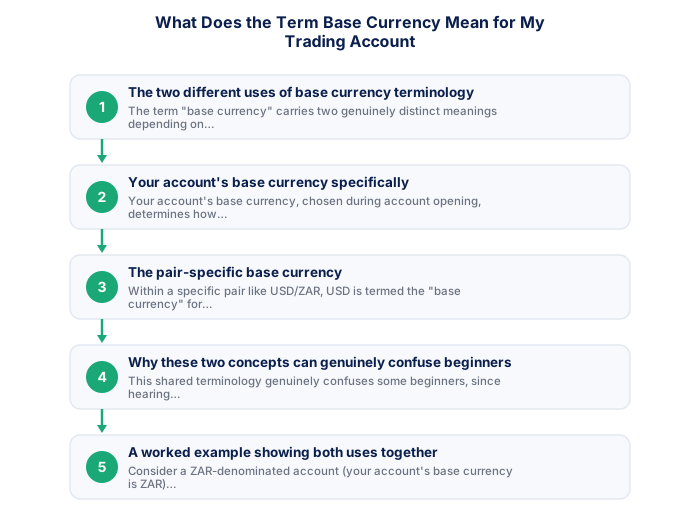
1. The two different uses of base currency terminology

The term "base currency" carries two genuinely distinct meanings depending on context: your account's base currency, the denomination your overall balance is held and displayed in, and the base currency within a specific currency pair notation, referring to the first-listed currency in that pair's name.

!
Do not deposit before FICA verification is complete

Depositing before verification risks funds being frozen if verification fails. Complete all document submission and wait for account activation before making your first deposit.

ZA
FICA requirement: FSCA-regulated brokers must verify your identity under the Financial Intelligence Centre Act. Prepare SA ID, recent proof of address, and bank statement before applying.

2. Your account's base currency specifically

Your account's base currency, chosen during account opening, determines how your overall balance, equity, and profit or loss are displayed and calculated. For South African traders this is commonly ZAR, though some brokers also offer USD or other currency options.

When evaluating brokers operating in South Africa, the FSCA register is the definitive verification resource. Checking not only that a broker is listed but also that their specific scope of authorisation covers the instruments and services you intend to use is an important step that many traders skip. The FSCA also publishes enforcement actions and consumer warnings on its website, which are worth reviewing for any broker you are considering.

Account Opening Document Checklist
  • South African ID or valid passport
  • Proof of residential address dated within 3 months
  • Proof of bank account ownership
  • Selfie or photo for biometric verification (some brokers)
  • Source of funds declaration if depositing above threshold
Day 1
Choose FSCA-regulated broker. Verify FSP number at fsca.co.za.
Day 1-2
Submit online application with FICA documents.
Day 2-4
FICA verification completed. Account activated.
Day 3-5
First EFT deposit reflects in trading account.
Day 4+
Open demo. Practise platform before live trades.
Week 2+
Place first live trades when platform and strategy are confirmed.
1

Choose FSCA-regulated broker

Verify the FSP number is current at fsca.co.za.

2

Submit FICA documents

SA ID, proof of address within 3 months, bank account proof.

3

Fund via EFT

Make the initial deposit from your SA bank account in ZAR.

4

Open demo account first

Practice on demo before activating your live account.

5

Start with minimum capital

Begin with an amount you can afford to lose while learning.

3. The pair-specific base currency

Within a specific pair like USD/ZAR, USD is termed the "base currency" for that pair's specific notation purposes, completely independent of whatever currency your own account happens to be denominated in. These two uses of identical terminology address genuinely different things.

1-3 daysFICA verification timeline
3 monthsmax age for address proof
18 yearsminimum age for SA trading account
R0cost to open a demo account
DODON'T
Verify FSCA FSP number at fsca.co.za before depositing
Trust marketing alone, always verify the register
Keep personal records of all deposits and withdrawals
Rely only on the broker's records for compliance and tax
Enable two-factor authentication immediately
Use the same password across trading and email accounts
Open a demo account before depositing live capital
Skip demo and go straight to a live funded account

4. Why these two concepts can genuinely confuse beginners

This shared terminology genuinely confuses some beginners, since hearing "base currency" without clear context leaves ambiguous which specific meaning is intended, clarifying which usage applies in any specific discussion, by checking whether the conversation concerns your overall account or a specific currency pair's quote notation, resolves this ambiguity.

Common FICA Rejection Reasons
Rejection reasonFix
Address proof older than 3 monthsGet a recent utility bill or bank statement
Name mismatch between documentsUse documents with exactly matching full name
Poor quality scanRetake with good lighting, all corners visible
PO Box addressBrokers require physical residential address only

5. A worked example showing both uses together

Consider a ZAR-denominated account (your account's base currency is ZAR) trading USD/ZAR (where USD is that specific pair's base currency), your trading profit or loss on this position ultimately displays in ZAR, your account's base currency, even though the pair itself uses USD as its own, separate base currency for quote notation purposes.

6. Checking your own account's specific currency

Your account's base currency is typically displayed clearly within your platform's account summary or settings, giving a definitive, direct way to confirm which currency your own overall balance and results are actually denominated in.

South African traders have a natural advantage when analysing ZAR-denominated instruments because they observe the domestic drivers of rand movements directly and continuously. The key analytical discipline is separating USD/ZAR movements that are driven by global USD strength from those driven by SA-specific factors. When the rand is weakening at the same time as other major EM currencies, the driver is typically global risk appetite, not a SA-specific issue. When the rand is weakening while EM peers are stable or strengthening, a domestic SA factor is at work and requires a different analytical and positioning response.

For South African traders operating within the FSCA-regulated environment, the combination of clear regulatory oversight, ZAR account access, and the unique analytical opportunities provided by rand-specific market drivers creates a well-structured foundation for developing a professional trading practice. The key to converting this foundation into consistent results is not finding the perfect strategy or the perfect instrument but developing the discipline to execute a sound strategy consistently across a large enough sample of trades to allow the strategy's statistical edge to express itself.

South African traders who maintain a weekly review routine, checking the SARB economic calendar for the coming week, reviewing the Eskom load shedding schedule, assessing the current GNU coalition stability backdrop, and marking key support and resistance levels on the instruments they trade, consistently outperform traders who approach each session without any structured preparation. This weekly routine takes 30 to 45 minutes and produces a clearer analytical framework that reduces impulsive decisions and improves the quality of trade selection throughout the week.

Opening a trading account with an FSCA-regulated broker involves a FICA verification process that provides meaningful protection for the broader financial system as well as the individual trader. The documentation requirements under the Financial Intelligence Centre Act require financial services providers to verify client identity and source of funds as part of South Africa's anti-money-laundering framework. Most brokers complete this process within one to three business days for straightforward applications. The most common source of delays is submitting proof of address documents that are older than three months or that do not exactly match the name on the identity document. Reviewing your documentation for these potential issues before submission typically produces a smoother process and faster account activation, allowing you to move more quickly from application to live trading.

Opening a trading account with an FSCA-regulated broker involves a FICA verification process that provides meaningful protection for the broader financial system as well as the individual trader. The documentation requirements under the Financial Intelligence Centre Act require financial services providers to verify client identity and source of funds as part of South Africa's anti-money-laundering framework. Most brokers complete this process within one to three business days for straightforward applications. The most common source of delays is submitting proof of address documents that are older than three months or that do not exactly match the name on the identity document. Reviewing your documentation for these potential issues before submission typically produces a smoother process and faster account activation, allowing you to move more quickly from application to live trading.

โ˜… Why It Matters

Worth double-checking: confirm whether your broker's stated leverage limits apply per account in your base currency or get recalculated per trade based on the instrument's own currency. This detail occasionally affects your real maximum position size in ways the headline leverage figure doesn't make obvious.

Account base currency versus pair base currency
Account base currency
Pair base currency
Whatitis
Currency of your account
First currency in a pair
Example account
ZAR account
EUR in EUR/USD
Profitvloss expressed in
Your account currency
NIA
Conversion triggered when
Trading non-account-currency instruments
NIA
Common confusion
N/A
Same term, different meaning in context
Account base currency is the currency your balance is held in.
Pair base currency is the first currency listed in the pair, unrelated.

Account base currency refers to the currency your trading balance is held in. The base currency of a pair refers to the first listed currency in that pair, a related but distinct concept.

โœ• Common mistakes

  • Confusing your account's base currency with a currency pair's base currency. These are related but genuinely separate concepts.
  • Choosing an account currency without considering your income currency. A mismatch adds ongoing conversion friction.
  • Assuming this setting can be easily changed later. Most brokers treat it as fixed at account opening.
How long does account verification take at most South African brokers?

Most FSCA-regulated brokers complete identity verification within one to three business days when all required documents are submitted correctly. Electronic document submission often accelerates the process.

What documents do I need to open a trading account in South Africa?

You typically need a South African ID or passport, proof of residential address dated within three months, and proof of bank account ownership. Some brokers require additional documentation for higher deposit tiers.

South African traders who approach their trading activity with the same rigour they would apply to any skilled professional discipline typically develop more durable results than those who treat trading as primarily intuitive. This means maintaining written records of every trade and its rationale, reviewing performance at regular intervals with specific metrics rather than general impressions, and updating trading rules based on evidence from actual performance rather than from theory alone. The structured approach separates traders who improve continuously from those who repeat the same errors across extended periods without identifying the underlying cause.

South African traders have a natural analytical advantage on rand-paired currencies because they observe the domestic drivers of ZAR directly and continuously. The technical relationships between major currency pairs and the USD/ZAR, particularly the negative correlation between USD/ZAR and risk-on periods, become more predictable once you understand which component of USD/ZAR movement is driven by global USD strength and which is driven by SA-specific fundamental factors. Building this analytical separation into your daily market review produces more precise ZAR trading hypotheses than treating USD/ZAR as a single undifferentiated signal.

Understanding how South African market conditions differ from the global trading environment covered in most textbooks gives local traders a genuine analytical edge. The JSE's resources weighting, the rand's dual sensitivity to global EM flows and domestic fundamentals, and the specific calendar of SA market events, SARB MPC dates, budget speeches, credit rating reviews, create a richer analytical environment than pure technical analysis alone captures. Building awareness of these SA-specific layers alongside standard trading principles produces more sound analysis for ZAR instruments and JSE-listed products.

Key Takeaways

  1. Your account's base currency is the denomination your balance and profit or loss are displayed in, distinct from the base currency within any specific pair.
  2. Your account's base currency is the denomination your balance and profit or loss figures are displayed in.
  3. This is distinct from the base currency within any specific currency pair you might be trading.
  4. The two different uses of base currency terminology.
  5. Your account's base currency specifically.

Frequently asked follow-up questions

Can my account's base currency differ from the pairs I trade?

Yes, this is common. You can hold a ZAR-denominated account while trading pairs involving entirely different currencies, with conversion applied automatically.

Does changing my account's base currency require opening a new account?

Generally yes, most brokers treat this setting as fixed once your account is opened.

Is there a standard default base currency most South African traders use?

ZAR is commonly chosen by South African traders, though USD and other options are sometimes also available depending on your specific broker.

๐Ÿ“š Sources & further reading

This article draws on general information published by the South African regulators and established financial education resources listed below. Always check each source directly for the most current detail.

Explore more South African trading guides on TradeAnswers.

๐Ÿ›ก๏ธ
Practice without risk

Turn This Definition Into Practice

Now that you know the term, see it play out on real charts. Practice on a free demo account with zero risk.

Start Practising Free
  • FSCA RegulatedTrade with confidence
  • Practice Risk FreeReal market conditions
  • Beginner FriendlyPerfect for learning

79% of retail CFD accounts lose money. Demo accounts do not guarantee future profits.