i Short answer
The Information Regulator enforces POPIA compliance across South African organisations, including brokers handling your account data.
It provides an avenue for complaints about how your information is processed.
📋 ON THIS PAGE
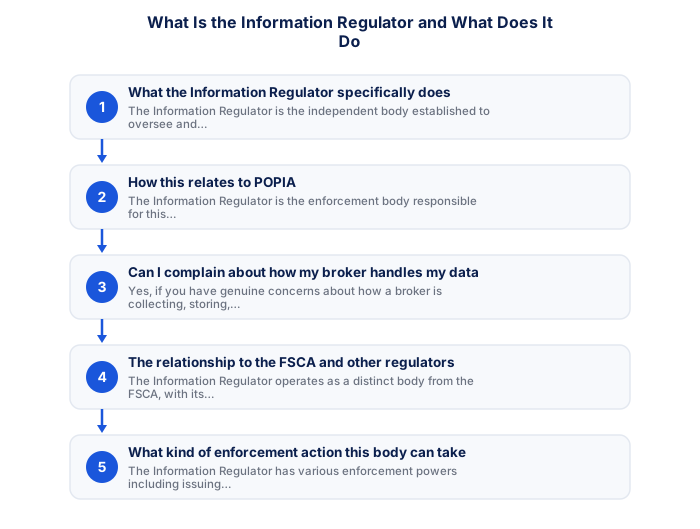
1. What the Information Regulator specifically does
The Information Regulator is the independent body established to oversee and enforce compliance with South Africa's data protection legislation, monitoring how organisations, including financial services providers, collect, process, and protect personal information.
It's worth understanding this as the enforcing body behind POPIA, discussed elsewhere on this site regarding your trading data protections specifically, similar to how the FSCA enforces FAIS, this Regulator exists specifically to give POPIA's protections genuine, practical teeth.
See also: What Does Pending Order Mean in Trading?
See also: What Is the FAIS Act and How Does It Relate to Trading?
2. How this relates to POPIA
The Information Regulator is the enforcement body responsible for POPIA, similar in structural relationship to how the FSCA enforces the broader financial conduct framework.
It's worth keeping this relationship clear, POPIA is the legislation setting out your data protection rights, while the Information Regulator is the institution responsible for enforcing those rights, two related but distinct pieces of the same overall protective framework.
- FSCA-regulated broker verified at fsca.co.za
- Demo account tested for minimum 60 days
- Trading plan written: entry, exits, position sizing
- Risk per trade defined (1-2% of account)
- Backup internet connection tested for load shedding
- Tax implications understood
3. Can I complain about how my broker handles my data
Yes, if you have genuine concerns about how a broker is collecting, storing, or sharing your personal information, related to FICA verification requirements specifically, you can lodge a complaint with the Information Regulator, which has authority to investigate this kind of data protection concern.
It's worth documenting your specific concern clearly before lodging any complaint, having concrete details about exactly how you believe your data was mishandled makes any complaint to this body considerably more actionable.
4. The relationship to the FSCA and other regulators
The Information Regulator operates as a distinct body from the FSCA, with its own specific mandate focused on data protection rather than broader financial conduct regulation. A broker's compliance failures could theoretically involve both regulatory frameworks simultaneously, depending on the specific nature of the issue.
It's worth appreciating why South Africa maintains these separate, specialised regulatory bodies rather than one single, all-purpose regulator, discussed elsewhere on this site regarding the broader regulatory environment, each body brings focused expertise to its particular area of oversight.
| Item | Detail |
|---|---|
| Regulator | FSCA, fsca.co.za |
| Exchange control | SARB, resbank.co.za |
| Tax authority | SARS, sars.gov.za |
| JSE hours | 09:00-17:00 SAST Mon-Fri |
| Best forex session | 15:00-17:00 SAST |
| CGT annual exclusion | R50,000 (individuals) |
5. What kind of enforcement action this body can take
The Information Regulator has various enforcement powers including issuing compliance notices, conducting investigations, and in serious cases, imposing penalties for genuine, sustained POPIA non-compliance, similar in broader spirit to the FSCA's own enforcement powers.
It's worth understanding this body's genuine enforcement authority as a meaningful protection, not merely a symbolic body, worth appreciating this as another concrete layer of accountability alongside the FSCA and other regulatory bodies discussed throughout this site.
6. Practical steps if you have a genuine data concern
If you have a specific concern about your data handling, raising this directly with your broker first, and escalating to the Information Regulator if this doesn't resolve the matter satisfactorily, is a sensible approach.
If a dispute with the FSCA itself arises, for example over a licensing decision, the Financial Services Tribunal exists as an independent body where such decisions can be formally appealed, separate from the broker complaints process.
The FSCA handles financial conduct complaints under the FAIS Act.
The Information Regulator enforces POPIA and handles complaints about data handling. The FSCA enforces financial conduct under the FAIS Act. A broker data breach is for the Information Regulator, not the FSCA.
The difference between traders who improve systematically and those who plateau for extended periods is typically not natural talent or market insight but the quality of their record-keeping and review process. Traders who maintain a detailed journal, review every trade against their original rationale, and update their trading plan based on accumulated evidence rather than gut feeling develop a feedback loop that continuously improves their decision quality. This structured approach is available to every trader regardless of experience level and costs nothing except the discipline to apply it consistently.
★ Why It Matters
Worth knowing: the Information Regulator's enforcement powers and public guidance have expanded meaningfully since POPIA's compliance deadline passed, worth checking their published guidance directly if you have a specific data-handling concern, rather than relying on older general summaries.
✕ Common mistakes
- Not checking current guidance when a specific data-handling concern arises. Direct, current sources are more reliable than general secondhand summaries.
- Assuming this body's role is identical to the FIC's or FSCA's. It addresses data protection specifically, a distinct regulatory function.
- Treating the Regulator's existence as sufficient without understanding how to actually file a concern. Knowing the practical process matters more than awareness alone.
Key Takeaways
- The Information Regulator enforces POPIA compliance across South African organisations, including the brokers handling your personal trading account data.
- The Information Regulator enforces POPIA compliance across South African organisations, including brokers handling your account data.
- It provides an avenue for complaints about how your information is processed.
- What the Information Regulator specifically does.
- How this relates to POPIA.
Frequently asked follow-up questions
Is the Information Regulator the same as the FSCA?
No, these are distinct bodies with different mandates. The Information Regulator focuses specifically on data protection, while the FSCA regulates broader financial conduct.
Does every broker need to register with the Information Regulator?
Specific registration requirements depend on the nature and scale of data processing involved. Checking current Information Regulator guidance gives the most accurate, current detail.
Can I request my broker delete my data through this regulator?
You can lodge a complaint if your broker doesn't appropriately respond to a legitimate data request, though direct requests to your broker remain the appropriate first step.
How long does an Information Regulator investigation typically take?
This varies considerably by case complexity. Checking directly with the regulator gives the most accurate expectation for your specific situation.
Does this regulator only handle South African companies?
Its enforcement focus is on organisations processing data within South African jurisdiction, which can include international companies serving South African clients depending on the specific circumstances.
