i Short answer
The Companies Act governs how South African companies are structured, managed, and held accountable generally.
It forms a baseline corporate governance framework alongside specific financial services regulation like the FSCA and FAIS.
📋 ON THIS PAGE
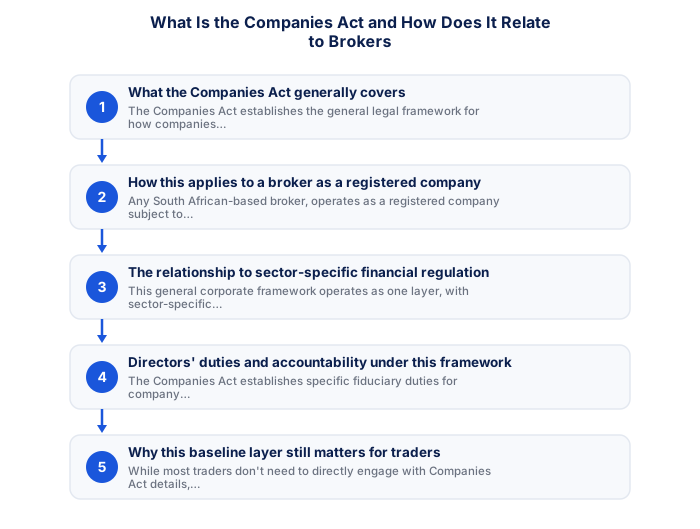
1. What the Companies Act generally covers
The Companies Act establishes the general legal framework for how companies are formed, governed, and wound up in South Africa, covering matters including company registration, directors' duties, shareholder rights, and financial reporting requirements applicable broadly across virtually all registered South African companies, regardless of their specific industry.
It's worth understanding this as the foundational, general-purpose corporate law that applies to virtually every registered South African company, regardless of industry, providing the baseline legal structure that sector-specific regulation like FSCA oversight, discussed throughout this site, then builds upon.
2. How this applies to a broker as a registered company
Any South African-based broker, operates as a registered company subject to this general framework, meaning it must meet the same baseline corporate governance and accountability standards applicable to companies generally, separate from but alongside the specific financial services regulation.
It's worth appreciating this layered structure, a broker operating in South Africa is genuinely subject to both this general corporate framework and the specific, additional financial services regulation discussed elsewhere on this site, not one or the other.
- FSCA-regulated broker verified at fsca.co.za
- Demo account tested for minimum 60 days
- Trading plan written: entry, exits, position sizing
- Risk per trade defined (1-2% of account)
- Backup internet connection tested for load shedding
- Tax implications understood
3. The relationship to sector-specific financial regulation
This general corporate framework operates as one layer, with sector-specific financial services regulation, providing an additional, more specific regulatory layer particular to financial services providers, a broker therefore needs to comply with both layers simultaneously.
It's worth understanding why this layered approach makes regulatory sense, the Companies Act addresses genuinely universal corporate governance concerns applicable to any company, while FSCA-specific regulation addresses the particular risks and protections relevant specifically to financial services activity.
4. Directors' duties and accountability under this framework
The Companies Act establishes specific fiduciary duties for company directors, requiring them to act in the company's best interests and with appropriate care and skill, this general accountability framework provides one layer of protection relevant to a broker's overall corporate governance, complementing the more specific client-protection obligations.
It's worth appreciating this as one further, if less visible, layer of accountability, directors of a properly registered broker carry genuine legal obligations under this framework, worth understanding as part of the broader accountability structure surrounding regulated financial companies.
| Item | Detail |
|---|---|
| Regulator | FSCA, fsca.co.za |
| Exchange control | SARB, resbank.co.za |
| Tax authority | SARS, sars.gov.za |
| JSE hours | 09:00-17:00 SAST Mon-Fri |
| Best forex session | 15:00-17:00 SAST |
| CGT annual exclusion | R50,000 (individuals) |
5. Why this baseline layer still matters for traders
While most traders don't need to directly engage with Companies Act details, this baseline corporate accountability framework contributes to the overall legitimacy and proper functioning of any South African-registered broker, working alongside the more directly client-relevant FSCA and FAIS regulation.
It's worth appreciating why this baseline corporate legitimacy matters even though it operates somewhat in the background, a broker's proper company registration provides a foundational layer of legal accountability that exists independently of, and alongside, the more directly visible FSCA licensing discussed throughout this site.
6. Checking a broker's company registration
South African company registration details are publicly searchable through the Companies and Intellectual Property Commission (CIPC), providing an additional, independent way to verify a broker's genuine corporate existence and registration status, complementing the FSCA licence verification as a further due-diligence step.
If a dispute with the FSCA itself arises, for example over a licensing decision, the Financial Services Tribunal exists as an independent body where such decisions can be formally appealed, separate from the broker complaints process.
The Companies Act governs corporate formation and internal governance.
The FAIS Act is the most directly relevant legislation for traders, governing how brokers must conduct themselves and requiring FSP licensing. The Companies Act governs internal corporate governance and is background context.
★ Why It Matters
Worth checking: a broker's company registration details on CIPC (the Companies and Intellectual Property Commission). Cross-referencing this against their FSCA licence details is a quick, independent way to confirm the legal entity you're dealing with is consistent across both registers.
✕ Common mistakes
- Assuming this Act alone fully covers financial services regulation. It forms a baseline corporate governance framework alongside, not instead of, FSCA and FAIS regulation.
- Treating Companies Act compliance as equivalent to financial services licensing. These address genuinely different aspects of a company's legal standing.
- Ignoring this register entirely when conducting due diligence on a broker. It's a useful, independent additional verification step.
Key Takeaways
- The Companies Act governs how South African companies are structured and run, forming a baseline corporate framework alongside specific FSCA financial regulation.
- The Companies Act governs how South African companies are structured, managed, and held accountable generally.
- It forms a baseline corporate governance framework alongside specific financial services regulation like the FSCA and FAIS.
- What the Companies Act generally covers.
- How this applies to a broker as a registered company.
See also: Is AvaTrade Regulated by the FSCA in South Africa?.
Frequently asked follow-up questions
Does the Companies Act apply to international brokers serving South Africans?
This specifically applies to South African-registered companies. International brokers would be subject to their own jurisdiction's equivalent corporate framework instead.
Can I check a broker's company details through CIPC myself?
Yes, CIPC maintains a publicly searchable register, providing independent verification of a South African company's registration status.
Does Companies Act compliance guarantee a broker treats clients fairly?
No, this addresses general corporate governance rather than client-specific conduct, which the FSCA and FAIS framework more directly addresses.
What's the difference between a company's CIPC registration number and its FSP number?
The CIPC number identifies the company as a registered legal entity generally, while the FSP number specifically confirms its FSCA authorisation to provide financial services.
Can director misconduct under the Companies Act lead to personal liability for a broker's directors?
Yes, in certain circumstances directors can face personal liability for breaching their fiduciary duties, though this is a separate legal question from the broker's own FSCA-regulated conduct toward clients.
