i Short answer
Honestly assessing your available time, financial goals, and genuine interest level helps clarify whether trading fits better as a casual hobby or a more serious pursuit.
📋 ON THIS PAGE
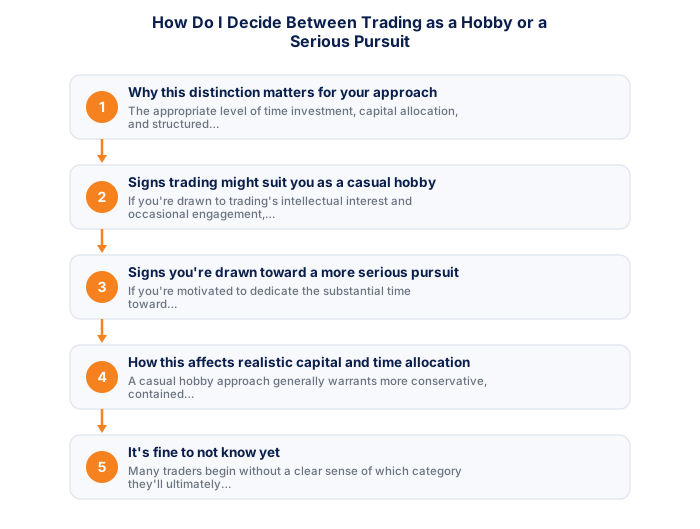
1. Why this distinction genuinely matters for your approach
The appropriate level of time investment, capital allocation, and structured learning differs depending on whether you're approaching trading as a casual, contained interest or a more serious pursuit you're committed to developing skill within over an extended period.
It's worth being explicit with yourself about which category genuinely describes your current situation, rather than leaving it vague, since an unclear sense of your own commitment level tends to produce a mismatched approach, either over-investing time and capital into what's genuinely meant to be a casual interest, or under-committing to something you actually want to pursue seriously.
2. Signs trading might suit you as a casual hobby
If you're drawn to trading's intellectual interest and occasional engagement, without wanting to dedicate substantial regular time or build toward significant financial outcomes through it specifically, a more casual, contained approach, smaller capital allocation, simpler strategies, less intensive routine, may genuinely suit your actual interests and circumstances better.
There's nothing lesser about this category worth feeling any need to justify or apologise for, a genuinely contained, hobby-level engagement with trading, approached honestly and with appropriate, modest capital, is a perfectly reasonable way to enjoy the intellectual interest markets offer without needing to frame it as a path toward significant income.
- FSCA-regulated broker verified at fsca.co.za
- Demo account tested for minimum 60 days
- Trading plan written: entry, exits, position sizing
- Risk per trade defined (1-2% of account)
- Backup internet connection tested for load shedding
- Tax implications understood
3. Signs you're drawn toward a more serious pursuit
If you're genuinely motivated to dedicate the substantial time toward developing real skill, interested in eventually generating meaningful supplementary or even primary income through trading, and willing to commit to the disciplined practice this requires, a more serious, structured approach fits your actual goals better.
It's worth being honest with yourself about whether this motivation is genuinely sustained, rather than simply an enthusiastic initial impulse, since the sustainability discussed elsewhere on this site depends on this deeper commitment actually holding up over the months of disciplined practice a serious pursuit genuinely requires.
4. How this affects realistic capital and time allocation
A casual hobby approach generally warrants more conservative, contained capital allocation and time investment, while a serious pursuit might justify, over time and once genuinely validated, somewhat greater allocation, though the discretionary capital principleescribes your approach.
It's worth revisiting your capital allocation specifically whenever your sense of which category you fall into shifts, rather than leaving an initial allocation decision fixed indefinitely regardless of how your actual engagement and results have since evolved.
| Item | Detail |
|---|---|
| Regulator | FSCA, fsca.co.za |
| Exchange control | SARB, resbank.co.za |
| Tax authority | SARS, sars.gov.za |
| JSE hours | 09:00-17:00 SAST Mon-Fri |
| Best forex session | 15:00-17:00 SAST |
| CGT annual exclusion | R50,000 (individuals) |
5. It's fine to genuinely not know yet
Many traders begin without a clear sense of which category they'll ultimately fall into, discovering their genuine level of interest and aptitude only through actual experience, starting cautiously, with modest, contained expectations, while remaining open to either outcome as genuine experience develops, is a perfectly reasonable starting position.
This uncertainty is worth treating as a genuinely normal, appropriate starting point rather than a problem requiring immediate resolution, giving yourself explicit permission to discover your own answer through actual, cautious experience tends to produce a more honest, better-informed eventual decision than forcing a premature commitment either way.
6. Revisiting this decision as your experience develops
Periodically revisiting this question as you accumulate genuine trading experience, rather than assuming your initial framing remains permanently fixed, allows your approach to evolve naturally based on your actual, demonstrated interest and results, rather than an early assumption that may no longer reflect your genuine, current relationship with trading.
A serious pursuit suits substantial, structured commitment.
A hobby approach suits occasional engagement with conservative capital allocation. A serious pursuit calls for substantial time investment and a deliberate learning structure.
★ Why It Matters
One honest test worth applying to yourself: would you keep doing the unglamorous parts, journaling every trade, reviewing losses in detail, if there were no possibility of ever making money from it, the answer tends to reveal more about genuine interest than any stated financial goal.
✕ Common mistakes
- Deciding based on early profit rather than genuine interest. Early profit is a weak predictor of long-term commitment.
- Avoiding the unglamorous parts like journaling and review. Willingness to do these tasks reveals more than stated goals.
- Assuming the decision is permanent and can't be revisited. Many traders shift between hobby and serious approaches over time.
- Not being honest about available time before committing either way. Mismatched time expectations undermine either approach.
Key Takeaways
- Honestly assessing your available time, financial goals, and genuine interest level helps clarify whether trading fits better as a casual hobby or serious pursuit.
- Honestly assessing your available time, financial goals, and genuine interest level helps clarify whether trading fits better as a casual hobby or a more serious pursuit.
- Why this distinction genuinely matters for your approach.
- Signs trading might suit you as a casual hobby.
- Signs you're drawn toward a more serious pursuit.
See also: How Much Time Does Trading Actually Require? and How Do I Build a Personal Trading Curriculum?.
Frequently asked follow-up questions
Can a hobby trader eventually become a serious one?
Yes, this transition happens naturally for some traders as genuine interest and demonstrated results develop over time.
Does casual trading mean I shouldn't bother learning proper risk management?
No, foundational risk management and discipline remain important regardless of how seriously you're pursuing trading overall.
Is there anything wrong with staying a casual hobby trader indefinitely?
Not at all; this represents a perfectly legitimate, sustainable approach for many people, provided expectations and capital allocation remain appropriately calibrated to this contained level of engagement.
