i Short answer
Realistic time commitment, regular breaks, and process-focused goals rather than purely outcome-driven pressure support a sustainable trading habit and help avoid burnout.
📋 ON THIS PAGE
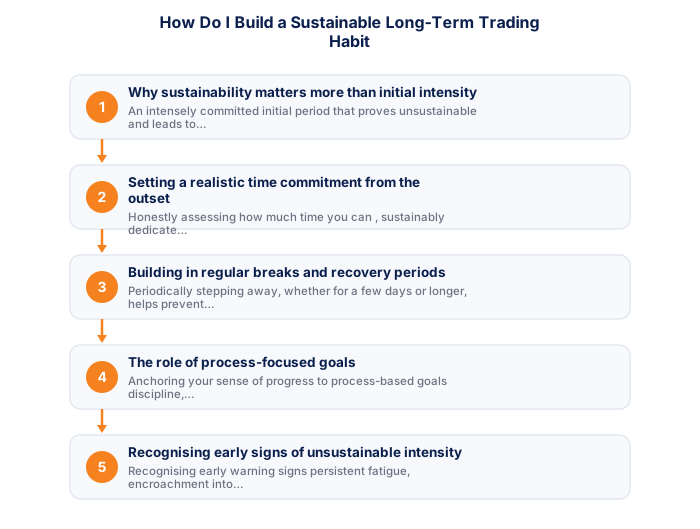
- Why sustainability matters more than initial intensity
- Setting a realistic time commitment from the outset
- Building in regular breaks and recovery periods
- The role of process-focused goals
- Recognising early signs of unsustainable intensity
- Adjusting your approach as life circumstances change
- Building a routine around a market calendar
1. Why sustainability matters more than initial intensity
As, an intensely committed initial period that proves unsustainable and leads to eventually abandoning trading altogether typically produces worse long-term outcomes than a more modest, but genuinely sustained, ongoing commitment maintained consistently over a considerably longer period.
It's worth recognising this pattern as a genuinely common trap rather than a personal failing if it describes your own experience, the initial enthusiasm that drives an intense early commitment is a natural, human response, the skill worth developing is noticing when that intensity starts becoming unsustainable and adjusting deliberately, rather than either forcing it to continue or abandoning trading altogether once it inevitably wanes.
2. Setting a genuinely realistic time commitment from the outset
Honestly assessing how much time you can , sustainably dedicate given your other life commitments, and building your trading approach around this realistic figure rather than an aspirational but unsustainable ideal, supports genuine longevity.
It's worth writing this realistic figure down explicitly and treating it as a genuine constraint on your trading style choice, discussed elsewhere on this site, rather than an aspiration to gradually work toward, a trading approach built around your actual available time from the start tends to prove more durable than one requiring you to somehow find additional time you don't currently have.
- FSCA-regulated broker verified at fsca.co.za
- Demo account tested for minimum 60 days
- Trading plan written: entry, exits, position sizing
- Risk per trade defined (1-2% of account)
- Backup internet connection tested for load shedding
- Tax implications understood
3. Building in regular breaks and recovery periods
Periodically stepping away, whether for a few days or longer, helps prevent the kind of cumulative fatigue and burnout that can otherwise develop from sustained, uninterrupted engagement over an extended period.
It's worth scheduling these breaks proactively rather than waiting until burnout has already set in to take one, a planned, deliberate pause taken while you're still functioning well tends to be shorter and more genuinely restorative than a forced break taken only after sustained fatigue has already accumulated significantly.
4. The role of process-focused goals
Anchoring your sense of progress to process-based goals, discipline, criteria adherence, honest journaling, rather than purely financial outcomes, supports more sustainable motivation than an approach entirely dependent on consistently favourable financial results.
This shift is worth practising deliberately if outcome-focused thinking currently dominates your own sense of progress, specifically reviewing your trading journal for evidence of consistent process adherence, rather than purely scanning for profit and loss figures, helps retrain your own sense of what 'a good trading day' actually means.
| Item | Detail |
|---|---|
| Regulator | FSCA, fsca.co.za |
| Exchange control | SARB, resbank.co.za |
| Tax authority | SARS, sars.gov.za |
| JSE hours | 09:00-17:00 SAST Mon-Fri |
| Best forex session | 15:00-17:00 SAST |
| CGT annual exclusion | R50,000 (individuals) |
5. Recognising early signs of unsustainable intensity
Recognising early warning signs, persistent fatigue, encroachment into family or rest time, declining enjoyment of the activity itself, before these patterns become deeply entrenched supports earlier, more effective adjustment than waiting until genuine burnout has already developed.
It's worth checking in with yourself honestly on a regular schedule specifically for these signs, rather than waiting for them to become obvious enough to notice without deliberate reflection, a brief, periodic self-check catches drift considerably earlier than relying on the problem eventually becoming impossible to ignore.
6. Adjusting your approach as life circumstances change
Periodically revisiting and adjusting your time commitment and overall approach as your broader life circumstances evolve, rather than rigidly maintaining an initial plan regardless of changing context, supports genuine, lasting sustainability over your trading journey's full extended timeline.
A realistic, honestly assessed pace holds up better over time.
An intensely committed initial period that proves unsustainable tends to lead to burnout. Honestly assessing a sustainable pace, with periodic breaks, holds up better over the long run.
★ Why It Matters
Something that correlates with longevity in the traders we've followed: a fixed, non-negotiable stopping time for each session, open-ended sessions that 'end whenever' tend to drift into fatigue-driven decisions in the final 30-60 minutes.
✕ Common mistakes
- Treating burnout symptoms as something to push through. Sustainable habits require recognising and responding to early warning signs.
- Skipping regular breaks because things are going well. Consistency, not intensity, tends to predict long-term sustainability.
- Not building in any recurring review of your own habits. Habits drift without periodic, deliberate reassessment.
Key Takeaways
- Realistic time commitment, regular breaks, and process-focused goals support a sustainable trading habit avoiding the burnout that overly intense approaches risk.
- Realistic time commitment, regular breaks, and process-focused goals rather than purely outcome-driven pressure support a sustainable trading habit and help avoid burnout.
- Why sustainability matters more than initial intensity.
- Setting a genuinely realistic time commitment from the outset.
- Building in regular breaks and recovery periods.
Building a routine around a market calendar
Habits hold better when they attach to something external rather than to willpower, and a trading calendar supplies exactly that structure.
South Africa has a predictable rhythm of scheduled events. The Monetary Policy Committee meets roughly every second month, with the final 2026 statement on 19 November. Statistics South Africa publishes consumer inflation in the third week of each month, gross domestic product quarterly, and the labour force survey quarterly. The National Budget lands in February and the medium term statement in November.
Anchoring a review routine to those dates turns an open-ended intention into a calendar entry. A monthly review in the week after the inflation print, a quarterly review after the GDP release, and a plan review before each MPC meeting gives four to six fixed points a year that do not depend on remembering.
The same structure helps with the harder habit, which is not trading. Deciding in advance that you do not open new positions in the hours around a scheduled release removes a category of impulsive decision without requiring any judgement in the moment.
The 2026 rate cycle is a reasonable illustration of why this matters. The Reserve Bank held in July on a split vote and then raised to 7.25% in September on a unanimous one. Someone who had already decided how they behave around MPC dates handled both without needing a view on which way the committee would go.
| Recurring event | Roughly when |
|---|---|
| SARB MPC statement | Every second month, next 19 November 2026 |
| Consumer inflation | Third week, monthly |
| GDP | Quarterly |
| Unemployment, QLFS | Quarterly |
| National Budget | February |
| Medium term statement | November |
See also: How Much Time Does Trading Actually Require?.
Frequently asked follow-up questions
Is it normal for trading intensity to fluctuate over time?
Yes, this is common and reasonable; the key is recognising and adjusting to genuinely unsustainable patterns, rather than ignoring them indefinitely.
Should I set a fixed schedule or remain flexible?
A predictable routine, generally supports discipline, though building in genuine flexibility for life's natural variability also supports long-term sustainability.
Does taking breaks ever hurt long-term skill development?
Generally not significantly, long-term engagement typically outweighs any modest pause's effect.
