What this page covers
Quick answer: Ceasing South African tax residency changes your banking, your tax and how money leaves the country. Key figures: on ceasing residency Exit tax; RA lock after ceasing 3 years; allowances after ceasing None; emigration route replaced 2023. Figures current at 19 November 2026, from South African Revenue Service, tax residency.
Ceasing South African tax residency changes your banking, your tax and how money leaves the country. The old financial emigration route no longer exists as a separate process.
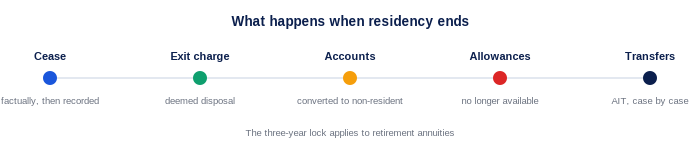
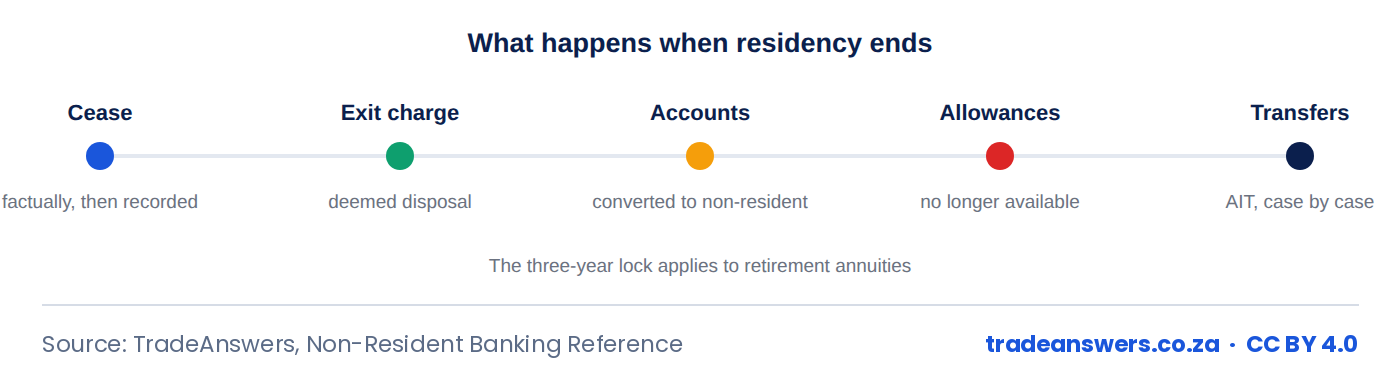
⬇ Download this chart (PNG) · Free to reuse with the credit “Source: TradeAnswers, Non-Resident Bank Accounts After Leaving South Africa” (CC BY 4.0).
| Item | While resident | After ceasing residency |
|---|---|---|
| Tax on worldwide income | Yes | No, South African source only |
| Single discretionary allowance | R2 million a year | Not available |
| Foreign investment allowance | R10 million a year with AIT | Not available |
| Bank accounts | Resident accounts | Converted to non-resident accounts |
| Transferring funds out | Under the allowances | AIT TCS PIN, case by case |
| Exit tax | Not applicable | Deemed disposal of worldwide assets |
Source: TradeAnswers, Non-Resident Bank Accounts After Leaving South Africa. Free to reuse with attribution (CC BY 4.0).
| Item | Rule |
|---|---|
| What triggers it | Ceasing to be a South African tax resident |
| What it taxes | A deemed disposal of worldwide assets at market value |
| What is excluded | South African immovable property, and some retirement interests |
| Rate | Capital gains tax at your applicable inclusion rate |
| When payable | In the year residency ceases |
TradeAnswers · CC BY 4.0
| Asset | May still hold |
|---|---|
| South African property | Yes |
| A non-resident bank account | Yes |
| JSE shares | Yes, through a non-resident account |
| A retirement annuity | Yes, with a three-year lock before withdrawal |
| A tax-free savings account | Yes, but contributions usually stop |
TradeAnswers · CC BY 4.0
📋 ON THIS PAGE
How these figures work
The three-year rule on retirement annuities means someone who ceases residency cannot withdraw the full value until three years have passed since residency ended.
Ceasing tax residency is a factual question answered by the treaty tie-breaker and the physical presence test, not by filling in a form (SARS, ceasing tax residency). The form records it. To apply these figures to your own numbers, use the SDA and FIA allowance tracker to track transfers made before ceasing residency.
Worked example: the exit charge on an offshore portfolio
Hypothetical figures for an individual ceasing residency. An offshore share portfolio cost R1 million and is worth R1.5 million on the day residency ends, a deemed gain of R500,000. After the R50,000 annual exclusion, R450,000 remains, and 40% of that, R180,000, is added to taxable income. At a 41% marginal rate the tax is about R73,800.
No shares were sold, so the tax has to be paid from other money. Planning the timing, and knowing which assets are excluded, such as South African property, is the reason to start the process with a tax adviser well before the move.
★ What this means in practice
There is no longer a separate financial emigration process. What remains is a tax residency change, recorded with SARS, and the AIT route for moving funds (SARS, tax compliance status).
✕ Common mistakes
- Assuming ceasing tax residency happens automatically when you move. It depends on the facts and any tax treaty, and SARS expects you to notify it and account for the exit charge.
- Leaving accounts with South African resident status after leaving. Banks need to know your residency so accounts and transfers are handled under the right rules.
- Forgetting the deemed disposal on exit. Ceasing residency triggers capital gains tax on most worldwide assets as if they were sold.
Terms used on this page
Spotted an outdated figure? If a figure or rate on this page no longer matches its source, email us the page and the source. A material correction is dated on the Updates Log; how figures are compiled and checked is set out in our data methodology.
Cite this page
Barosso, G. (2026, September 29). Non-Resident Bank Accounts After Leaving South Africa. TradeAnswers. https://www.tradeanswers.co.za/non-resident-banking-reference.htmlBarosso, G (2026) Non-Resident Bank Accounts After Leaving South Africa, TradeAnswers, figures current at 19 November 2026, https://www.tradeanswers.co.za/non-resident-banking-reference.htmlThe tables and the CSV on this page are free to reuse under a CC BY 4.0 licence: attribution with a link to this page. See the Press & Data Licence page.
Frequently asked questions
What is the exit charge?
A deemed disposal of your worldwide assets at market value when you cease South African tax residency, taxed as a capital gain.
Do I still have allowances after ceasing residency?
No. The single discretionary and foreign investment allowances are available to residents only.
Can I keep my South African accounts?
Yes, converted to non-resident accounts, which may be transferred abroad freely.
What happens to my retirement annuity?
You keep it, but it cannot be withdrawn in full until three years have passed since residency ceased.
Is financial emigration still a process?
Not as a separate one. What remains is a tax residency change recorded with SARS, plus the AIT route for moving funds.
How is residency actually decided?
By the ordinarily resident test and the physical presence test, and by the treaty tie-breaker where two countries both claim you.
Can a non-resident open a South African bank account?
Yes, a non-resident account, with a valid passport and proof of address abroad; the bank applies exchange control rules to money moving in and out.
 Download this data