What this page covers
Most cross-border payments never reach the Reserve Bank. They are handled by an authorised dealer, which is a bank acting under delegated authority. FinSurv only sees what falls outside that delegation.
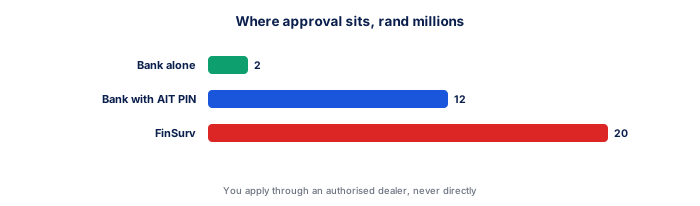
| Transaction | Approved by |
|---|---|
| Up to R2 million, single discretionary allowance | The bank, no approval needed |
| R2 million to R12 million, foreign investment | The bank, with a SARS AIT PIN |
| Above R12 million | FinSurv, on application |
| Loans to or from a non-resident | FinSurv |
| Offshore structures and intellectual property transfers | FinSurv |
| Routine trade payments | The bank, under delegated authority |
| Item | Detail |
|---|---|
| Who they are | Banks licensed to deal in foreign exchange |
| Delegated authority | They approve what the Currency and Exchanges Manual permits |
| Reporting | Every cross-border transaction is reported under BOPCUS |
| Documentation | They must hold proof of the purpose of each payment |
| Limited dealers | Some non-banks hold a restricted licence |
| Step | Detail |
|---|---|
| Route | Through your authorised dealer, not directly |
| Information required | Purpose, amount, parties, supporting agreements |
| Typical time | Several weeks, longer for complex structures |
| Outcome | Approval, conditional approval or refusal |
| Validity | Approvals are usually time limited |
How these figures work
The figures on this page come from the body that publishes them and change on a schedule rather than continuously, which is what makes them worth keeping in one place. You cannot apply to FinSurv directly. Every application goes through an authorised dealer, which is why the bank you use affects how smoothly it goes.
Every cross-border payment, however small, is reported to the Reserve Bank under BOPCUS with a reason code. That reporting is why the bank asks what a payment is for.
★ What this means in practice
Exchange control applies to residents. Someone who has ceased tax residency is in a different regime, with its own documentation.
✕ Common mistakes
- You cannot apply to FinSurv directly. You cannot apply to FinSurv directly. Every application goes through an authorised dealer, which is why the bank you use affects how smoothly it goes.
- Every cross-border payment, however small, is reported to the Reserve Ba. Every cross-border payment, however small, is reported to the Reserve Bank under BOPCUS with a reason code. That reporting is why the bank asks what a payment is for.
- Exchange control applies to residents. Exchange control applies to residents. Someone who has ceased tax residency is in a different regime, with its own documentation.
- Taking a figure without its date. A number from a reference page is only as good as when it was last checked, which is why the date sits at the top of this one.
Notes on reading these figures
- You cannot apply to FinSurv directly. Every application goes through an authorised dealer, which is why the bank you use affects how smoothly it goes.
- Every cross-border payment, however small, is reported to the Reserve Bank under BOPCUS with a reason code. That reporting is why the bank asks what a payment is for.
- Exchange control applies to residents. Someone who has ceased tax residency is in a different regime, with its own documentation.
To put this into practice, the Exchange Control Allowances runs the arithmetic on your own numbers; Offshore Transfer Process covers the same ground in ordinary language; SARB Foreign Exchange Reserves goes into the detail this page only summarises; Non-Resident Banking is the related figure worth reading beside it; and South African Financial Laws covers what this page leaves out.
Terms used on this page
Frequently asked questions
What is an authorised dealer?
A bank licensed to handle foreign exchange under delegated authority from the Reserve Bank. Most transactions never go beyond it.
When do I need FinSurv approval?
Above R12 million in a calendar year, and for loans to or from non-residents and certain offshore structures.
Can I apply to the Reserve Bank directly?
No. Every application goes through an authorised dealer, which is why the bank you use affects how it goes.
What is BOPCUS?
The reporting system under which every cross-border payment is reported to the Reserve Bank with a reason code.
Why does my bank ask what a payment is for?
Because it must report the reason and hold documentation supporting it.
How long does FinSurv take?
Several weeks, and longer for complex structures. It is not a same-week process.
 Download this data