i Short answer
Unemployment data provides broader economic health context relevant to overall growth and policy assessment.
It typically produces more gradual sentiment effects than the more immediately market-moving GDP and inflation releases.
📋 ON THIS PAGE
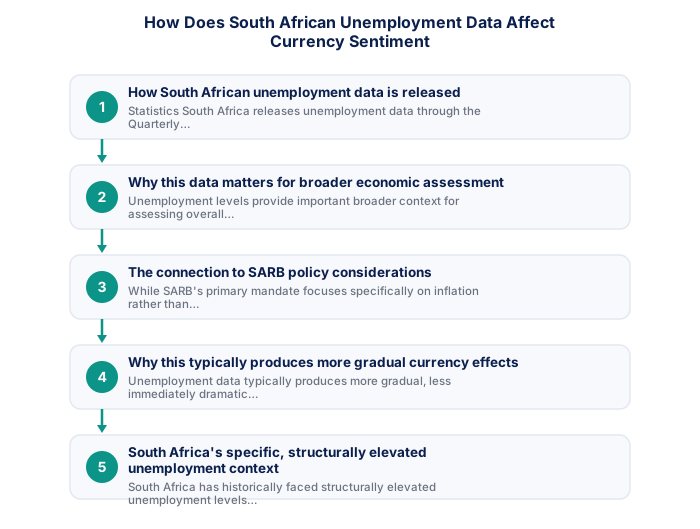
- How South African unemployment data is released
- Why this data matters for broader economic assessment
- The connection to SARB policy considerations
- Why this typically produces more gradual currency effects
- South Africa's specific, structurally elevated unemployment context
- Incorporating this data into your broader fundamental analysis
1. How South African unemployment data is released
Statistics South Africa releases unemployment data through the Quarterly Labour Force Survey, providing regular, scheduled insight into the proportion of the working-age population currently employed, unemployed, or outside the labour force entirely, similar in scheduling pattern to the GDP data.
It's worth adding this specific release schedule to your broader economic calendar awareness, discussed elsewhere on this site, even though its market impact tends to be more gradual than other releases, knowing when this data lands helps you correctly attribute any subsequent Rand movement to this specific factor rather than mistaking it for something else.
2. Why this data matters for broader economic assessment
Unemployment levels provide important broader context for assessing overall economic health and the genuine effectiveness of growth policies, connecting to the broader growth assessment, since persistently high unemployment can signal underlying structural economic challenges beyond what headline growth figures alone might suggest.
See also: How Does SA Unemployment Relate to Currency Markets?
It's worth tracking this data alongside GDP growth figures specifically, discussed elsewhere on this site, since unemployment and growth data together give a more complete picture of genuine economic health than either figure viewed in isolation, worth combining rather than relying on a single indicator alone.
- FSCA-regulated broker verified at fsca.co.za
- Demo account tested for minimum 60 days
- Trading plan written: entry, exits, position sizing
- Risk per trade defined (1-2% of account)
- Backup internet connection tested for load shedding
- Tax implications understood
3. The connection to SARB policy considerations
While SARB's primary mandate focuses specifically on inflation rather than employment directly, unlike some other central banks with explicit dual mandates, broader unemployment trends can still factor into SARB's overall economic assessment and broader policy considerations, even without unemployment serving as SARB's primary direct policy target.
It's worth understanding this distinction clearly, since it affects how directly unemployment data feeds into interest rate expectations, unlike a central bank with an explicit employment mandate, SARB's primary inflation focus means unemployment data influences policy more indirectly, through its broader effect on economic conditions and inflation dynamics, rather than as a direct policy trigger itself.
4. Why this typically produces more gradual currency effects
Unemployment data typically produces more gradual, less immediately dramatic currency reaction compared to interest rate decisions or even GDP and inflation data specifically, since unemployment trends tend to shift more slowly and predictably than the more immediately actionable, policy-relevant data.
It's worth calibrating your expectations accordingly, rather than anticipating the same kind of sharp, immediate reaction that a surprise interest rate decision might produce, unemployment data's more gradual influence means its effects are often better understood as part of a broader trend than as a single, dramatic market-moving event.
| Item | Detail |
|---|---|
| Regulator | FSCA, fsca.co.za |
| Exchange control | SARB, resbank.co.za |
| Tax authority | SARS, sars.gov.za |
| JSE hours | 09:00-17:00 SAST Mon-Fri |
| Best forex session | 15:00-17:00 SAST |
| CGT annual exclusion | R50,000 (individuals) |
5. South Africa's specific, structurally elevated unemployment context
South Africa has historically faced structurally elevated unemployment levels compared to many other economies, reflecting longstanding structural economic challenges, this structural context means individual quarterly fluctuations often matter less for currency sentiment than longer-term trend direction and genuine, sustained policy progress addressing these deeper structural issues.
It's worth understanding this structural context specifically because it shapes how markets interpret each individual data release, a modest quarterly improvement or deterioration means something different against this elevated structural backdrop than the same percentage change would in an economy without this longstanding pattern.
6. Incorporating this data into your broader fundamental analysis
Tracking unemployment data trends over time, rather than reacting sharply to any single quarterly release, and considering it alongside the other South African economic indicators, supports a more complete, appropriately-weighted understanding of South Africa's broader economic trajectory relevant to longer-term Rand sentiment.
This connects directly to the SARB's Monetary Policy Committee (MPC), which meets several times a year to set the repo rate, decisions that ripple through borrowing costs, the Rand, and market sentiment well beyond the immediate announcement.
A single unemployment data release rarely moves the Rand immediately. The underlying trend over time feeds into broader risk assessment rather than producing sharp reactions.
★ Why It Matters
Worth knowing precisely: the quarterly unemployment release rarely moves the Rand on the day itself, since it's a lagging, slow-moving indicator, its real relevance shows up gradually through its influence on credit rating reviews and longer-term sentiment, not as an immediate trading catalyst.
✕ Common mistakes
- Ignoring youth unemployment specifically in favour of the headline figure. International investors often weight this sub-figure differently.
- Treating unemployment data as disconnected from credit rating reviews. It feeds into the same broader risk assessment over time.
- Assuming a single release changes the overall trend materially. This data matters more as a slow-moving trend than a single data point.
Key Takeaways
- Unemployment data provides broader economic health context, though it typically produces more gradual sentiment effects than more immediately market-moving releases.
- Unemployment data provides broader economic health context relevant to overall growth and policy assessment.
- It typically produces more gradual sentiment effects than the more immediately market-moving GDP and inflation releases.
- How South African unemployment data is released.
- Why this data matters for broader economic assessment.
See also: Why Is August Historically the Rand's Worst Month?.
Frequently asked follow-up questions
How often is South African unemployment data released?
Quarterly, through Statistics South Africa's Quarterly Labour Force Survey, similar in general scheduling pattern to other South African economic data.
Does unemployment data ever produce significant currency movement?
It can, particularly if results significantly surprise expectations or reveal a meaningful trend shift, though typically less dramatically than more immediately market-moving data releases.
Is South Africa's unemployment rate unusually high compared to global standards?
South Africa has historically faced structurally elevated unemployment relative to many other economies; checking current Statistics South Africa data provides the most accurate, current specific figures.
