i Short answer
Foreign investor demand for South African government bonds directly affects Rand demand, since purchasing these bonds requires acquiring Rand first.
📋 ON THIS PAGE
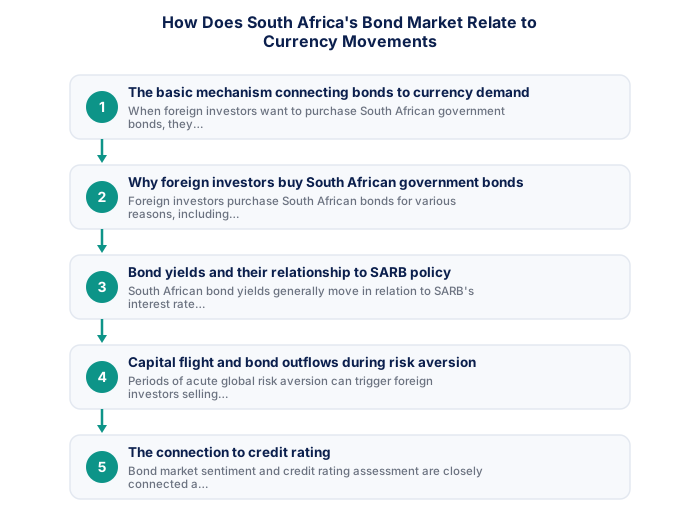
1. The basic mechanism connecting bonds to currency demand
When foreign investors want to purchase South African government bonds, they generally need to first convert their own currency into Rand to make this purchase, creating direct Rand demand through this specific transaction, increased foreign bond buying interest therefore tends to support Rand demand, all else equal, through this direct mechanical channel.
It's worth picturing this mechanism concretely: a foreign pension fund deciding to purchase South African government bonds must first sell its own currency and buy Rand to complete that purchase, meaning genuine, sustained foreign bond-buying interest translates directly into genuine Rand demand in the currency market itself.
2. Why foreign investors buy South African government bonds
Foreign investors purchase South African bonds for various reasons, including attractive relative yields compared to bonds available in their home markets, portfolio diversification objectives, and overall confidence in South Africa's fiscal sustainability and broader economic outlook.
It's worth understanding this yield-seeking motivation as closely related to the broader interest rate differential discussed elsewhere on this site, foreign bond buying and general currency yield-seeking flows are two expressions of essentially the same underlying international capital allocation dynamic.
- FSCA-regulated broker verified at fsca.co.za
- Demo account tested for minimum 60 days
- Trading plan written: entry, exits, position sizing
- Risk per trade defined (1-2% of account)
- Backup internet connection tested for load shedding
- Tax implications understood
South African traders accessing forex and CFD markets should understand that the instruments they trade through FSCA-regulated brokers are derivative contracts rather than ownership of the underlying asset. This means that all profits and losses are settled in cash, position sizes can be adjusted to suit any account size, and the same trading infrastructure provides access to global markets from a ZAR-denominated account. Understanding this fundamental structure helps traders make better decisions about instrument selection, position sizing, and account management.
3. Bond yields and their relationship to SARB policy
South African bond yields generally move in relation to SARB's interest rate policy and broader inflation expectations, with higher yields, all else equal, tending to attract more foreign investment interest given the more attractive relative return this offers compared to lower-yielding alternatives elsewhere.
It's worth tracking South African government bond yields periodically alongside SARB policy announcements, seeing how yields actually move around scheduled rate decisions gives you concrete, observable confirmation of this relationship rather than accepting it purely as an abstract principle.
4. Capital flight and bond outflows during risk aversion
Periods of acute global risk aversion can trigger foreign investors selling South African bonds and repatriating this capital toward perceived-safer assets, creating Rand selling pressure through the reverse of the mechanism, compounding the broader emerging-market currency weakness this kind of risk-aversion episode typically produces.
It's worth recognising this as a specific, concrete mechanism underlying the broader safe-haven and risk-sentiment dynamics discussed throughout this site, bond outflows during genuine global stress aren't simply correlated with Rand weakness, they're one of the direct, mechanical channels actually producing it.
| Item | Detail |
|---|---|
| Regulator | FSCA, fsca.co.za |
| Exchange control | SARB, resbank.co.za |
| Tax authority | SARS, sars.gov.za |
| JSE hours | 09:00-17:00 SAST Mon-Fri |
| Best forex session | 15:00-17:00 SAST |
| CGT annual exclusion | R50,000 (individuals) |
5. The connection to credit rating
Bond market sentiment and credit rating assessment are closely connected, a rating downgrade typically reduces bond attractiveness to certain institutional investors operating under specific rating-threshold mandates, directly affecting the bond demand and associated currency dynamics.
It's worth following rating agency announcements specifically for their bond market implications, since a rating change can trigger mechanical, rules-based selling from certain institutional bond investors whose mandates restrict them to holding only investment-grade rated debt, producing a more concrete, immediate market effect than the rating change's reputational impact alone.
6. Tracking bond market sentiment as a trader
South African traders following USD/ZAR specifically can track broader bond market sentiment indicators, including reported foreign bond inflow or outflow data and South African government bond yield trends, as one additional input within the broader fundamental analysis, alongside SARB policy, credit rating, and the other factors.
This connects directly to the SARB's Monetary Policy Committee (MPC), which meets several times a year to set the repo rate, decisions that ripple through borrowing costs, the Rand, and market sentiment well beyond the immediate announcement.
Yields rising due to credit risk concerns can coincide with weakness.
Rising bond yields driven by rate hikes can coincide with Rand strength. Rising yields driven by credit risk concerns instead can coincide with Rand weakness, the opposite effect.
★ Why It Matters
A connection worth watching directly: a rising yield on South African government bonds doesn't automatically mean Rand strength, if the yield is rising because of credit risk concerns rather than rate hikes, the Rand can weaken even as yields climb, the *reason* behind the move matters more than the move itself.
✕ Common mistakes
- Assuming rising bond yields always mean Rand strength. Yields rising due to credit risk concerns can coincide with Rand weakness instead.
- Ignoring why yields are moving, not just that they are. The underlying reason matters more than the yield direction alone.
- Treating bond and currency markets as fully independent. Foreign bond demand directly affects Rand demand.
- Not tracking foreign ownership trends in SA government bonds. Shifts here often precede or accompany Rand moves.
Key Takeaways
- Foreign investor demand for South African government bonds directly affects Rand demand, connecting bond market sentiment to broader currency movements.
- Foreign investor demand for South African government bonds directly affects Rand demand, since purchasing these bonds requires acquiring Rand first.
- The basic mechanism connecting bonds to currency demand.
- Why foreign investors buy South African government bonds.
- Bond yields and their relationship to SARB policy.
Frequently asked follow-up questions
Where can I find data on foreign bond inflows and outflows?
The South African Reserve Bank and National Treasury publish relevant data; financial news sources also regularly report on these broader bond market trends.
Does rising bond yields always strengthen the Rand?
Not always mechanically or immediately. This general tendency can be overridden by other simultaneous factors, including broader risk sentiment or credit concerns.
Are South African bonds attractive compared to other emerging markets?
This varies by current relative yields and risk perception; checking current comparative analysis provides the most accurate, up-to-date picture for this specific comparison.
