i Short answer
Since most forex markets close over weekends, deliberately stepping away from checking your account during this natural pause supports healthier, more sustainable balance.
📋 ON THIS PAGE
- Why weekends offer a natural pause point
- The temptation to check anyway despite closed markets
- Setting a specific weekend checking policy for yourself
- Using screen time tools to support this boundary
- What to do instead during this natural break
- Preparing for Monday without constant weekend monitoring
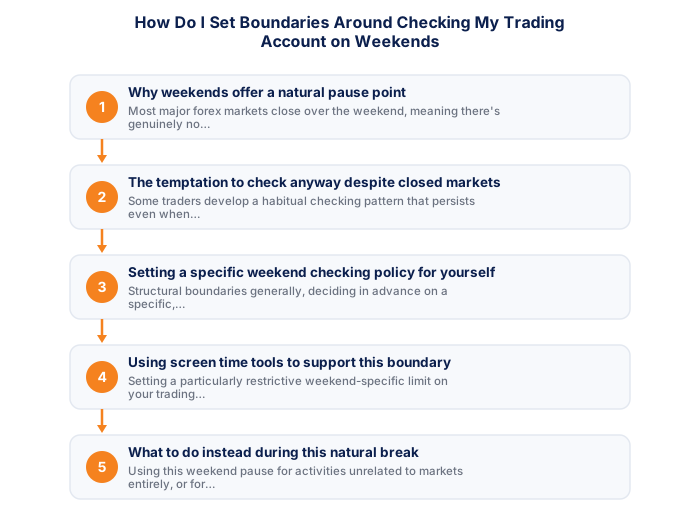
1. Why weekends offer a natural pause point
Most major forex markets close over the weekend, meaning there's genuinely no new price action to check or respond to during this period, making weekends a naturally convenient time to practise stepping away entirely.
It's worth actually using this natural pause deliberately rather than letting it pass unnoticed, a weekend genuinely free from market-related checking offers a rare, built-in opportunity for the kind of mental rest that supports sustainable, long-term trading, worth treating as a genuine feature of the trading week rather than simply dead time.
2. The temptation to check anyway despite closed markets
Some traders develop a habitual checking pattern that persists even when markets are closed, reflecting more of a psychological habit than any genuine informational need, since there's simply nothing new to observe during this closed period.
It's worth noticing this pattern honestly in your own behaviour if it applies, checking an app that has genuinely nothing new to show you is a useful, concrete signal that the checking has become more about managing anxiety than gathering any actual useful information.
- South African ID or valid passport
- Proof of residential address dated within 3 months
- Proof of bank account ownership
- Selfie or photo for biometric verification (some brokers)
- Source of funds declaration if depositing above threshold
Choose FSCA-regulated broker
Verify the FSP number is current at fsca.co.za.
Submit FICA documents
SA ID, proof of address within 3 months, bank account proof.
Fund via EFT
Make the initial deposit from your SA bank account in ZAR.
Open demo account first
Practice on demo before activating your live account.
Start with minimum capital
Begin with an amount you can afford to lose while learning.
3. Setting a specific weekend checking policy for yourself
Structural boundaries generally, deciding in advance on a specific, deliberate weekend policy, perhaps checking only once on Sunday evening to prepare for the coming week, rather than throughout the weekend, provides helpful structure for this boundary.
It's worth writing this specific policy down explicitly, in the same way you'd document any other trading rule, a written weekend policy is considerably easier to hold yourself to consistently than a vague, unwritten intention to 'not check too much.'
4. Using screen time tools to support this boundary
Setting a particularly restrictive weekend-specific limit on your trading app, or simply removing related notifications during this period, provides additional structural support for this boundary.
It's worth setting this restriction up in advance, during a calm moment before the weekend actually begins, rather than trying to exercise willpower reactively once the urge to check has already arisen, a structural barrier removes the need for in-the-moment self-control entirely.
| Rejection reason | Fix |
|---|---|
| Address proof older than 3 months | Get a recent utility bill or bank statement |
| Name mismatch between documents | Use documents with exactly matching full name |
| Poor quality scan | Retake with good lighting, all corners visible |
| PO Box address | Brokers require physical residential address only |
5. What to do instead during this natural break
Using this weekend pause for activities unrelated to markets entirely, or for reflective activities like reviewing your trading journal without the pressure of live, ongoing positions, supports both genuine rest and worthwhile, lower-pressure reflection.
It's worth having a few specific, planned activities ready for this time, rather than simply hoping something else will naturally fill the space, having concrete alternatives ready makes it considerably easier to actually redirect your attention away from market-related checking during this genuine downtime.
6. Preparing for Monday without constant weekend monitoring
Reviewing the upcoming week's scheduled events once, perhaps Sunday evening, provides adequate preparation for Monday's market open without requiring continuous monitoring throughout the entire closed weekend period.
In South African time (SAST, which is GMT+2 year-round), the London session typically opens around 09:00-10:00 and the New York session around 15:00-16:00, so the overlap between roughly 15:00 and 17:00 SAST tends to bring the highest liquidity and volatility for major forex pairs.
A deliberate policy, with app restrictions, breaks that pattern.
Some traders develop a habitual checking pattern that persists even when markets are closed. A deliberate, restrictive weekend policy helps break that reflexive habit.
★ Why It Matters
Worth using directly: most phones let you set app-specific time restrictions, applying this to your trading app on weekends removes the decision from willpower entirely, which tends to work better than simply intending not to check.
✕ Common mistakes
- Relying purely on willpower to avoid checking. Built-in phone restrictions remove the decision from willpower entirely.
- Treating weekend checking as harmless since markets are closed. The habit itself can still reinforce compulsive checking patterns.
- Not having a clear, stated boundary to hold yourself to. Vague intentions are easier to break than explicit rules.
- Checking 'just once' and letting that become a daily habit. Small exceptions tend to erode boundaries gradually.
Key Takeaways
- Since most forex markets close over weekends, deliberately stepping away from account checking during this period supports healthier, more sustainable balance.
- Since most forex markets close over weekends, deliberately stepping away from checking your account during this natural pause supports healthier, more sustainable balance.
- Why weekends offer a natural pause point.
- The temptation to check anyway despite closed markets.
- Setting a specific weekend checking policy for yourself.
See also: What Is Screen Time Management and Why Does It Matter for Traders?.
Frequently asked follow-up questions
Do any markets remain open over weekends that I should still monitor?
Cryptocurrency markets, often continue trading over weekends, meaning traders specifically holding crypto positions may have genuine reason for some weekend monitoring, unlike standard forex markets.
Is it unhealthy to think about trading at all during weekends?
Occasional, natural thought isn't inherently unhealthy. The concern is compulsive, anxiety-driven checking despite markets being closed.
Should I close all positions before the weekend to avoid this temptation entirely?
This is a personal choice some traders make, though maintaining positions with proper stop-losses can also be a reasonable approach.
Can setting weekend boundaries improve my actual trading performance?
Many traders find that genuine rest and reduced anxiety, support better decision-making once markets reopen, though this varies by individual circumstance.
Does this boundary apply equally to reviewing my trading journal?
Reviewing your journal reflectively, differs from anxiously monitoring live positions, and can be a worthwhile, lower-pressure weekend activity if approached calmly.
