i Short answer
Shift workers can align swing or position trading review sessions with their off-shift hours, prioritising a consistent personal routine over any fixed clock time.
Since forex markets operate continuously across global sessions, shift workers have genuine flexibility to build a sustainable routine.
📋 ON THIS PAGE
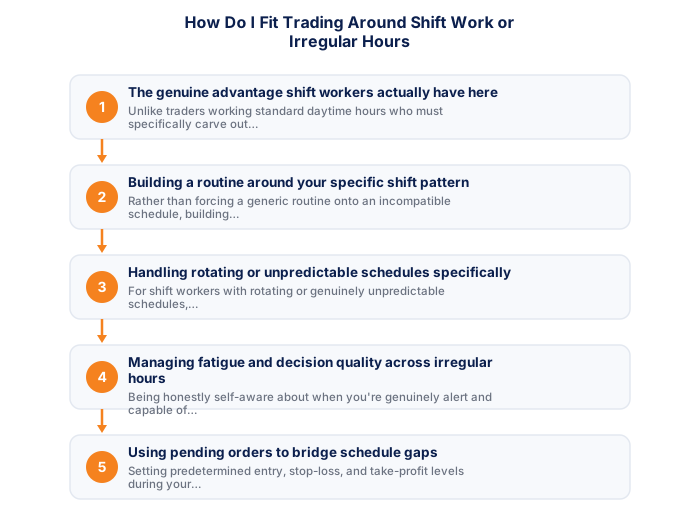
- The genuine advantage shift workers actually have here
- Building a routine around your specific shift pattern
- Handling rotating or unpredictable schedules specifically
- Managing fatigue and decision quality across irregular hours
- Using pending orders to bridge schedule gaps
- Being realistic about which trading style genuinely fits
1. The genuine advantage shift workers actually have here
Unlike traders working standard daytime hours who must carve out evening time for trading-related activity, shift workers sometimes have genuine flexibility during traditional daytime hours when they're off-shift, potentially aligning naturally with different global trading sessions than the typical evening-focused routine most South African traders adopt.
It's worth recognising and actually using this advantage deliberately rather than defaulting to whatever routine feels conventional, a shift worker who has genuine daytime availability during a major trading session has an opportunity many standard-hours traders would genuinely envy, worth building your entire approach around rather than treating as incidental.
2. Building a routine around your specific shift pattern
Rather than forcing a generic routine onto an incompatible schedule, building your pre-market preparation, execution, and review routine around whatever consistent block of off-shift time genuinely works for your particular shift pattern gives a more sustainable foundation than attempting to fit trading into whatever scraps of time remain after a more rigid, generic schedule.
See also: How Do I Handle Trading While Traveling or on Holiday?
It's worth writing this shift-specific routine down explicitly, in the same way any trading plan benefits from being documented, having a clear, written structure for each shift pattern variation removes the need to work out your approach fresh every time your schedule shifts.
- FSCA-regulated broker verified at fsca.co.za
- Demo account tested for minimum 60 days
- Trading plan written: entry, exits, position sizing
- Risk per trade defined (1-2% of account)
- Backup internet connection tested for load shedding
- Tax implications understood
3. Handling rotating or unpredictable schedules specifically
For shift workers with rotating or genuinely unpredictable schedules, maintaining flexibility in exactly which hours you review charts and execute trades, while still preserving the underlying structured routine of pre-market preparation and post-session review, supports consistency in process even when the specific clock hours vary from week to week.
It's worth accepting that some weeks will genuinely accommodate more structured trading time than others, rather than forcing a rigid, unchanging routine onto a schedule that doesn't support it, building this flexibility in from the outset tends to produce a more sustainable long-term approach than fighting against your actual, variable circumstances.
4. Managing fatigue and decision quality across irregular hours
Shift work's inherent disruption to normal sleep patterns can affect day trading decision quality if trading is attempted during periods of genuine fatigue. Being honestly self-aware about when you're genuinely alert and capable of disciplined decision-making, rather than trading simply because time happens to be available, supports better outcomes.
It's worth treating this self-awareness as seriously as any other risk management practice discussed throughout this site, deliberately avoiding active trading decisions during periods you know are genuinely compromised by fatigue protects your capital just as effectively as a properly calculated stop-loss does.
| Item | Detail |
|---|---|
| Regulator | FSCA, fsca.co.za |
| Exchange control | SARB, resbank.co.za |
| Tax authority | SARS, sars.gov.za |
| JSE hours | 09:00-17:00 SAST Mon-Fri |
| Best forex session | 15:00-17:00 SAST |
| CGT annual exclusion | R50,000 (individuals) |
5. Using pending orders to bridge schedule gaps
Setting predetermined entry, stop-loss, and take-profit levels during your structured review session lets your analysis translate into action even during shift hours when you genuinely cannot actively monitor the markets, supporting the swing and position trading styles that are particularly compatible with irregular schedules.
This approach is worth leaning on heavily specifically because it directly addresses shift work's core challenge, the inability to monitor markets continuously during unpredictable working hours, pending orders let your careful, well-rested analysis execute reliably even during periods when you genuinely cannot be actively present.
6. Being realistic about which trading style genuinely fits
Given shift work's inherent unpredictability, day trading and scalping, which require sustained, continuous attention during specific market hours, generally fit less naturally with irregular shift schedules than swing or position trading, which tolerate the kind of flexible, less continuously-monitored approach shift work circumstances often require.
In South African time (SAST, which is GMT+2 year-round), the London session typically opens around 09:00-10:00 and the New York session around 15:00-16:00, so the overlap between roughly 15:00 and 17:00 SAST tends to bring the highest liquidity and volatility for major forex pairs.
Rather than forcing a generic routine onto an incompatible schedule, building your specific pre-market and review windows around your actual shift pattern works far better.
★ Why It Matters
Worth tracking for a month: note your decision quality (using your own journal's win rate or rule-adherence rate) by which shift rotation you were on that week. Shift workers often discover their trading quality varies more by sleep-cycle phase than by anything market-related.
✕ Common mistakes
- Forcing a fixed trading schedule onto an irregular shift pattern. Aligning trading to your actual rotation tends to work better than fighting it.
- Trading immediately after a night shift without adjusting expectations. Fatigue affects judgement even when it doesn't feel obvious in the moment.
- Not tracking results by shift rotation to spot personal patterns. This segmentation often reveals patterns invisible in aggregate statistics.
Key Takeaways
- Shift workers can align swing or position trading review sessions with their off-shift hours, prioritising consistent routine over fixed clock times.
- Shift workers can align swing or position trading review sessions with their off-shift hours, prioritising a consistent personal routine over any fixed clock time.
- Since forex markets operate continuously across global sessions, shift workers have genuine flexibility to build a sustainable routine.
- The genuine advantage shift workers actually have here.
- Building a routine around your specific shift pattern.
See also: Can I Trade Forex with a Full-Time Job?.
Frequently asked follow-up questions
Is shift work an advantage or disadvantage for trading?
It carries both genuine flexibility advantages and fatigue-related challenges, making honest self-assessment of your own specific situation more useful than a universal answer.
Should I avoid trading entirely during night shifts?
This depends on your personal alertness and discipline during these hours. Many traders find structured, lower-frequency approaches more compatible with irregular alertness than active, continuous monitoring.
Can I still maintain a consistent trading journal with an irregular schedule?
Yes, the journaling habit remains valuable regardless of schedule, simply requiring flexibility in exactly when you complete it.
