i Short answer
Forex and CFD markets remain technically open during South African public holidays, but show somewhat reduced local participation.
Major international holidays in financial centres like the US or UK affect global market liquidity more broadly and significantly.
📋 ON THIS PAGE
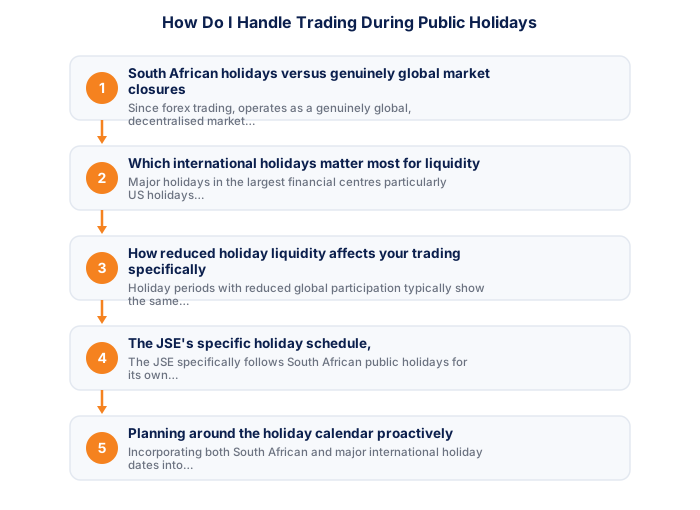
- South African holidays versus genuinely global market closures
- Which international holidays matter most for liquidity
- How reduced holiday liquidity affects your trading specifically
- The JSE's own holiday schedule
- Planning around the holiday calendar proactively
- Using quiet holiday periods productively
1. South African holidays versus genuinely global market closures
Since forex trading operates as a global, decentralised market rather than a single exchange, a South African public holiday doesn't close global forex markets. Trading continues through other active regional sessions, though South African-specific participation and any SA-focused news flow naturally thin out on these days.
It's worth being specific about which instruments this distinction actually affects, since forex pairs and globally-traded instruments continue functioning through a South African holiday, while South African-specific instruments like JSE-listed shares follow their own local schedule, worth checking the specific instrument you're trading rather than assuming a blanket rule applies universally.
For related context, see South African public holiday trading guide, complete overview of how SA holidays affect all instrument types.
2. Which international holidays matter most for liquidity
Major holidays in the biggest financial centres, US holidays like Thanksgiving and Christmas especially, along with significant UK and European holidays, have a much larger effect on overall global forex liquidity, given how much of total global trading volume runs through those centres compared to any single region's own holiday calendar.
It's worth building a simple personal calendar of these major international holidays specifically, rather than relying purely on South African public holiday awareness, since the international dates that genuinely affect global liquidity often differ entirely from your own local public holiday schedule.
- FSCA-regulated broker verified at fsca.co.za
- Demo account tested for minimum 60 days
- Trading plan written: entry, exits, position sizing
- Risk per trade defined (1-2% of account)
- Backup internet connection tested for load shedding
- Tax implications understood
3. How reduced holiday liquidity affects your trading specifically
Holiday periods with reduced global participation typically bring the same wider spreads and less reliable execution seen in any low-liquidity conditions, which is why some traders get more cautious or trim position size position sizes during these known quiet periods.
It's worth checking current spreads directly before trading during any known holiday-adjacent period, rather than assuming your usual spread expectations still apply, a quick check confirms whether conditions are genuinely as thin as expected or whether liquidity has held up better than anticipated.
4. The JSE's own holiday schedule
The JSE follows South African public holidays for its own trading schedule, so JSE Top 40 CFD trading is affected differently by South African holidays than the broader forex market is, given the JSE's nature as a specific national exchange rather than the more continuously-running forex market.
It's worth marking JSE-specific holiday closures separately from your broader forex-focused calendar, given how this distinct schedule can easily be overlooked if you're primarily tracking global forex holiday patterns rather than South Africa's own specific exchange calendar.
| Item | Detail |
|---|---|
| Regulator | FSCA, fsca.co.za |
| Exchange control | SARB, resbank.co.za |
| Tax authority | SARS, sars.gov.za |
| JSE hours | 09:00-17:00 SAST Mon-Fri |
| Best forex session | 15:00-17:00 SAST |
| CGT annual exclusion | R50,000 (individuals) |
5. Planning around the holiday calendar proactively
Keeping both South African and major international holiday dates in your broader trading calendar, alongside the economic calendar for scheduled data releases, helps you plan around these known quieter periods deliberately, rather than getting caught out by unexpectedly thin liquidity or wider spreads on a holiday you hadn't anticipated.
It's worth reviewing this combined calendar at the start of each month as part of your broader routine, rather than only checking individual dates as they approach, a monthly overview helps you plan your trading intensity and expectations across the full period ahead, rather than being surprised by an approaching quiet stretch.
6. Using quiet holiday periods productively
Rather than necessarily sitting out these periods entirely, some traders use known quiet holiday windows for strategy review, journal analysis, and broader learning, treating the naturally reduced opportunity as a useful pause for reflection rather than downtime to fill with forced trading.
In South African time (SAST, which is GMT+2 year-round), the London session typically opens around 09:00-10:00 and the New York session around 15:00-16:00, so the overlap between roughly 15:00 and 17:00 SAST tends to bring the highest liquidity and volatility for major forex pairs.
Major holidays in the largest financial centres, particularly US holidays, affect global liquidity considerably more than South African-specific holidays do.
★ Why It Matters
Worth checking rather than assuming: South African public holidays don't line up with US or UK market holidays, so a quiet local holiday can still be a perfectly normal, fully liquid trading day for USD pairs. The calendar that matters is the market's, not your own.
✕ Common mistakes
- Assuming a quiet local holiday means quiet global markets. The relevant calendar is the market's, not necessarily South Africa's own.
- Not checking which international holidays actually affect your traded pairs. US or UK holidays matter more for liquidity than South African ones for most instruments.
- Treating every holiday as equally likely to reduce volatility. Effects vary considerably depending on which markets are actually closed.
- Trading a normal-sized position during genuinely thin holiday liquidity. Reduced liquidity can mean wider spreads and less predictable execution.
Key Takeaways
- Markets remain open during South African public holidays but show reduced liquidity, while major international holidays affect global market activity more broadly.
- Forex and CFD markets remain technically open during South African public holidays, but show somewhat reduced local participation.
- Major international holidays in financial centres like the US or UK affect global market liquidity more broadly and significantly.
- South African holidays versus genuinely global market closures.
- Which international holidays matter most for liquidity.
Frequently asked follow-up questions
Is it riskier to trade on a major international holiday?
Generally yes, given the reduced liquidity and wider spreads covered above, so extra caution or smaller position sizes are a reasonable call during these known periods.
Do all forex pairs show the same holiday liquidity reduction?
Major pairs generally hold up better during quieter periods than already-thinner exotic pairs, which tend to show more pronounced holiday liquidity effects.
Should I close all positions before a major holiday?
That's a personal risk management choice. Some traders do this specifically to avoid holding positions through reduced-liquidity periods.
