i Short answer
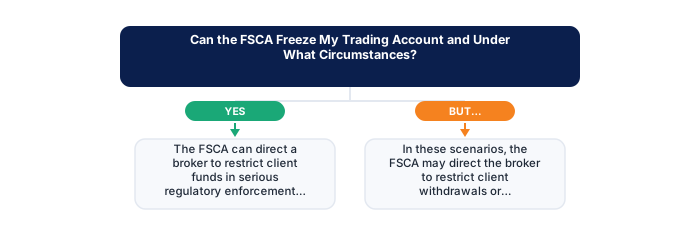
The FSCA can direct a broker to restrict client funds in serious regulatory enforcement situations, most commonly when a broker's licence is suspended or revoked.
This kind of restriction generally targets the broker's overall conduct and regulatory standing, not any individual client's trading behaviour.
📋 ON THIS PAGE
- The distinction between broker-level and client-level action
- Circumstances that could trigger this kind of restriction
- What happens to your funds during such a restriction
- How this differs from a margin call or stop-out
- Your rights during a regulatory restriction
- How to reduce your exposure to this kind of risk
1. The distinction between broker-level and client-level action
It's important to understand that FSCA enforcement action of this kind is almost always directed at the broker as a regulated entity, not at individual clients personally. The FSCA doesn't typically have authority to freeze a specific individual trader's account based on that individual's own trading decisions or behaviour, its regulatory authority operates at the level of licensing and supervising financial services providers themselves.
This distinction is worth remembering specifically if you ever encounter alarming online claims about the FSCA 'freezing' individual trader accounts over personal disputes or disagreements, since that framing generally misrepresents how FSCA authority actually operates, worth being sceptical of such claims rather than assuming they accurately describe the regulator's genuine powers.
2. Circumstances that could trigger this kind of restriction
Circumstances that could lead to this kind of broker-level restriction include serious, sustained regulatory non-compliance, concerns about a broker's financial soundness or solvency, or investigation into potential serious misconduct. In these scenarios, the FSCA may direct the broker to restrict client withdrawals or trading activity temporarily while the underlying regulatory matter is investigated or resolved.
It's worth understanding these as genuinely serious, relatively rare scenarios rather than routine regulatory activity, the FSCA doesn't restrict broker-level activity casually, this kind of intervention reflects a significant, substantiated concern rather than a minor or technical compliance issue.
- Search FSP name or number at fsca.co.za
- Confirm licence is current and not suspended
- Check scope covers forex and CFD activity
- Confirm client funds in segregated accounts
- Read FSCA enforcement actions history
- Test customer support before depositing
- Client funds legally segregated
- FSCA complaints process available
- SA consumer protections apply
- ZAR account, no FX conversion costs
- Some offshore brokers offer wider instruments
- Regulatory overhead passed on in spreads
- Stricter position limits for retail clients
- FICA verification required before trading
- Client funds segregated
- Formal complaints process
- FSCA dispute resolution
- SA consumer law applies
- ZAR account available
- Fund safety not guaranteed
- Disputes overseas only
- SA law does not apply
- Currency conversion costs
- Tax reporting more complex
3. What happens to your funds during such a restriction
FSCA regulation generally requires brokers to keep client funds separate from the broker's own operating funds specifically to protect client money during exactly this kind of regulatory or financial difficulty scenario. A restriction on activity doesn't necessarily mean your funds are lost, it more typically means access is temporarily paused while the situation is assessed.
This is precisely why fund segregation, discussed in more detail elsewhere on this site, matters so much in practice, not as an abstract regulatory requirement, but as the specific mechanism that protects your actual deposited capital during exactly this kind of scenario, when a broker itself becomes the source of disruption rather than ordinary market risk.
4. How this differs from a margin call or stop-out
This kind of regulatory restriction is entirely distinct from the margin call and stop-out mechanisms tied to leverage. Those are routine risk management features triggered by your own account's specific margin level, while a regulatory restriction is an external, broker-wide action unrelated to any individual client's specific trading performance or account status.
Keeping these two categories clearly separate in your own understanding matters practically: a margin call or stop-out is something your own risk management directly controls and can prevent, while a regulatory restriction is entirely outside any individual client's control, the appropriate response to each is genuinely different.
| Protection | FSCA Regulated | Offshore Unregulated |
|---|---|---|
| Client fund segregation | ✓ Required | Varies by broker |
| SA complaints process | ✓ Available | ✗ Not available |
| SA consumer law applies | ✓ Yes | ✗ No |
| ZAR account available | ✓ Typically | Often USD/EUR only |
5. Your rights during a regulatory restriction
If your broker becomes subject to this kind of regulatory restriction, the FSCA's complaints and enforcement processes, generally provide updates and a framework for affected clients to understand the situation and pursue resolution, though the specific timeline and outcome depend heavily on the particular circumstances of each individual case.
It's worth keeping your own account statements and communication records well-organised generally, not just during an active dispute, since having clear, accessible documentation ready considerably speeds up any process you might need to engage with the FSCA or broker directly should this kind of situation ever arise.
6. How to reduce your exposure to this kind of risk
The most practical safeguard against this risk is thorough broker due diligence. Choosing a broker with a clean, sustained regulatory history and verified current FSCA licence status reduces the likelihood of encountering this kind of serious enforcement scenario in the first place.
The FSCA regulatory framework provides South African retail traders with meaningful protection that extends beyond simply verifying a broker's licence number. The requirement for FSCA-regulated brokers to maintain segregated client accounts means your deposited funds are legally separated from the broker's operating funds. In the event of broker insolvency, this segregation protects client money from creditor claims against the company. FSCA-regulated brokers must also maintain adequate financial resources, submit to regulatory oversight, and adhere to disclosure requirements covering fees, risks, and conflicts of interest. For traders considering offshore brokers outside FSCA supervision, the loss of these domestic protections is a material risk consideration, particularly for larger account balances where the downside of unregulated broker failure would be financially significant.
An FSCA freeze is a rare, distinct regulatory enforcement action.
A margin call is a routine, market-driven mechanism, entirely distinct from a rare FSCA regulatory restriction, which stems from broker-level enforcement action, not your own trading.
★ Why It Matters
Worth knowing in advance rather than discovering during a crisis: if your broker's licence is suspended, the freeze on withdrawals can sometimes outlast the underlying issue by weeks while administrative processes catch up, which is a strong argument for not concentrating all your capital with a single broker.
✕ Common mistakes
- Concentrating all capital with a single broker. Diversifying across brokers reduces the impact of any single regulatory action.
- Not monitoring your broker's own regulatory standing periodically. Checking the FSCA register occasionally can surface early warning signs.
- Panicking and attempting rapid withdrawals once a freeze is rumoured. This rarely succeeds and adds confusion to an already uncertain situation.
Key Takeaways
- The FSCA can direct a broker to restrict client funds in serious regulatory enforcement situations, though this targets the broker, not individual client conduct.
- The FSCA can direct a broker to restrict client funds in serious regulatory enforcement situations, most commonly when a broker's licence is suspended or revoked.
- This kind of restriction generally targets the broker's overall conduct and regulatory standing, not any individual client's trading behaviour.
- The distinction between broker-level and client-level action.
- Circumstances that could trigger this kind of restriction.
See also: What Is Market Manipulation and Could I Be Accused of It?.
Frequently asked follow-up questions
Can my account be frozen because of my own trading losses?
No, trading losses alone don't trigger this kind of regulatory restriction; margin calls and stop-outs are the relevant mechanisms for managing account-specific risk.
How would I find out if my broker faced this kind of restriction?
Brokers are generally required to communicate significant regulatory developments to clients, and FSCA public notices, also provide official confirmation of enforcement actions.
Does this happen often to FSCA-regulated brokers?
This represents a serious enforcement step rather than a routine occurrence, generally reserved for significant, sustained regulatory concerns rather than minor compliance issues.
Can the FSCA freeze just my individual account specifically, or only an entire broker's operations?
FSCA enforcement actions typically target the broker entity itself rather than singling out individual client accounts, meaning this kind of restriction generally affects all clients of that specific broker simultaneously.
What should I do if I suspect my broker is under this kind of restriction?
Checking official FSCA notices directly and contacting your broker for clarification are reasonable first steps, rather than relying solely on rumours or unverified social media claims about the situation.
