i Short answer
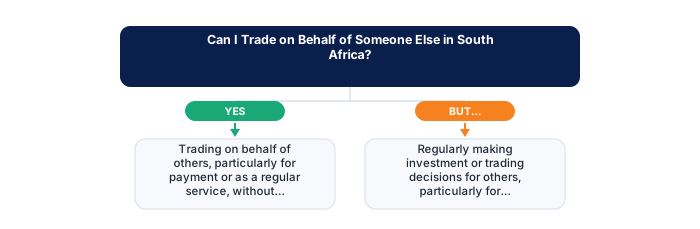
Trading on behalf of others, particularly for payment or as a regular service, without proper FAIS and FSCA licensing can constitute unauthorised financial services.
This is distinct from simply discussing trades informally within your own household.
📋 ON THIS PAGE
- The difference between managing your own account and someone else's
- When this could constitute unauthorised financial services
- The power of attorney and mandate route
- Copy trading as a regulated alternative
- Family and informal arrangements specifically
- Practical guidance if someone asks you to trade for them
1. The difference between managing your own account and someone else's
Trading your own account with your own capital and your own judgement is a completely different activity from making trading decisions for someone else's account, using their capital. The first is a personal financial activity with no regulatory dimension beyond your own tax obligations. The second, where you're exercising discretion over another person's financial assets, is a form of financial services provision that is regulated in South Africa under the Financial Advisory and Intermediary Services Act (FAIS).
It's worth pausing on this distinction any time an informal arrangement starts to feel like it's drifting from the first category toward the second. The distinction that matters legally isn't primarily about payment or formality, it's about whether someone else's financial assets are being managed based on your judgement and discretion, even informally.
The scale or frequency of the arrangement doesn't necessarily determine whether regulation applies. A single informal arrangement where you place trades in someone else's account based on your analysis is structurally similar, from a regulatory standpoint, to a formal ongoing arrangement, the relevant question is the nature of the activity, not how official it feels.
This distinction also matters from a liability standpoint. When you're trading someone else's money, any losses are their losses, but in an unregulated informal arrangement, the remedies available to them if something goes wrong are limited compared to what a regulated arrangement would provide.
2. When this could constitute unauthorised financial services
Doing this regularly, especially for payment, or as part of an ongoing arrangement presented as a service, can fall within regulated financial services under FAIS. The relevant category is discretionary asset management, and providing it without the appropriate FSCA licence exposes you to significant regulatory risk.
This is worth taking seriously even when the arrangement feels informal or well-intentioned, since regulatory frameworks generally focus on the substance of what's happening rather than the form. An unlicensed person managing another person's trading account, even as a favour to a friend, occupies a grey area that can create real legal exposure if something goes wrong.
- SARB economic calendar checked for the week
- Next Eskom load shedding schedule reviewed
- GNU stability news reviewed
- Stats SA data releases noted
- Credit agency review dates checked
- US/global events that move EM risk noted
The FSCA takes unauthorised financial services provision seriously, and the consequences for individuals found to be providing regulated services without the appropriate authorisation can include enforcement action, fines, and prohibition from providing financial services in future. These consequences apply regardless of how informally or benevolently the arrangement was structured.
If you're genuinely interested in managing money professionally, the correct path is understanding the FAIS licensing requirements and pursuing the appropriate category of authorisation, not working around the requirement informally. The FSCA's website provides the current requirements for different categories of financial services providers.
3. The power of attorney and mandate route
Some brokers allow a client to grant a formal power of attorney or trading mandate to a specific person, authorising them to trade on the account within defined parameters. This documented route provides a structured framework for what would otherwise be an informal arrangement, it creates clear scope, accountability, and a record of the authority that was granted.
This documented route protects both parties. The person managing the account has a clear, written record of what they were authorised to do. The account holder has documented limits on the authority they granted. And both parties have a formal record that reduces the ambiguity that typically complicates disputes in informal arrangements.
| Event | Frequency | ZAR impact | Source |
|---|---|---|---|
| SARB MPC | 6x per year | High | resbank.co.za |
| Budget Speech | Annual (February) | Very high | treasury.gov.za |
| Credit reviews | Annual each agency | Very high | Agency sites |
| Stats SA CPI | Monthly | Medium | statssa.gov.za |
| Eskom stage | As needed | Low-medium | eskomsepush.com |
- SA context provides genuine informational edge
- ZAR pairs accessible via FSCA brokers in ZAR accounts
- Rand volatility creates larger intraday ranges
- 6 SARB meetings/year create regular macro setups
- Higher geopolitical risk than G10 pairs
- Load shedding creates unique operational disruptions
- SA rand liquidity thinner than major G10 pairs
- SA-specific news requires constant local monitoring
Even with a formal power of attorney, the question of whether the activity constitutes regulated financial services doesn't entirely disappear. If the arrangement is commercial in nature, if the person managing the account receives compensation, the FAIS licensing question becomes relevant regardless of the POA documentation.
Before establishing any formal trading authority arrangement, confirming with your specific broker what they allow, what documentation is required, and what limitations apply is the right starting point. Broker policies on this differ, and some have more developed formal mechanisms for third-party trading authority than others.
4. Copy trading as a regulated alternative
Copy trading through a regulated platform's built-in infrastructure provides a structured alternative to informal trading authority arrangements. In a copy trading setup, one person's trades are automatically replicated in another's account through the platform's own systems, with defined risk parameters, transparent terms, and the ability to start and stop the arrangement at any time.
The regulatory distinction between copy trading through a platform's regulated infrastructure and directly managing someone's account is meaningful. Copy trading operates within the broker's own regulated framework with specific terms governing the relationship. Direct account management outside that framework creates a different set of regulatory questions.
For account holders who want their trading replicated by someone else, and for traders who want to make their approach available to others, the copy trading structure provides a legitimate, transparent mechanism that doesn't require either party to manage FAIS licensing questions independently.
5. Family and informal arrangements specifically
Swapping trading ideas informally with family or close friends, where everyone still makes their own final decision and executes their own trades on their own account, is a normal social activity, not a regulated financial service. The key distinction is whether each person is independently deciding and acting, or whether you're deciding and acting on their behalf.
A useful test worth applying honestly: is each person still making their own final decision and clicking the button themselves? If yes, you're in the realm of sharing analysis and ideas, which is unregulated. If you're the one deciding what trade to place and executing it in their account, the arrangement is structurally different regardless of how informally it's described.
Family arrangements can also create interpersonal complications that formal business relationships usually manage more cleanly. Clear expectations upfront about who is responsible for losses, what the arrangement involves, and how it can be ended help prevent the kind of ambiguity that creates conflict when trading outcomes are disappointing.
Keeping detailed records of any arrangement where you assist someone else with trading decisions, even informal ones, is worth doing from the outset. Having documentation of what was agreed, what authority was granted, and what happened during the arrangement provides protection if the relationship becomes complicated or if questions arise later.
6. Practical guidance if someone asks you to trade for them
If someone asks you to trade for them, particularly for any kind of payment, the right first step is looking into whether the arrangement needs FAIS licensing. The FSCA's public resources and the FAIS Act outline what types of activities require authorisation, and a brief consultation with a legal practitioner familiar with financial services regulation can clarify your specific situation.
Any FSCA-regulated broker operating in South Africa is bound by POPIA, the Protection of Personal Information Act, which governs how personal and financial information is handled. This applies to any arrangement involving access to another person's trading account, adding a data protection dimension to the other compliance considerations.
It's worth having this conversation explicitly and early, rather than letting an informal favour gradually solidify into an ongoing arrangement without clear terms or agreed expectations. The ambiguity that develops in informal arrangements, about responsibility for losses, about continuation, about compensation, is much harder to address once the arrangement is already established than before it begins.
Helping a family member understand a trade you've already placed is different, legally and practically, from placing trades in their account on their behalf. The former is education and discussion; the latter is discretionary management. Keeping that distinction clear in how you engage with requests for trading help prevents drifting from one category into the other.
✕ Common mistakes
- Assuming informal family arrangements carry no regulatory risk. Regular trading on someone else's behalf can resemble unauthorised financial service provision.
- Not distinguishing between advice and execution. Explaining a trade is different from placing it for someone else.
- Accepting payment for managing someone else's account informally. This significantly raises the regulatory stakes.
- Ignoring the FAIS implications of ongoing involvement. See what the FAIS Act covers before agreeing to this kind of arrangement.
Key Takeaways
- Trading on behalf of others without proper licensing can constitute unauthorised financial services, distinct from simply discussing trades within your own household.
- Trading on behalf of others, particularly for payment or as a regular service, without proper FAIS and FSCA licensing can constitute unauthorised financial services.
- This is distinct from simply discussing trades informally within your own household.
- The difference between managing your own account and someone else's.
- When this could constitute unauthorised financial services.
See also: What Is Social Trading and Copy Trading Explained?.
Frequently asked follow-up questions
Can I trade my spouse's account if we share finances?
This is worth discussing directly with your specific broker, since formal documentation or a power of attorney arrangement, may be required even within a shared household.
Does helping a friend understand their own trades count as managing their account?
No, providing general education or discussing strategy while they make their own independent decisions differs from actually executing trades on their behalf.
Is there a minimum threshold before FAIS licensing becomes required?
This depends on the specific nature and regularity of the service provided; consulting directly with the FSCA or a qualified professional clarifies your specific situation if genuinely uncertain.
What happens if I trade for a relative without any formal arrangement and something goes wrong?
Without documented authorisation, disputes over responsibility for losses can become messy, since there's no formal mandate clarifying what was actually agreed between you and the account holder.
Can a financial advisor manage my trading account on my behalf?
A properly licensed advisor can, provided they hold the relevant FAIS authorisation for this kind of discretionary management and you've entered a formal, documented mandate covering this specific arrangement.
