i Short answer
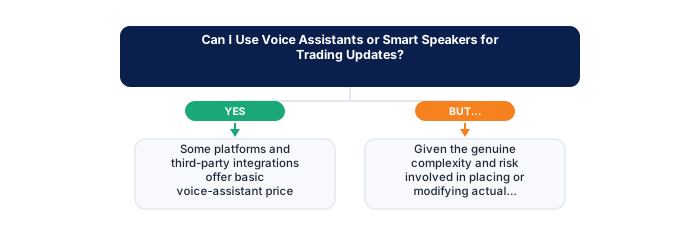
Some platforms and third-party integrations offer basic voice-assistant price queries for checking current rates or account status.
This remains a minor convenience feature rather than a genuine, complete trading interface for actual order placement or detailed analysis.
📋 ON THIS PAGE
1. What voice assistant integration typically offers
Where voice integration exists, it typically covers simple queries: an instrument's current price, your account balance, possibly a brief P&L summary, through a brief spoken response. Some brokers have developed voice assistant integrations with limited functionality, and certain general-purpose financial apps support similar queries through platforms like Alexa, Google Assistant, or Siri.
It's worth testing this feature's actual accuracy and responsiveness for yourself before relying on it even for simple queries. Price data accessed through a voice assistant may be slightly delayed relative to your broker's live feed, and the precision of the response format: whether it rounds figures, which spread it quotes, can vary between integrations.
The value of this kind of quick query is primarily for passive awareness: a rough check on whether a position is broadly in profit or loss, or whether a market has moved significantly while you were doing something else. It's a peripheral information tool, not an analytical one.
Integration quality varies significantly by broker and by voice platform. Most brokers have not prioritised voice integration as a core product feature, which means the experience is often rudimentary compared to the mobile app. Treating voice queries as a convenience layer on top of your normal monitoring process, rather than a replacement for it, sets accurate expectations.
2. The genuine limitation for actual trading actions
No major broker offers voice-controlled order placement or position modification for live trading accounts, and this isn't a gap they're likely to fill soon. Placing a trade involves confirming specific parameters: instrument, direction, size, leverage, stop level, take-profit level, with precision that a spoken command format would handle poorly and that the financial consequences of a misheard instruction make unacceptably risky.
This limitation is worth appreciating as a deliberate, sensible design choice rather than a feature gap. The combination of ambiguity in voice interpretation, the potential for background noise to trigger commands, and the financial consequences of an incorrectly executed trade means voice-controlled execution creates risk that significantly outweighs its convenience benefit.
- FSCA-regulated broker verified at fsca.co.za
- Demo account tested for minimum 60 days
- Trading plan written: entry, exits, position sizing
- Risk per trade defined (1-2% of account)
- Backup internet connection tested for load shedding
- Tax implications understood
The underlying principle here: that any action with significant financial consequences deserves deliberate, verified input, applies broadly to trading tool design. The friction of having to open your app and tap through an order confirmation screen isn't an inconvenience to be removed; it's a moment of deliberate confirmation that the action you're about to take is the one you actually intend.
Voice-based trading tools designed for professional or quantitative contexts do exist in specific institutional settings, but these use very different architectures: structured command formats, confirmation requirements, strict instrument and parameter constraints, that bear little resemblance to the casual voice interaction that consumer voice assistants provide.
3. Security considerations specific to voice queries
Asking your account balance or open positions out loud carries a small but real privacy consideration: anyone nearby could overhear account information you might prefer to keep private. This matters more in shared spaces: open-plan offices, households with multiple people present, public spaces, than when you're alone.
It's worth extending this awareness to smart speakers with always-listening functionality. A device that responds to a wake word is inherently less private than a device that requires a deliberate interaction, and the data captured by wake-word detection is processed by the device's platform provider. For financial information queries, using voice on a device you're actively holding and directing is meaningfully more private than querying a shared smart speaker in a room.
The privacy consideration for voice queries is less about security breach risk: a casual overheard comment about a balance doesn't typically create direct financial risk, and more about information hygiene: maintaining appropriate privacy around your financial situation in whatever contexts matter to you personally.
4. How this compares to widgets
Voice assistants and home-screen widgets solve a similar problem: quick information access without opening the full app, through different interaction models suited to different contexts. A widget shows information passively and continuously; a voice query retrieves information on demand but requires speaking out loud.
It's worth choosing between these based on your actual context in the moment. Driving or cooking genuinely suits voice better than looking at a screen. Sitting at a desk with other people present suits a glanced widget better than a spoken query. The right tool is context-dependent, and both have legitimate uses as peripheral awareness tools alongside your primary platform.
| Item | Detail |
|---|---|
| Regulator | FSCA, fsca.co.za |
| Exchange control | SARB, resbank.co.za |
| Tax authority | SARS, sars.gov.za |
| JSE hours | 09:00-17:00 SAST Mon-Fri |
| Best forex session | 15:00-17:00 SAST |
| CGT annual exclusion | R50,000 (individuals) |
Widgets also typically update more frequently and display richer information than a voice summary: current price, P&L, and movement since a reference point can all be visible simultaneously in a widget in a way that a spoken response can't replicate without becoming unwieldy. For visual information, widgets generally provide better density.
5. Availability across different brokers and platforms
Voice integration remains a niche feature across the retail brokerage industry. Availability varies considerably, and plenty of brokers don't offer it at all as a supported feature. Those that do typically treat it as an experimental or convenience add-on rather than a core product capability.
It's worth treating voice integration as a genuinely minor factor in your broker comparison rather than a meaningful differentiator. Regulatory standing, execution quality, fee structure, and client fund protection are the factors that determine whether a broker relationship is sound. Voice assistant compatibility is a nice-to-have that appears after all of those in any rational prioritisation.
Checking whether your existing broker offers any voice integration is worth a few minutes of investigation if this appeals to you. But discovering it isn't available shouldn't factor meaningfully into any decision to switch brokers: the conditions that make voice integration useful are too marginal to justify switching a regulatory relationship for.
6. A realistic view of this feature's practical usefulness
For most traders, voice assistant integration is a minor convenience layer rather than a meaningful trading tool. The real analytical and execution work still happens through a screen with full charting, order management, and context: voice queries contribute at the margins, not at the core.
Treat this purely as a convenience layer: a voice assistant reading out a price doesn't convey context: whether that price represents a significant level, how it compares to the session's range, whether it's approaching your stop, in the way that a chart view does. The information value of a voice query is therefore limited to the immediate number, without the context that makes numbers meaningful in trading.
The traders who find voice integration genuinely useful tend to be those who are specifically managing positions during activities that make screen use impractical: cooking, driving, exercise, and want passive awareness without stopping what they're doing. For this narrow use case, the feature adds real value. For most other trading contexts, the screen remains the right tool.
✕ Common mistakes
- Treating a spoken price as sufficient context for a decision. A voice update doesn't convey whether that price just gapped sharply.
- Relying on voice assistants for anything beyond simple reference. These tools aren't designed for genuine trading decisions.
- Assuming voice data is as current as your platform's live feed. Update frequency can differ from your actual broker's feed.
- Using shared smart speakers without considering account privacy. Voice queries tied to your account may be audible to others nearby.
Key Takeaways
- Some platforms offer basic voice-assistant price queries, though this remains a minor convenience feature rather than a genuine trading interface.
- Some platforms and third-party integrations offer basic voice-assistant price queries for checking current rates or account status.
- This remains a minor convenience feature rather than a genuine, complete trading interface for actual order placement or detailed analysis.
- What voice assistant integration typically offers.
- The genuine limitation for actual trading actions.
Frequently asked follow-up questions
Is voice assistant integration secure for checking my balance?
It carries the privacy consideration of being overheard, though the underlying account security itself depends on your broader account protection practices.
Can I set up price alerts through a voice assistant?
Some integrations may support this; checking your specific broker's documentation clarifies exactly what voice-based functionality, if any, is available to you.
Should I choose a broker specifically because it offers this feature?
This is a minor convenience rather than a core consideration. Broader broker evaluation factors matter considerably more for most traders.
