i Short answer
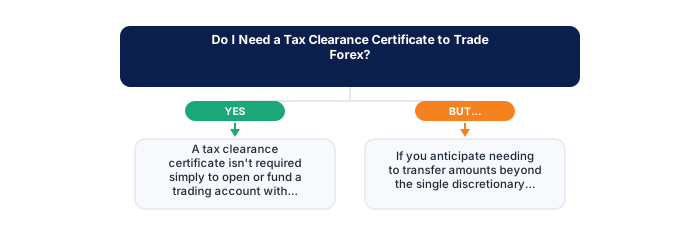
A tax clearance certificate isn't required simply to open or fund a trading account with an FSCA-regulated broker.
It may become relevant for larger cross-border transfers under the SARB foreign investment allowance rules, where SARS clearance can form part of the compliance process.
📋 ON THIS PAGE
1. When a tax clearance certificate is not needed
For the large majority of South African traders using a local FSCA-regulated broker and funding their account through standard EFT or card deposit methods, no tax clearance certificate is required at any point in this process. Opening a trading account, depositing funds domestically, and withdrawing profits back to a South African bank account generally doesn't trigger this specific requirement.
It's worth confirming this genuinely describes your own situation before assuming it applies automatically, most South African retail traders using a domestic ZAR account do fall squarely within this straightforward category, but it's worth double-checking against your own specific funding and withdrawal pattern rather than assuming without verification.
SARS does not automatically receive your trading profits from your broker. You must declare all trading income on your annual ITR12. Non-disclosure attracts interest, penalties, and potential audit.
| Allowance | Tax Clearance Needed? | Typical Use |
|---|---|---|
| Single Discretionary Allowance | No, up to the annual limit | Everyday transfers, smaller trading capital |
| Foreign Investment Allowance | Yes | Larger transfers beyond the discretionary limit |
2. When it might become relevant for larger transfers
South Africans can move funds offshore under two main allowance categories, and for amounts exceeding the single discretionary allowance specifically, accessing the foreign investment allowance generally requires obtaining tax clearance from SARS as part of the application process through an authorised dealer (typically your bank).
It's worth tracking your cumulative annual transfers if you're moving money offshore periodically rather than in one lump sum, since it's the total amount within a given period that determines which allowance category and requirements apply, not simply the size of any single individual transfer viewed in isolation.
- Download annual trade statement from broker
- Identify all profits and losses with dates
- Determine revenue vs capital gains classification
- Calculate provisional tax liability for both periods
- File ITR12 within the SARS filing season deadline
- Keep all supporting documentation for 5 years
- Capital gains: lower effective rate
- R50,000 annual CGT exclusion
- CGT losses offset future gains
- Only 40% of gain included in taxable income
- Revenue: full marginal rate up to 45%
- No annual exclusion for revenue income
- Must register as provisional taxpayer
- SARS scrutiny on active traders
3. The difference between the two SARB allowance categories
The single discretionary allowance, generally up to a specified annual amount, doesn't require this additional tax clearance step. The larger foreign investment allowance, covering amounts beyond this threshold, does generally require this SARS clearance as part of the broader compliance process, this distinction matters specifically for traders moving larger sums to fund an offshore brokerage account directly.
It's worth checking the current specific threshold for the single discretionary allowance directly with your bank or SARS, rather than relying on a figure that may become outdated, since these thresholds can be adjusted over time and confirming the current, accurate figure matters more than working from memory of a number you encountered previously.
4. How the clearance process generally works
Obtaining tax clearance for foreign investment purposes generally involves applying through SARS, confirming your tax affairs are in good standing, before your bank, acting as an authorised dealer, will process the larger cross-border transfer. This process can take some time to complete, making it worth planning well in advance if you anticipate needing to move a larger sum offshore.
It's worth starting this process considerably earlier than you think you'll need it, particularly if you're working toward a specific deadline for funding an offshore account, since unexpected delays in confirming your tax affairs are genuinely in good standing can add meaningfully to the overall timeline beyond the clearance application itself.
| Factor | Revenue trading | Capital gains |
|---|---|---|
| Tax rate | Up to 45% marginal | Effective 18% max |
| Taxable amount | 100% of profit | 40% of gain |
| Annual exclusion | None | R50,000 per year |
| Losses | Offset against income | Offset against capital gains only |
5. This is separate from your annual tax return obligation
It's worth distinguishing this transfer-specific clearance process from your ongoing, separate obligation to declare trading income on your annual tax return, the clearance certificate relates specifically to the mechanics of moving larger sums across South Africa's exchange control border, while your annual return obligation exists regardless of whether any cross-border transfer has occurred at all.
This is worth keeping conceptually distinct in your own planning, since a trader might correctly complete the transfer-specific clearance process while still separately falling behind on their broader annual filing obligation, or vice versa, the two processes address genuinely different compliance requirements that don't automatically satisfy each other.
6. Practical steps if you plan larger transfers
If you anticipate needing to transfer amounts beyond the single discretionary allowance threshold, discussing this specific plan with your bank's authorised dealer department well in advance, and ensuring your SARS tax affairs are current and in good standing, helps avoid delays when the actual transfer becomes necessary.
It's also worth knowing that any FSCA-regulated broker operating in South Africa is bound by POPIA (the Protection of Personal Information Act), which governs how your personal and financial data must be collected, stored, and protected.
South African traders face a tax environment that is more nuanced than most international trading guides acknowledge. SARS classifies trading income based on the totality of facts rather than a single bright-line test. The key factors include trading frequency, position holding periods, the sophistication of the approach, whether trading represents a primary or significant secondary income source, and whether the trader has demonstrated a consistent profit-seeking intent. Two traders with identical profit amounts can receive different tax treatment depending on these broader contextual factors. Maintaining a detailed trading journal that documents intent, strategy, and approach from the outset creates contemporaneous evidence that supports your preferred classification if SARS ever raises a query. Annual review with a registered tax practitioner who has experience in trading income matters is the most reliable approach as your activity evolves.
Larger transfers beyond it require a tax clearance certificate.
Routine deposits within the R2 million single discretionary allowance don't need a tax clearance certificate. Larger transfers under the foreign investment allowance do require one.
★ Why It Matters
A timing detail that trips people up: the tax clearance process for larger transfers can take longer than expected if your tax affairs aren't fully up to date, so checking your own SARS compliance status before you need a large transfer urgently is worth doing well in advance.
✕ Common mistakes
- Assuming this is required for routine, modest deposits. It's typically only relevant for larger transfers under the foreign investment allowance.
- Leaving tax affairs unresolved until a transfer is urgently needed. Clearance processing can take longer than expected if compliance issues exist.
- Confusing this certificate with general FICA verification. These are separate processes serving different regulatory purposes.
- Not checking SARS compliance status well in advance of a planned transfer. Early checking avoids unnecessary delays later.
Key Takeaways
- A tax clearance certificate isn't required simply to open a trading account, but may be needed for certain larger cross-border fund transfers under SARB rules.
- A tax clearance certificate isn't required simply to open or fund a trading account with an FSCA-regulated broker.
- It may become relevant for larger cross-border transfers under the SARB foreign investment allowance rules, where SARS clearance can form part of the compliance process.
- When a tax clearance certificate is not needed.
- When it might become relevant for larger transfers.
Frequently asked follow-up questions
How long does obtaining tax clearance typically take?
This varies, making it worth starting the process well in advance of when you actually need to complete a larger transfer, rather than leaving it until the last moment.
Does this apply if my broker is based in South Africa?
Generally not, since funding a South African-based broker doesn't typically involve the cross-border transfer this clearance process specifically relates to.
Can my bank handle this process for me?
Your bank, acting as an authorised dealer, typically guides you through the necessary steps, though confirming your own SARS tax affairs are current remains your own responsibility.
Does having outstanding tax debt automatically disqualify me from getting clearance?
Outstanding, unresolved tax issues can delay or complicate obtaining clearance; resolving any genuine outstanding matters with SARS first generally smooths this process considerably.
Is tax clearance a one-time certificate or does it need renewing for each transfer?
Tax clearance for this purpose is typically tied to a specific transaction or application rather than being a permanent, reusable certificate, meaning a fresh clearance process generally applies for each significant transfer.
