i Short answer
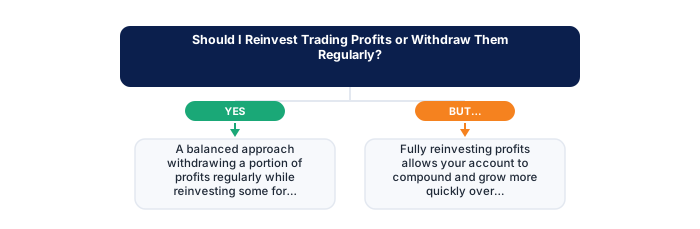
A balanced approach, withdrawing a portion of profits regularly while reinvesting some for continued growth, generally suits most traders better than either extreme.
📋 ON THIS PAGE
1. The case for fully reinvesting profits
Fully reinvesting profits lets your account compound and grow more quickly over time, since position sizing scales with account growth, a larger account balance, applying the same disciplined risk percentage, can produce larger absolute profits going forward, assuming continued validated strategy performance.
It's worth being clear-eyed that this compounding benefit assumes continued, genuine profitability, which isn't guaranteed, a fully reinvested account grows faster during good periods but also carries more accumulated capital exposed during a genuinely difficult stretch, worth weighing this asymmetry deliberately.
2. The case for regularly withdrawing profits
Regularly withdrawing some profits provides genuine, realised financial benefit you can actually use, reduces your overall account's exposure to the cumulative risk of an eventually larger, fully-compounded balance, and can provide psychological reassurance that your trading activity is producing tangible, real-world value beyond simply a growing number on a screen.
It's worth appreciating this reduced exposure benefit concretely, funds withdrawn from your trading account are, by definition, no longer at risk to any future trading loss, a genuine, tangible form of risk management alongside the position-sizing discipline discussed throughout this site.
- South African ID or valid passport
- Proof of residential address dated within 3 months
- Proof of bank account ownership
- Selfie or photo for biometric verification (some brokers)
- Source of funds declaration if depositing above threshold
Choose FSCA-regulated broker
Verify the FSP number is current at fsca.co.za.
Submit FICA documents
SA ID, proof of address within 3 months, bank account proof.
Fund via EFT
Make the initial deposit from your SA bank account in ZAR.
Open demo account first
Practice on demo before activating your live account.
Start with minimum capital
Begin with an amount you can afford to lose while learning.
3. The psychological dimension of this decision
Some traders find that never withdrawing anything can create an unhealthy, purely abstract relationship with their results, adding to the wellbeing concerns trading can sometimes bring, while regular, even modest withdrawals can reinforce a more grounded, realistic sense of trading's genuine, tangible benefit.
It's worth checking in with your own relationship to your results honestly, if your account balance feels more like an abstract scoreboard than something connected to genuine, usable value, occasional withdrawals can help reconnect your trading to its actual underlying financial purpose.
4. A balanced middle-ground approach worth considering
Many traders adopt a predetermined rule, perhaps withdrawing a fixed percentage of profits above a certain account threshold each month or quarter, while reinvesting the remainder, giving both genuine, tangible benefit and continued account growth, rather than committing entirely to either extreme.
It's worth writing this specific rule down explicitly, in the same way any other trading or financial decision benefits from being documented, rather than deciding on withdrawals ad hoc each time, a predetermined rule removes the temptation to make this decision reactively based on how a particular month happened to go.
| Rejection reason | Fix |
|---|---|
| Address proof older than 3 months | Get a recent utility bill or bank statement |
| Name mismatch between documents | Use documents with exactly matching full name |
| Poor quality scan | Retake with good lighting, all corners visible |
| PO Box address | Brokers require physical residential address only |
5. How your broader financial goals should inform this choice
Your broader financial goals, building toward a larger trading account, or generating regular supplementary income, should genuinely inform this choice, tied to the same thinking behind separating speculative from investment capital, rather than defaulting to one approach without this kind of deliberate consideration.
6. Revisiting this decision periodically as circumstances change
As your account size, broader financial circumstances, and trading goals evolve over time, periodically revisiting this withdrawal-versus-reinvestment decision, part of the same broader capital allocation review, ensures your approach continues genuinely reflecting your current situation rather than an earlier, potentially outdated decision.
Withdrawing regularly reinforces trading as real income and derisks gains.
Reinvesting profits compounds the account over time but demands strict percentage-based sizing discipline. Regular withdrawals derisk gains and reinforce trading as genuinely producing real income.
★ Why It Matters
Worth tracking: your own psychological reaction to a losing trade when 100% of profits are reinvested versus when a portion has already been withdrawn and feels "banked." Many traders report meaningfully different risk tolerance depending on this, worth knowing about yourself before choosing a policy.
✕ Common mistakes
- Reinvesting 100% of profits without testing how this affects your risk tolerance. Some traders take on more risk once profits feel like 'house money'.
- Withdrawing everything immediately without allowing any account growth. This can limit your ability to scale position sizing over time.
- Not having any explicit policy and deciding ad hoc each time. An inconsistent approach makes performance harder to evaluate over time.
- Ignoring your own psychological reaction to reinvested versus withdrawn profit. This personal factor matters as much as the mathematical trade-off.
Is this reported to SARS automatically?
A local broker issues an IT3(b) and SARS increasingly receives offshore data through CRS and CARF. Declaring remains yours. Broker reporting to SARS covers what arrives and when.
Decisions about withdrawing versus reinvesting trading profits involve both financial planning and trading psychology considerations. Regularly withdrawing a proportion of trading profits, even a small amount, provides tangible evidence that trading is generating real value and reinforces the discipline of treating trading as a productive activity rather than purely a capital appreciation exercise. South African traders should also consider the SARS tax timing implications of withdrawals, since unrealised profits within the trading account are not typically taxable until realised.
Key Takeaways
- A balanced approach withdrawing a portion of profits regularly while reinvesting some for account growth suits most traders better than either extreme alone.
- A balanced approach, withdrawing a portion of profits regularly while reinvesting some for continued growth, generally suits most traders better than either extreme.
- The case for fully reinvesting profits.
- The case for regularly withdrawing profits.
- The psychological dimension of this decision.
See also: Can I Retire Early in South Africa?.
Frequently asked follow-up questions
Is there a standard recommended withdrawal percentage?
There's no universal figure. Many traders choose a specific percentage reflecting their own personal financial goals and risk tolerance.
Does withdrawing profits affect my tax obligations?
Tax liability generally arises from realised trading profits regardless of whether you withdraw or reinvest them, a separate consideration from the withdrawal decision itself.
Should beginners withdraw profits immediately or build their account first?
Many beginners initially focus on reinvesting to build sufficient account size, avoiding undercapitalisation, before establishing a regular withdrawal pattern once their account reaches a more comfortable working size.
