i Short answer
An authorised FSP holds the actual FSCA licence directly and bears primary regulatory responsibility.
A representative operates under that FSP's licence on its behalf, subject to the FSP's own compliance supervision.
📋 ON THIS PAGE
1. What an authorised FSP actually is
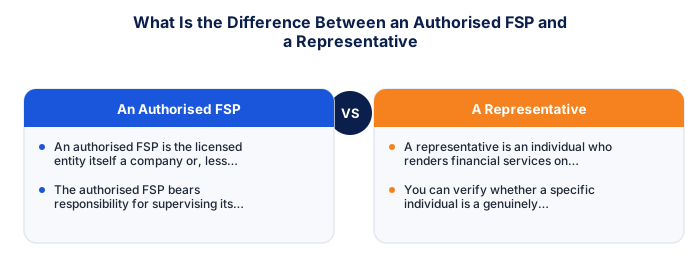
An authorised FSP is the licensed entity itself, a company or, less commonly, an individual, that has gone through the FSCA's licensing process and holds direct regulatory responsibility for the financial services it provides. This is the entity whose licence number you'd verify when checking a broker's regulatory status, and which bears ultimate accountability for compliance with FAIS and other applicable regulation.
It's worth checking this specific FSP status directly through the FSCA register, discussed throughout this site's legal content, since this is the foundational licence that everything else in this regulatory structure depends on.
| Feature | Authorised FSP | Representative |
|---|---|---|
| What it is | The licensed company itself | An individual working for the FSP |
| Licence held | Full FSP licence from the FSCA | Individual authorisation under the FSP |
| Accountability | Bears ultimate responsibility | Supervised by the FSP |
| How to verify | FSCA register, by company name | FSCA register, by individual name |
| Can operate independently | Yes, within its licence scope | No, only under FSP supervision |
2. What a representative is and does
A representative is an individual who renders financial services on behalf of an authorised FSP, typically an advisor, broker consultant, or salesperson who interacts directly with clients but doesn't hold an independent FSCA licence themselves. Representatives must meet specific competency and fit-and-proper requirements under FAIS and must be registered with the FSCA under their sponsoring FSP's licence.
It's worth understanding why this individual-level authorisation exists as a separate layer, an FSP's overall licence doesn't automatically authorise every individual employee to provide advice or services, each representative needs their own specific, verifiable authorisation.
- FSCA-regulated broker verified at fsca.co.za
- Demo account tested for minimum 60 days
- Trading plan written: entry, exits, position sizing
- Risk per trade defined (1-2% of account)
- Backup internet connection tested for load shedding
- Tax implications understood
3. The supervision relationship between FSP and representative
The authorised FSP bears responsibility for supervising its representatives, ensuring they comply with FAIS requirements including the Section 45 disclosure, and maintaining appropriate compliance oversight. This supervisory relationship means a representative's conduct ultimately reflects on, and can create liability for, the sponsoring FSP itself.
It's worth appreciating what this supervision relationship means practically for accountability, the FSP bears ultimate responsibility for its representatives' conduct, giving you a clear, identifiable entity to hold accountable if a specific representative's guidance or conduct falls short.
4. How to verify someone is a genuine, registered representative
You can verify whether a specific individual is a genuinely registered representative, and under which authorised FSP, through the FSCA's public register, using the same process as broader broker licence verification. This verification step is worthwhile if you're receiving financial guidance from an individual claiming to represent a specific firm, since this confirms both their registration status and their genuine connection to the firm they claim to represent.
It's worth doing this specific verification for anyone claiming to offer you personalised financial guidance, rather than assuming their employment with a properly licensed FSP automatically extends this authorisation to them individually.
| Item | Detail |
|---|---|
| Regulator | FSCA, fsca.co.za |
| Exchange control | SARB, resbank.co.za |
| Tax authority | SARS, sars.gov.za |
| JSE hours | 09:00-17:00 SAST Mon-Fri |
| Best forex session | 15:00-17:00 SAST |
| CGT annual exclusion | R50,000 (individuals) |
5. Why this distinction matters for accountability
Understanding this distinction matters because it clarifies where regulatory accountability ultimately sits, complaints or concerns about a representative's conduct through the FSCA complaints process are generally directed at or involve the sponsoring authorised FSP, since the FSP bears the primary licensing responsibility and supervisory duty for its representatives' conduct.
It's worth keeping this two-layer structure clearly in mind whenever you're evaluating who's providing you guidance, checking both the underlying FSP's licence and the specific individual's representative status gives you a complete picture of the genuine accountability actually in place.
6. Practical checks before trusting financial guidance
Before acting on guidance from anyone presenting themselves as a financial services representative, confirming both their individual registration status and the authorised FSP they represent through the FSCA's public register provides meaningful protection against unauthorised or misrepresented financial guidance, complementing broader broker verification practices generally.
A representative acts under the FSP's licence and supervision.
An authorised FSP holds its own FSCA licence and is primarily accountable for conduct. A representative operates under that FSP's licence, supervised by a Key Individual, not independently licensed.
★ Why It Matters
Worth checking: search both the FSP's licence number and the individual representative's own name on the FSCA register separately. A properly licensed FSP can still have a representative who isn't currently authorised to act on its behalf, these are two distinct things worth verifying independently.
✕ Common mistakes
- Assuming all staff at a licensed firm are automatically authorised representatives. Individual authorisation status should be checked on the register directly.
- Not understanding which party bears primary regulatory responsibility. This affects where accountability actually sits in a dispute.
- Treating FSP and representative status as a single combined check. These are genuinely two separate things worth verifying independently.
Key Takeaways
- An authorised FSP holds the actual FSCA licence, while a representative operates under that licence on the FSP's behalf, subject to specific FAIS oversight.
- An authorised FSP holds the actual FSCA licence directly and bears primary regulatory responsibility.
- A representative operates under that FSP's licence on its behalf, subject to the FSP's own compliance supervision.
- What an authorised FSP actually is.
- What a representative is and does.
See also: What Is a Section 45 Disclosure and Why Does It Matter? and What Is Market Manipulation and Could I Be Accused of It?.
Frequently asked follow-up questions
Can a representative operate independently of any FSP?
No, by definition a representative operates under an authorised FSP's licence; an individual offering financial services independently would need to hold their own FSP authorisation.
Does a representative need separate qualifications from the FSP itself?
Yes, representatives must individually meet FAIS competency and fit-and-proper requirements, registered specifically under their sponsoring FSP.
Is this distinction relevant to forex and CFD brokers specifically?
It can be, particularly if you're dealing with an individual broker consultant or advisor rather than directly with the broker entity itself, making verification of both layers worthwhile.
What happens to a representative if their sponsoring FSP loses its licence?
A representative's authorisation is tied to their sponsoring FSP, so if that FSP's licence is suspended or revoked, the representative generally can no longer operate under that specific authorisation either.
Can one representative work for multiple different FSPs at the same time?
This is possible in some circumstances depending on the specific FAIS registration arrangements involved, though it's worth confirming directly which specific FSP a representative is acting for in any given interaction.
