What this page covers
Since September 2024 a South African retirement fund splits new contributions in two. One third goes to a savings component you may draw on once a year; two thirds go to a retirement component locked until retirement.
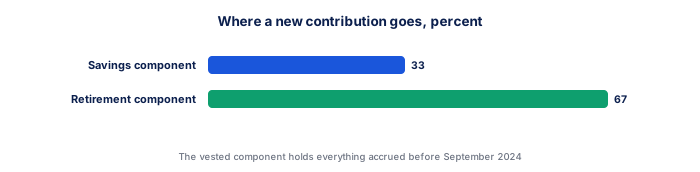
| Component | Where contributions go | Access before retirement |
|---|---|---|
| Savings | One third of new contributions | One withdrawal per tax year |
| Retirement | Two thirds of new contributions | None, must be annuitised at retirement |
| Vested | Everything accrued before 1 September 2024 | Under the old rules |
| Item | Rule |
|---|---|
| Frequency | Once per tax year |
| Minimum withdrawal | R2,000 |
| Maximum | The full savings component balance |
| Tax | At your marginal rate, as ordinary income |
| Fee | The fund may charge an administration fee per withdrawal |
| Taxable income | Marginal rate | Tax on a R30,000 withdrawal | Net received |
|---|---|---|---|
| R250,000 | 26% | R7,800 | R22,200 |
| R450,000 | 31% | R9,300 | R20,700 |
| R650,000 | 36% | R10,800 | R19,200 |
| R900,000 | 41% | R12,300 | R17,700 |
| R2,000,000 | 45% | R13,500 | R16,500 |

Download this data
Every table on this page as a spreadsheet, with the source and the date it was checked in the header rows.
⬇ Download CSVHow these figures work
The figures on this page come from published sources and change on a schedule rather than continuously, which is what makes them worth recording in one place. A savings withdrawal is taxed as income, not at the retirement lump sum rates. That is the point most people miss: it is the most expensive way to access retirement money short of resigning.
The withdrawal is added to your income for the year, so it can push you into a higher bracket and raise the tax on everything else.
★ A worked example
Reading the tables together is where the value is. Seed capital moved into the savings component at implementation was capped at 10% of the vested balance or R30,000, whichever was lower.
✕ Common mistakes
- A savings withdrawal is taxed as income, not at the retirement lump su. A savings withdrawal is taxed as income, not at the retirement lump sum rates. That is the point most people miss: it is the most expensive way to access retirement money short of resigning.
- The withdrawal is added to your income for the year, so it can push yo. The withdrawal is added to your income for the year, so it can push you into a higher bracket and raise the tax on everything else.
- Seed capital moved into the savings component at implementation was ca. Seed capital moved into the savings component at implementation was capped at 10% of the vested balance or R30,000, whichever was lower.
- Taking a figure without its date. A number from a reference page is only as good as when it was last checked, which is why the date sits at the top of this one.
Notes on reading these figures
- A savings withdrawal is taxed as income, not at the retirement lump sum rates. That is the point most people miss: it is the most expensive way to access retirement money short of resigning.
- The withdrawal is added to your income for the year, so it can push you into a higher bracket and raise the tax on everything else.
- Seed capital moved into the savings component at implementation was capped at 10% of the vested balance or R30,000, whichever was lower.
To put these figures to work, the Two-Pot Withdrawal Tax Calculator runs the arithmetic on your own numbers, and Using a two-pot withdrawal for trading capital covers the same ground in ordinary language. Repeat two-pot withdrawals and Retirement Fund Contribution Limits go into the detail this table only summarises. The SARS Income Tax Tables covers the part this table leaves out.
Put this table on your own site
The table below can sit on your own page and stays current without you editing anything.
- Preview the embeddable table as it will appear on your site
Place this snippet on your page and the table is embedded live, rather than copied and left to age.
<iframe src="https://www.tradeanswers.co.za/embed/ref-two-pot-retirement-system-reference.html" width="100%" height="620" style="border:0" title="Two-Pot Retirement System Reference"></iframe>Free to use with attribution. The link back to this page is built into the embed.
Terms used on this page
Frequently asked questions
How often can I withdraw from the savings component?
Once per tax year, with a minimum of R2,000. The year runs 1 March to the end of February.
How is a savings withdrawal taxed?
At your marginal rate, as ordinary income. It is not taxed on the retirement lump sum table, which is why it is expensive.
Can I access the retirement component early?
No. It is locked until retirement and must then be used to buy an annuity, with limited exceptions.
What is the vested component?
Everything accrued before 1 September 2024. It stays under the rules that applied when it was contributed.
Does a withdrawal affect my tax bracket?
Yes. It is added to your income for the year, so a large withdrawal can push other income into a higher bracket.
Was there an opening balance in the savings component?
Yes, seeded at 10% of the vested balance or R30,000, whichever was lower.