i Short answer
Step away briefly from active trading immediately afterward, avoid retaliatory trades, and honestly review what happened once emotions have settled.
Reconnecting the loss to your strategy's known, accepted risk parameters helps, rather than treating it as an isolated catastrophe.
📋 ON THIS PAGE
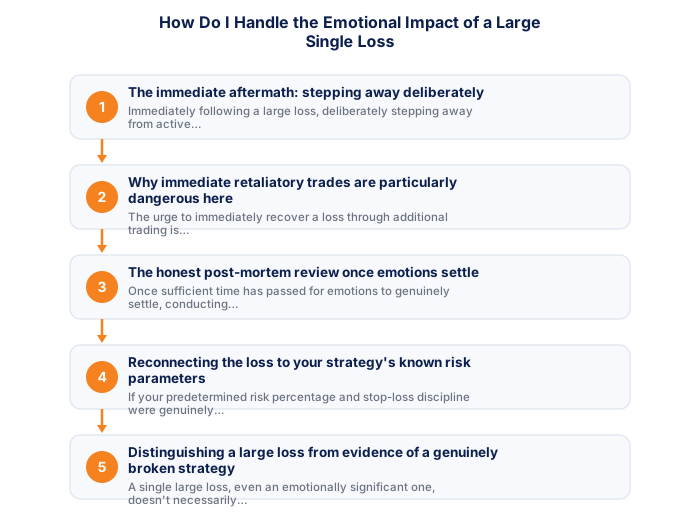
- The immediate aftermath: stepping away deliberately
- Why immediate retaliatory trades are particularly dangerous here
- The honest post-mortem review once emotions settle
- Reconnecting the loss to your strategy's known risk parameters
- Distinguishing a large loss from evidence of a genuinely broken strategy
- Seeking support if the emotional impact feels overwhelming
1. The immediate aftermath: stepping away deliberately
Right after a large loss, deliberately stepping away from active trading and chart-watching for a while, rather than continuing to trade through the immediate emotional aftermath, gives the acute intensity time to settle before you make any further decisions. This is the same cooling-off principle behind revenge trading prevention.
It's worth deciding on this specific step-away duration in advance, as part of your broader trading plan, rather than trying to judge in the moment how long feels appropriate, a predetermined rule removes the difficult, emotionally-compromised decision of judging your own readiness to return while still genuinely affected by the loss.
2. Why immediate retaliatory trades are particularly dangerous here
The urge to immediately recover a loss through more trading is especially intense after a large one, given the heightened emotional state that scale of loss naturally produces, which is exactly when structural safeguards matter most.
It's worth having a specific, concrete safeguard in place before this moment ever arrives, whether that's a hard daily loss limit that locks you out of further trading, or simply a firm personal rule to close the platform entirely, relying on willpower alone during exactly this heightened emotional state is precisely the unreliable foundation discussed elsewhere on this site regarding discipline generally.
- Emotional state is neutral
- Yesterday's results not influencing today
- Trading plan is open and reviewed
- Loss limit for today defined and accepted
- Phone notifications silenced
- Backup connectivity confirmed
- Written rules eliminate in-the-moment decisions
- Journalling creates a feedback loop for improvement
- Pre-session checks reduce emotionally-driven entries
- Regular breaks prevent compounding mistakes
- Building discipline requires active daily effort
- Losses immediately test emotional stability
- No external accountability in retail trading
- Social pressure to perform can override rules
Write your trading plan
Entry rules, risk rules, and conditions to NOT trade, all in writing.
Pre-session check
Check your emotional state before opening your platform. Skip if not neutral.
Execute only plan setups
Take only positions that fully match your written criteria.
Journal after each trade
Record rationale, emotion at entry, and outcome immediately after closing.
Weekly rules review
Assess rule adherence weekly. Adjust strategy based on evidence, not emotion.
3. The honest post-mortem review once emotions settle
Once enough time has passed for emotions to actually settle, an honest post-mortem, checking whether your predetermined strategy criteria and stop-loss discipline were actually followed, or whether some deviation made the loss worse than it needed to be, gives you useful diagnostic information, separate from the immediate emotional reaction.
It's worth genuinely waiting until you feel calm before conducting this review, rather than rushing into it out of anxiety to understand what happened, a review conducted while still emotionally activated tends to produce either excessive self-blame or defensive rationalisation, neither of which gives you the honest, balanced assessment this process is meant to provide.
4. Reconnecting the loss to your strategy's known risk parameters
If your predetermined risk percentage and stop-loss discipline were actually followed, then even a "large" loss in absolute terms is just your accepted risk materialising as one normal outcome within the range your strategy's statistical edge already accounts for. Reframing it this way, where it's actually accurate, can meaningfully lighten its outsized emotional weight.
It's worth actually pulling up your strategy's backtested or historical maximum drawdown figures during this review specifically, seeing concretely that a loss of this size falls within, or even below, your strategy's known statistical range provides more genuine reassurance than simply trying to convince yourself abstractly that it was 'normal.'
5. Distinguishing a large loss from evidence of a genuinely broken strategy
A single large loss, even an emotionally significant one, doesn't necessarily mean your strategy is broken. Checking whether it falls within your strategy's known, tested range of outcomes helps you tell a normal, if uncomfortable, result apart from a genuine signal that the strategy needs reconsidering.
It's worth applying the same sample-size thinking here that applies to losing streaks more broadly, discussed elsewhere on this site, a single large loss, however painful, is one data point, and drawing conclusions about your strategy's genuine viability from one data point alone risks exactly the kind of premature strategy abandonment that undermines otherwise sound, statistically favourable approaches.
6. Seeking support if the emotional impact feels overwhelming
If a large loss's emotional impact feels genuinely overwhelming, noticeably affecting your mood, sleep, or day-to-day functioning beyond what feels proportionate even accounting for how hard this is, talking to trusted friends, family, or a mental health professional is a reasonable, constructive response worth taking seriously.
Immediately after a large loss, deliberately stepping away from active trading helps. Once emotions genuinely settle, an honest post-mortem checks whether your predetermined risk discipline was actually followed.
★ Why It Matters
A distinction worth making for yourself immediately afterward: was this loss within your predetermined risk parameters (meaning the system worked exactly as designed, even though it doesn't feel that way), or did it exceed them, the appropriate response differs significantly between these two cases.
✕ Common mistakes
- Reacting immediately with a retaliatory trade. This is one of the clearest paths into a deeper, compounding loss.
- Reviewing the loss in detail while still emotionally affected. Same-day post-mortems tend to produce distorted, overly harsh conclusions.
- Treating every large loss as evidence the strategy has failed. A single loss, even a large one, is rarely sufficient evidence either way.
Will my stop fill at the price I set?
It fills at the next available price rather than the one you set. Over a weekend gap or a news release, that difference can be substantial. stop-loss against mental stop covers it in full.
Should I move my stop to breakeven?
It caps the downside and raises the chance of being stopped out by ordinary noise before the move completes. Whether that trade is worth it depends on the instrument's volatility. Stop-loss against mental stop covers it in full.
Key Takeaways
- Step away briefly, avoid immediate retaliatory trades, review what genuinely happened, and reconnect the loss to your strategy's known, accepted risk parameters.
- Step away briefly from active trading immediately afterward, avoid retaliatory trades, and honestly review what happened once emotions have settled.
- Reconnecting the loss to your strategy's known, accepted risk parameters helps, rather than treating it as an isolated catastrophe.
- The immediate aftermath: stepping away deliberately.
- Why immediate retaliatory trades are particularly dangerous here.
Frequently asked follow-up questions
How long should I wait before reviewing a large loss?
This varies by person, but waiting until the emotional intensity has actually settled, rather than reviewing in the rawest immediate aftermath, generally produces more useful, honest reflection.
Does a large loss always mean I should reduce my position sizing going forward?
Not automatically, provided it happened within your predetermined, tested risk parameters. Worth assessing honestly through the post-mortem above rather than reacting reflexively.
Is it normal to feel significant distress after a large trading loss?
Yes, that's a normal human response to real financial loss. The concern is when the distress becomes disproportionate or leads to undisciplined, retaliatory behaviour.
