i Short answer
The sunk cost fallacy leads traders to hold losing positions longer because of capital already committed, rather than evaluating current conditions.
📋 ON THIS PAGE
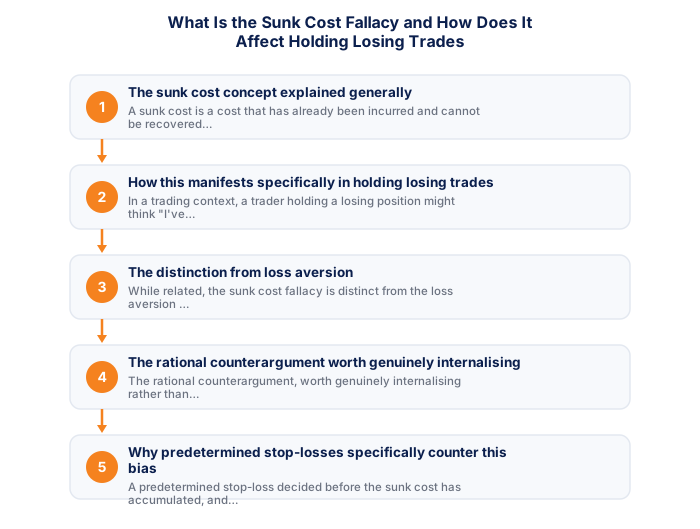
- The sunk cost concept explained generally
- How this manifests specifically in holding losing trades
- The distinction from loss aversion
- The rational counterargument worth genuinely internalising
- Why predetermined stop-losses specifically counter this bias
- Recognising sunk cost thinking in your own trading journal
1. The sunk cost concept explained generally
A sunk cost is a cost that has already been incurred and cannot be recovered regardless of future decisions. The sunk cost fallacy refers to the well-documented tendency to factor these unrecoverable past costs into present decisions, even though rational decision-making should, in principle, only consider future costs and benefits, treating sunk costs as genuinely irrelevant to forward-looking choices.
It's worth recognising this as a genuinely well-documented pattern across many life decisions beyond trading, people finish bad meals because they've already paid, stay in unsatisfying situations because of time already invested, worth appreciating this as a broad, near-universal human tendency.
2. How this manifests specifically in holding losing trades
In a trading context, a trader holding a losing position might think "I've already lost so much on this trade, I need to hold on until it recovers to justify this loss," treating the amount already lost as a reason to continue holding, rather than evaluating purely whether the position's current technical or fundamental outlook genuinely still supports continued holding from this point forward.
It's worth checking your own trading journal specifically for reasoning referencing how much you've already lost as a justification for continuing to hold, discussed elsewhere on this site regarding the disposition effect specifically, this closely related pattern often shows up alongside sunk cost thinking.
- FSCA-regulated broker verified at fsca.co.za
- Demo account tested for minimum 60 days
- Trading plan written: entry, exits, position sizing
- Risk per trade defined (1-2% of account)
- Backup internet connection tested for load shedding
- Tax implications understood
- Predictable cost per trade
- Widens less during news
- Better for news traders
- Slightly wider average
- Very low in calm markets
- Widens during high-impact news
- Lower average cost
- Better for swing traders
3. The distinction from loss aversion
While related, the sunk cost fallacy is distinct from loss aversion. Loss aversion concerns the disproportionate psychological pain of realising a loss generally, while the sunk cost fallacy specifically concerns using the magnitude of an already-incurred loss as a reason for a forward-looking decision, even though this magnitude is, strictly speaking, irrelevant to what should happen next.
It's worth understanding these as related but genuinely distinct biases, loss aversion is about the felt pain of a loss itself, while sunk cost specifically involves letting past, unrecoverable investment influence a forward-looking decision that should be evaluated independently of that history.
4. The rational counterargument worth genuinely internalising
The rational counterargument, worth genuinely internalising rather than simply intellectually acknowledging, is that the amount you've already lost on a specific position has no bearing whatsoever on what the position is likely to do next. The only relevant question is whether your current analysis, applied fresh to the position's present situation, still supports holding it, completely independent of how much has already been lost getting to this point.
It's worth practising this reframe explicitly whenever you notice sunk cost reasoning arising, asking yourself 'if I had no position at all right now, would I open this exact trade today' cuts through the psychological weight of your already-committed capital.
| Item | Detail |
|---|---|
| Regulator | FSCA, fsca.co.za |
| Exchange control | SARB, resbank.co.za |
| Tax authority | SARS, sars.gov.za |
| JSE hours | 09:00-17:00 SAST Mon-Fri |
| Best forex session | 15:00-17:00 SAST |
| CGT annual exclusion | R50,000 (individuals) |
5. Why predetermined stop-losses specifically counter this bias
A predetermined stop-loss decided before the sunk cost has accumulated, and then executed automatically regardless of how the trader might be reasoning about it once the loss is mounting, is exactly why this structural safeguard counters the sunk cost fallacy so effectively. The exit decision was made calmly in advance, before any sunk cost existed to distort the reasoning.
It's worth appreciating this connection explicitly, discussed throughout this site's risk management content, a stop-loss order set before you have any emotional investment in the trade's outcome protects you from exactly the kind of sunk-cost-driven decision-making that tends to emerge once real capital is genuinely at stake.
6. Recognising sunk cost thinking in your own trading journal
Reviewing your trading journal specifically for instances where you held a losing position past your original predetermined stop-loss level, and honestly examining your stated reasoning at the time, can reveal whether sunk cost thinking, explicitly or implicitly referencing the amount already lost as justification for continuing to hold, played a role in that specific decision.
The sunk cost fallacy causes traders to hold losing positions because of how much they've already lost, not because of current market analysis. The market doesn't care about your entry price. A hard stop removes this decision.
★ Why It Matters
Worth asking yourself directly at the moment of deciding whether to hold a losing position: if I had no position at all right now, would I open this trade today at the current price? The sunk cost fallacy is precisely the gap between this honest answer and what you're actually doing.
✕ Common mistakes
- Holding a losing position because of capital already committed to it. The honest question is whether you'd open this trade fresh today, not what's already been spent.
- Not asking the 'would I open this today' question directly and honestly. This specific test cuts through the sunk cost fallacy more effectively than general awareness alone.
- Treating the size of a loss as a reason to avoid closing the position. This reasoning is precisely the fallacy at work, not sound risk management.
- Continuing to add to a losing position to 'justify' the original commitment. This compounds the fallacy's cost rather than addressing the underlying decision.
Key Takeaways
- The sunk cost fallacy leads traders to hold losing positions longer because of capital already committed, rather than evaluating the trade's current merit.
- The sunk cost fallacy leads traders to hold losing positions longer because of capital already committed, rather than evaluating current conditions.
- The sunk cost concept explained generally.
- How this manifests specifically in holding losing trades.
- The distinction from loss aversion.
See also: How Do I Handle the Emotional Impact of a Large Single Loss? and How Do I Handle Comparison With My Own Past Trading Results?.
Frequently asked follow-up questions
Is the sunk cost fallacy unique to trading?
No, this is a well-documented general human cognitive bias affecting decisions across many domains, including business and personal finance decisions beyond trading specifically.
Can recognising this bias intellectually help me avoid it?
Intellectual awareness helps, but structural safeguards like predetermined stop-losses tend to be more reliable than relying on in-the-moment willpower alone.
Does this bias only apply to losing trades?
It's most commonly discussed regarding losing positions, though the same underlying pattern of referencing already-incurred costs can theoretically affect other trading-related decisions too.
