i Short answer
Anchoring bias leads traders to fixate on an initial reference price, often their own entry point, distorting judgement about whether current price genuinely represents good value.
📋 ON THIS PAGE
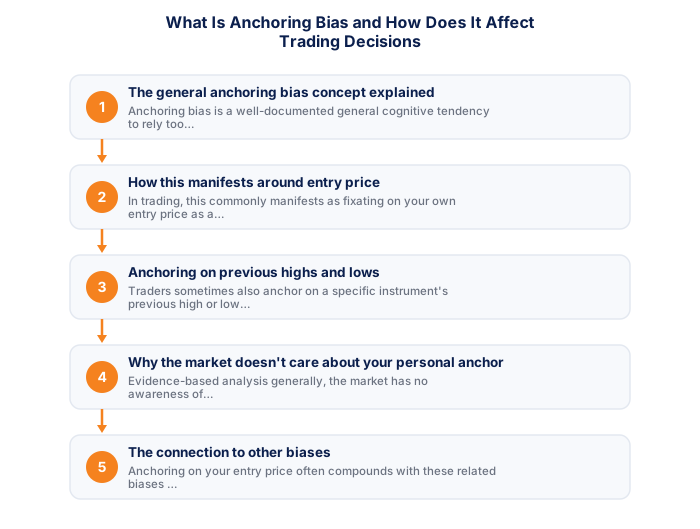
1. The general anchoring bias concept explained
Anchoring bias is a well-documented general cognitive tendency to rely too heavily on an initial piece of information, the "anchor," when making subsequent judgements, even when this anchor has no genuine logical bearing on the actual decision at hand.
It's worth understanding this as a genuinely well-documented cognitive pattern that affects decision-making far beyond trading specifically, this same anchoring tendency shows up in negotiations, price perception generally, and countless other judgement contexts, worth recognising it as a fundamental feature of human cognition rather than a trading-specific quirk.
2. How this specifically manifests around entry price
In trading, this commonly manifests as fixating on your own entry price as a reference point for evaluating a position's current status, rather than objectively assessing whether the current price level genuinely represents a good entry or exit opportunity based purely on present, independent analysis.
See also: What Is the Gambler's Fallacy in Trading?
Behavioural research calls this trading journal, and it explains why holding a losing position feels easier than closing it.
- Emotional state is neutral
- Yesterday's results not influencing today
- Trading plan is open and reviewed
- Loss limit for today defined and accepted
- Phone notifications silenced
- Backup connectivity confirmed
- Written rules eliminate in-the-moment decisions
- Journalling creates a feedback loop for improvement
- Pre-session checks reduce emotionally-driven entries
- Regular breaks prevent compounding mistakes
- Building discipline requires active daily effort
- Losses immediately test emotional stability
- No external accountability in retail trading
- Social pressure to perform can override rules
3. Anchoring on previous highs and lows
Traders sometimes also anchor on a specific instrument's previous high or low price, treating this historical level as inherently significant for future decisions, even when current market conditions and analysis, might not genuinely support this specific historical level's continued relevance.
It's worth distinguishing this from the genuine, technically meaningful use of support and resistance levels, discussed elsewhere on this site, a level becomes an anchoring bias specifically when you're fixating on it emotionally rather than treating it as one input within broader, deliberate technical analysis.
4. Why the market doesn't care about your personal anchor
Evidence-based analysis generally, the market genuinely has no awareness of or regard for your specific entry price or any other personal reference point, price moves based on the aggregated decisions of countless other participants, entirely independent of your own particular anchor.
It's worth internalising this specifically because it's easy to intellectually understand while still emotionally struggling with it, repeating this principle to yourself explicitly during moments when a personal anchor feels emotionally significant helps interrupt the bias's influence on your actual decision.
5. The connection to other biases
As, anchoring on your entry price often compounds with these related biases, wanting to "at least break even" relative to your personal anchor, rather than objectively assessing whether holding or closing genuinely makes sense given current, independent analysis.
It's worth mapping out these connections for your own trading psychology awareness, recognising that these biases often reinforce each other rather than operating independently helps you address the underlying pattern more effectively than treating each specific bias as an entirely separate problem.
6. Practical techniques to counter this bias
Criteria-based decision-making generally, deliberately evaluating a position based purely on current technical or fundamental analysis, rather than your personal entry price, and using predetermined exit criteria set independently of this anchor, helps counter this bias's natural pull.
Anchoring bias causes traders to over-weigh a reference price, like a round number or their entry price. The market doesn't know or care where you entered, making entry price anchoring particularly harmful.
★ Why It Matters
Something worth testing on yourself directly: review a recent trade and ask whether your exit decision was driven by current technical conditions or by a desire to get back to your original entry price, the anchor to your entry price is often invisible until you deliberately look for its influence.
✕ Common mistakes
- Fixating on your own entry price when deciding whether to exit. This anchor can distort judgement about whether current price genuinely represents good value.
- Not testing whether your exit decisions are driven by current conditions or your entry price. This specific check often reveals anchoring you weren't consciously aware of.
- Treating your entry price as inherently meaningful to the market. The market has no awareness of, or relationship to, your specific entry point.
- Anchoring on a previous price level long after conditions have changed. Stale anchors can persist well past their relevance.
Key Takeaways
- Anchoring bias leads traders to fixate on an initial reference price, distorting subsequent judgement about whether current levels represent genuine value.
- Anchoring bias leads traders to fixate on an initial reference price, often their own entry point, distorting judgement about whether current price genuinely represents good value.
- The general anchoring bias concept explained.
- How this specifically manifests around entry price.
- Anchoring on previous highs and lows.
See also: What Is Loss Aversion and How Does It Affect Trading Decisions? and What Is Outcome Bias and How Does It Distort Self-Assessment?.
Frequently asked follow-up questions
Is it ever useful to remember my entry price at all?
Yes, for calculating your actual profit or loss and risk-reward outcome, though this differs from letting it bias your forward-looking decision about whether to hold or close.
Does anchoring bias affect experienced traders too?
Yes, this is a general human cognitive tendency rather than something automatically eliminated through experience, making ongoing awareness valuable regardless of experience level.
Can anchoring ever work in my favour by coincidence?
Occasionally a decision influenced by this bias might coincidentally work out, but this reflects luck rather than sound process, and doesn't validate anchoring as a reliable approach.
How is anchoring different from the sunk cost fallacy?
They're related but distinct; anchoring concerns fixating on a reference point generally, while sunk cost specifically concerns reluctance to abandon something already invested in, discussed in detail elsewhere.
Can a trading journal help me identify my own anchoring patterns?
Yes, reviewing your past decisions can reveal whether you've been anchoring on entry prices or historical levels inappropriately.
