i Short answer
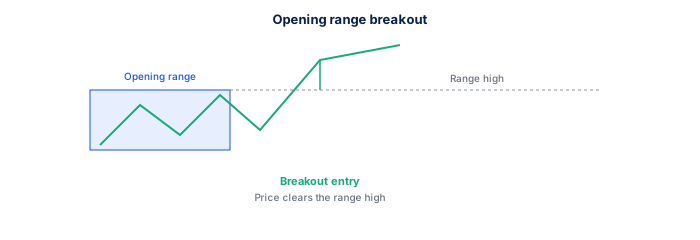
Opening range breakout trading defines a price range from the session's first specific period, then trades a subsequent break beyond that range.
This anticipates continued directional movement.
📋 ON THIS PAGE
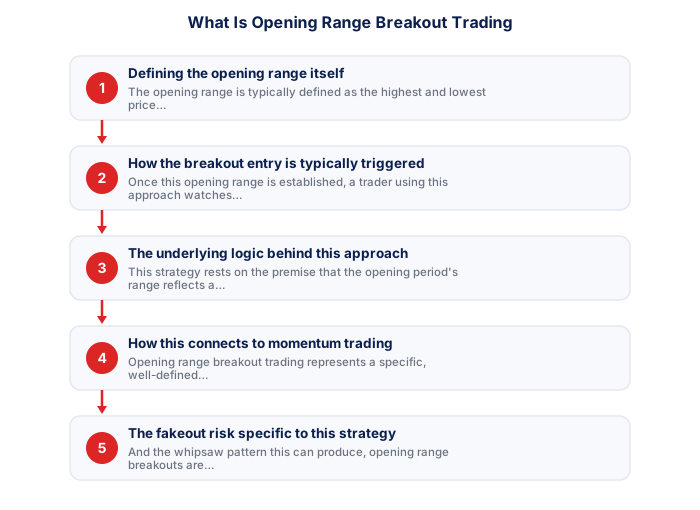
1. Defining the opening range itself
The opening range is typically defined as the highest and lowest price reached during a specific, predetermined early period of the trading session, commonly the first 15, 30, or 60 minutes, depending on the trader's chosen approach and the particular instrument's typical volatility.
It's worth testing a couple of different timeframe choices against your specific instrument and strategy through backtesting, rather than assuming a single standard duration works universally. A shorter opening range captures an earlier, sometimes noisier snapshot of price action, while a longer one gives a more settled range at the cost of a later, potentially less favourable entry point once a genuine breakout does occur.
2. How the breakout entry is typically triggered
Once this opening range is established, a trader using this approach watches for price to subsequently break decisively above the range's high (a bullish breakout) or below the range's low (a bearish breakout), often using a pending order placed just beyond each respective boundary to enter automatically once that breakout genuinely occurs.
Using a pending order here, rather than watching manually and reacting in real time, is worth appreciating as more than convenience, it removes the hesitation and second-guessing that can creep in when watching price approach a level live, letting your predetermined analysis execute exactly as planned rather than being subject to in-the-moment doubt.
- FSCA-regulated broker verified at fsca.co.za
- Demo account tested for minimum 60 days
- Trading plan written: entry, exits, position sizing
- Risk per trade defined (1-2% of account)
- Backup internet connection tested for load shedding
- Tax implications understood
3. The underlying logic behind this approach
This strategy rests on the premise that the opening period's range reflects a temporary equilibrium between early buyers and sellers, and that a decisive break beyond this established range, particularly with supporting volume, signals genuine directional conviction likely to continue for at least some further distance within that same session.
It's worth checking for genuine supporting volume specifically, where your platform provides this data, rather than treating any break beyond the range as equally meaningful. A breakout accompanied by a clear increase in trading activity carries more genuine conviction than one that barely clears the boundary on unremarkable volume, a distinction worth building into your specific entry criteria.
4. How this connects to momentum trading
Opening range breakout trading is a specific, well-defined application of the broader momentum philosophy, betting on continuation of a newly-established directional move rather than anticipating reversal, similar in underlying logic to momentum trading generally.
Understanding this connection is useful beyond simple categorisation, since it means the broader considerations that apply to momentum trading generally, being wary of chasing a move that's already extended, respecting that momentum can reverse suddenly, apply equally to this specific, more narrowly defined variant.
| Item | Detail |
|---|---|
| Regulator | FSCA, fsca.co.za |
| Exchange control | SARB, resbank.co.za |
| Tax authority | SARS, sars.gov.za |
| JSE hours | 09:00-17:00 SAST Mon-Fri |
| Best forex session | 15:00-17:00 SAST |
| CGT annual exclusion | R50,000 (individuals) |
5. The fakeout risk specific to this strategy
Opening range breakouts are genuinely susceptible to false signals, where price briefly breaks the range before reversing back within it, the same fakeout and whipsaw risk that affects breakout trading generally. This makes disciplined stop-loss placement particularly important for this strategy.
Some traders address this specific risk by requiring price to close beyond the range boundary on their chosen timeframe, rather than triggering on the first brief touch, adding a small confirmation delay that filters out at least some of the more fleeting, false breakouts at the cost of a marginally later, sometimes less favourable entry.
6. Practical considerations for South African day traders
Defining your opening range relative to whichever session you're actively trading, perhaps the London open given its convenient South African timing, rather than an arbitrary, unrelated time period, ensures this strategy genuinely aligns with the liquidity and volatility characteristics relevant to your actual trading window.
An opening range breakout strategy defines the high and low of the first 30-60 minutes as the range, then enters in the direction of the break when price moves decisively beyond it with volume confirmation.
★ Why It Matters
Worth backtesting for your own instrument: try a few different opening range durations (5, 15, and 30 minutes, for instance) rather than assuming a commonly cited default is optimal. The ideal range length appears to vary by instrument and even by typical volatility regime.
✕ Common mistakes
- Not backtesting different range durations for your own traded instrument. This testing reveals which specific duration genuinely works best for you.
- Trading every opening range breakout regardless of broader context. Some breakouts occur against a backdrop that makes continuation less likely.
- Ignoring volume confirmation when assessing a breakout's genuine strength. Volume can help distinguish a genuine breakout from a likely fakeout.
Key Takeaways
- Opening range breakout trading defines a price range from the session's first period, then trades a subsequent break beyond that established range.
- Opening range breakout trading defines a price range from the session's first specific period, then trades a subsequent break beyond that range.
- This anticipates continued directional movement.
- Defining the opening range itself.
- How the breakout entry is typically triggered.
Frequently asked follow-up questions
How long should the opening range period be?
This varies by trader preference and instrument, with 15-60 minutes being commonly cited options. Testing different periods through backtesting helps identify what suits your particular approach.
Does this strategy work on all instruments equally?
Effectiveness can vary by instrument's typical opening volatility and liquidity characteristics, making instrument-specific testing valuable.
Should I trade both bullish and bearish breakouts from the same range?
Many traders do prepare pending orders for both directions, since the opening range itself doesn't predict which direction will ultimately break, only that a breakout in either direction is anticipated.
