i Short answer
Predetermined partial-exit rules or trailing stop adjustments, decided in advance rather than reactively, support disciplined early profit-taking without abandoning your original strategy criteria. Try our free Profit/Loss Calculator to work through the numbers yourself.
📋 ON THIS PAGE
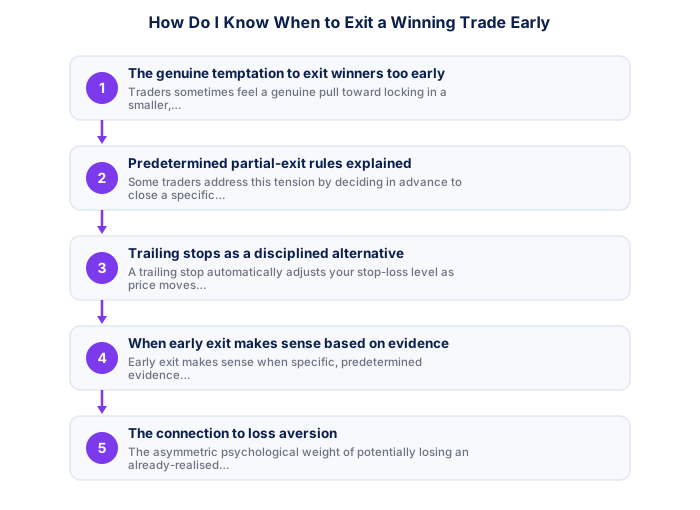
1. The genuine temptation to exit winners too early
As, traders sometimes feel a genuine pull toward locking in a smaller, currently-realised gain rather than risking that this gain might disappear if held toward the original, larger predetermined target, even when the underlying analysis supporting that original target hasn't genuinely changed.
It's worth recognising this specific feeling in the moment it arises, an urge to lock in gains that feels less like careful analysis and more like anxious relief, since noticing this distinction helps you tell a genuinely evidence-based early exit apart from one driven purely by loss aversion discussed elsewhere on this site.
2. Predetermined partial-exit rules explained
Some traders address this tension by deciding in advance to close a specific portion of their position once it reaches a certain profit threshold, while letting the remainder continue toward the original target, providing a structured, predetermined way to lock in some gain while still maintaining exposure to the original, larger anticipated move.
It's worth defining this specific threshold and portion size during calm, deliberate planning rather than deciding in the moment a trade happens to move favourably, a predetermined rule, 'close half at 1:1 risk-reward, let the rest run toward the original target,' removes the ambiguity that otherwise invites emotional, inconsistent decision-making.
- FSCA-regulated broker verified at fsca.co.za
- Demo account tested for minimum 60 days
- Trading plan written: entry, exits, position sizing
- Risk per trade defined (1-2% of account)
- Backup internet connection tested for load shedding
- Tax implications understood
3. Trailing stops as a disciplined alternative
As (see stop-loss), a trailing stop automatically adjusts your stop-loss level as price moves favourably, locking in progressively more profit as the trade develops, without requiring manual, reactive decisions at each specific point, this provides a structured way to protect accumulated gains while still allowing the position room to continue running.
It's worth testing your chosen trailing stop distance through backtesting before relying on it live, a trailing stop set too tight can exit you from a genuinely strong trend prematurely on normal price noise, while one set too wide gives back more profit than necessary before actually protecting your gains.
4. When early exit genuinely makes sense based on evidence
Early exit makes sense when specific, predetermined evidence suggests the original thesis has weakened, perhaps a clear reversal signal, or a significant fundamental development, rather than simply general anxiety about losing the currently-realised gain without this kind of specific, predetermined supporting evidence.
It's worth writing down in advance exactly what specific evidence would justify an early exit, rather than deciding this threshold reactively once a trade is already open and moving in your favour, having this criteria predetermined keeps your early exits evidence-based rather than emotionally reactive.
| Item | Detail |
|---|---|
| Regulator | FSCA, fsca.co.za |
| Exchange control | SARB, resbank.co.za |
| Tax authority | SARS, sars.gov.za |
| JSE hours | 09:00-17:00 SAST Mon-Fri |
| Best forex session | 15:00-17:00 SAST |
| CGT annual exclusion | R50,000 (individuals) |
5. The connection to loss aversion
The asymmetric psychological weight of potentially losing an already-realised gain, compared to never having had that gain in the first place, can distort exit decisions in ways disconnected from your strategy's actual underlying logic, recognising this bias explicitly helps distinguish genuine evidence-based exit decisions from purely anxiety-driven ones.
It's worth reminding yourself explicitly, in the moment this asymmetric pull arises, that an unrealised gain reduced back toward breakeven and a trade that was never profitable represent the same actual financial outcome, even though they feel very different, this reframe can help interrupt the emotional pull toward a premature, fear-driven exit.
6. Reviewing your exit decisions in your journal
Specifically reviewing your past early-exit decisions, checking what would have happened had you held toward the original target, provides valuable, evidence-based feedback on whether your specific early-exit tendency genuinely improves or actually harms your overall results over a meaningful sample.
Either way, letting the instrument's own volatility set the distance is sounder than picking a figure that looks tidy. volatility
Some traders address the pull toward locking in gains early by closing a specific portion of their position, while a trailing stop automatically adjusts as price moves favourably.
★ Why It Matters
Something worth journaling : every time you exit early, note both what you'd have made by holding to your original target and how you felt in the moment, over enough trades this reveals whether your early exits are protecting genuine, recurring risk or just chronic impatience.
✕ Common mistakes
- Exiting early based on a vague feeling rather than a predetermined rule. Reactive exits are harder to evaluate and learn from than planned ones.
- Not logging early exits and their actual hypothetical outcome. Without this data, it's hard to tell if early exits are helping or hurting.
- Treating every early exit as good risk management. Some early exits are simply impatience wearing a risk-management label.
- Changing your exit rules trade by trade. Inconsistent rules make it impossible to evaluate exit quality over time.
Key Takeaways
- Predetermined partial-exit rules or trailing stop adjustments support disciplined early profit-taking without abandoning your original strategy criteria reactively.
- Predetermined partial-exit rules or trailing stop adjustments, decided in advance rather than reactively, support disciplined early profit-taking without abandoning your original strategy criteria.
- The genuine temptation to exit winners too early.
- Predetermined partial-exit rules explained.
- Trailing stops as a disciplined alternative.
Frequently asked follow-up questions
Is it always wrong to exit a winning trade before the original target?
No, predetermined partial exits and trailing stops represent disciplined, planned early exit approaches distinct from purely reactive, anxiety-driven decisions.
How do I distinguish genuine evidence from anxiety when considering early exit?
Asking whether your specific reasoning was decided in advance as part of your strategy criteria, or arose purely in the moment from discomfort, helps make this distinction.
Does using a trailing stop guarantee better results than a fixed target?
Not guaranteed; this represents a different exit approach with its own trade-offs, rather than being universally superior to a fixed, predetermined target.
