i Short answer
A trading playbook documents your specific, recognised setups with predetermined entry, exit, and risk criteria for each one.
It supports consistent execution by giving you a clear, written reference.
📋 ON THIS PAGE
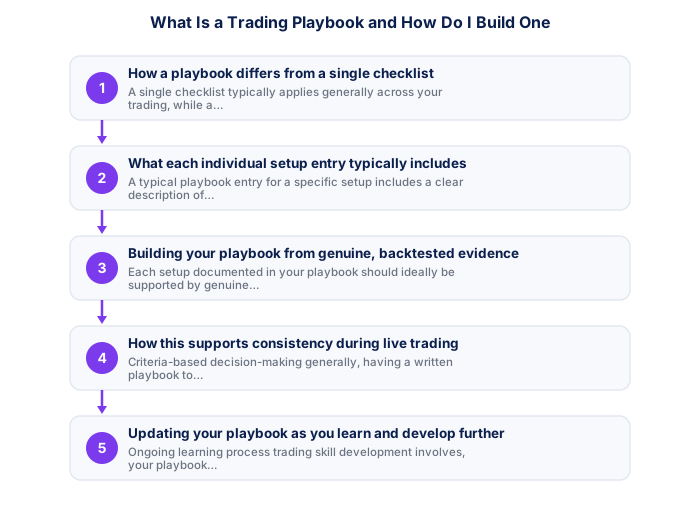
- How a playbook differs from a single checklist
- What each individual setup entry typically includes
- Building your playbook from genuine, backtested evidence
- How this supports consistency during live trading
- Updating your playbook as you learn and develop further
- A practical starting structure for your own playbook
1. How a playbook differs from a single checklist
A trading checklist applies uniformly to every trade, confirming basic conditions like trend alignment, risk-reward ratio, and stop placement before entry. A playbook goes one level deeper: it documents multiple distinct, named setups separately, each with its own specific criteria, typical context, and historical behaviour. Where a checklist asks 'does this trade meet my basic requirements?', a playbook asks 'which specific pattern am I looking at, and what do I know about how this pattern typically behaves?'
The distinction matters practically. A checklist can prevent bad trades; a playbook can help you execute good ones with more precision and confidence. A trader who recognises that a current setup matches a well-documented pattern in their playbook, with a documented win rate, typical hold time, and common failure mode, is making a fundamentally more informed decision than one who is applying generic criteria for the first time.
Building a playbook is also a process of defining what you're actually trading rather than the vague sense of 'I trade breakouts' or 'I follow trends.' Committing a pattern to a written playbook forces clarity about exactly what conditions it requires, what makes this instance different from a near-miss, and what the typical risk-reward profile looks like.
2. What each individual setup entry typically includes
A typical playbook entry for a specific setup includes: a clear visual or technical description of what the pattern looks like (ideally with annotated historical examples), the specific entry trigger criteria, where the initial stop-loss is placed and why, the typical profit target or exit criteria, the market conditions this setup tends to perform best in, and the common ways this pattern fails.
The failure modes section is worth treating as seriously as the entry criteria. Understanding how a setup typically breaks down, what it looks like when the pattern starts failing, what would make you exit early, is as important as knowing when to enter. Many experienced traders find their playbook's failure mode descriptions more useful in practice than their entry criteria.
- FSCA-regulated broker verified at fsca.co.za
- Demo account tested for minimum 60 days
- Trading plan written: entry, exits, position sizing
- Risk per trade defined (1-2% of account)
- Backup internet connection tested for load shedding
- Tax implications understood
Adding a few annotated chart screenshots showing historical examples of the setup, both good and failed instances, makes the playbook practical to use during live trading rather than theoretical. When you're trying to decide whether a current chart configuration matches your pattern, a comparison to documented historical examples produces faster and more accurate recognition than relying on a text description alone.
3. Building your playbook from genuine, backtested evidence
Each setup in your playbook should be supported by genuine backtested or forward-tested evidence rather than solely intuition about patterns you suspect might work. Testing gives you a statistical foundation, approximate win rate, average risk-reward, maximum consecutive losses, that makes the playbook a grounded reference rather than a collection of unverified ideas.
The backtesting doesn't need to be highly sophisticated. Manually reviewing several years of historical charts and logging instances of your pattern, noting the outcome of each, produces a dataset that's more useful than no data even if it lacks the rigor of systematic quantitative testing. The process of searching for historical instances also deepens your visual recognition of the pattern in ways that reading about it doesn't.
Forward-testing on a demo account, taking every instance of the pattern you identify in real time and logging the outcome, provides additional validation that your pattern recognition translates from historical chart review to live decision-making. Many setups that look clear in hindsight are less obvious in real time, and forward-testing surfaces that gap before you're trading real capital.
4. How this supports consistency during live trading
Having a written playbook to reference during live trading reduces reliance on in-the-moment judgment and memory under pressure. When you're looking at a chart with a position approaching your stop and wondering whether the current configuration matches your intended setup, comparing it to your playbook's documented criteria is more reliable than trying to remember what you decided during calm review.
The consistency benefit also extends to position sizing and trade management decisions. If your playbook documents that a specific setup typically takes three to five candles to play out and that early exit before that window reduces win rate, you have a reference for when impatience is pushing you toward a decision your historical evidence doesn't support.
| Item | Detail |
|---|---|
| Regulator | FSCA, fsca.co.za |
| Exchange control | SARB, resbank.co.za |
| Tax authority | SARS, sars.gov.za |
| JSE hours | 09:00-17:00 SAST Mon-Fri |
| Best forex session | 15:00-17:00 SAST |
| CGT annual exclusion | R50,000 (individuals) |
There's also a psychological benefit worth naming. A trader who enters a position because it matches a clearly documented, evidence-backed setup is in a different psychological state than one entering on a vague sense that 'this looks good.' The clarity of knowing exactly why you're in a trade makes it easier to hold through normal volatility without second-guessing, and easier to exit decisively if the setup invalidates.
5. Updating your playbook as you learn and develop further
Your playbook should evolve as you genuinely develop. Strategies can experience edge decay as market conditions change, as a setup becomes more widely followed, or as the market regime shifts from trending to ranging or vice versa. A playbook that isn't periodically reviewed against current evidence may be documenting patterns that no longer work the way they once did.
The update process should be evidence-driven rather than reaction-driven. Removing a setup after a losing streak may be responding to normal variance rather than edge decay; keeping an underperforming setup because you're emotionally attached to it ignores the same evidence. Setting a rule, reviewing each setup quarterly with a minimum sample of recent trades, creates a systematic review rather than an emotional one.
As you develop, you'll also add setups you didn't initially have the experience to recognise. The playbook grows more useful over time as more specific, well-documented patterns accumulate and as earlier entries are refined by additional observations.
6. A practical starting structure for your own playbook
A practical starting structure requires very little: a document or spreadsheet with one section per recognised setup, each containing the specific criteria and annotated examples. You don't need to define every possible setup before you start, beginning with the one or two patterns you trade most frequently and know best produces a working playbook faster than trying to catalogue everything at once.
Build incrementally rather than comprehensively. Add a new setup to your playbook only after you've traded it manually, journaled it across at least a dozen instances, and have a genuine sense of its typical behaviour. This prevents the playbook becoming a collection of theoretical setups you've read about but don't actually recognise reliably in live conditions.
Keep the playbook accessible during trading sessions. A playbook that exists but isn't referenced during actual trading produces less value than one that's actively consulted at the point of decision. Whether that means a printed document beside your screen, a separate monitor window, or a tablet showing the relevant page, making it physically present reduces the friction of using it when it matters.
✕ Common mistakes
- Adding setups to the playbook based on theory without real testing. Untested entries often don't survive contact with real, live execution.
- Building an overly long playbook with too many marginal setups. A few well-validated setups tend to outperform a sprawling, untested list.
- Not requiring a minimum number of journaled trades before formalising a new setup. A dozen or so tracked instances provides a more solid foundation than a handful.
- Treating the playbook as fixed once written rather than periodically updated. It should evolve as you gather more evidence about what genuinely works.
Key Takeaways
- A trading playbook documents your specific, recognised setups with predetermined entry, exit, and risk criteria for each, supporting consistent execution.
- A trading playbook documents your specific, recognised setups with predetermined entry, exit, and risk criteria for each one.
- It supports consistent execution by giving you a clear, written reference.
- How a playbook differs from a single checklist.
- What each individual setup entry typically includes.
Frequently asked follow-up questions
How many distinct setups should a beginner's playbook include?
Many experienced traders suggest starting with just one or two thoroughly understood, well-tested setups, rather than attempting to document many setups before genuinely mastering any.
Can a playbook include setups for different trading styles together?
Yes, if you trade multiple styles, documenting each style's specific setups within the same broader playbook structure is a reasonable approach.
Should I share my playbook with other traders or keep it private?
This is a personal choice. Some traders find value in discussing their playbook within trusted communities, while others prefer keeping this detailed documentation private.
Does building a playbook replace the need for ongoing backtesting?
No, this complements rather than replaces ongoing testing, since your playbook should be periodically updated based on continued evidence as strategies can experience edge decay over time.
Can dedicated software help build and maintain a trading playbook?
Some trading journal tools include playbook-style functionality, though a simple spreadsheet or document works equally well for most traders' needs.
