i Short answer
Purchasing power parity suggests exchange rates should theoretically equalise the price of identical goods across countries.
Real-world deviations from this theoretical equilibrium can persist for extended periods, limiting its direct practical relevance.
📋 ON THIS PAGE
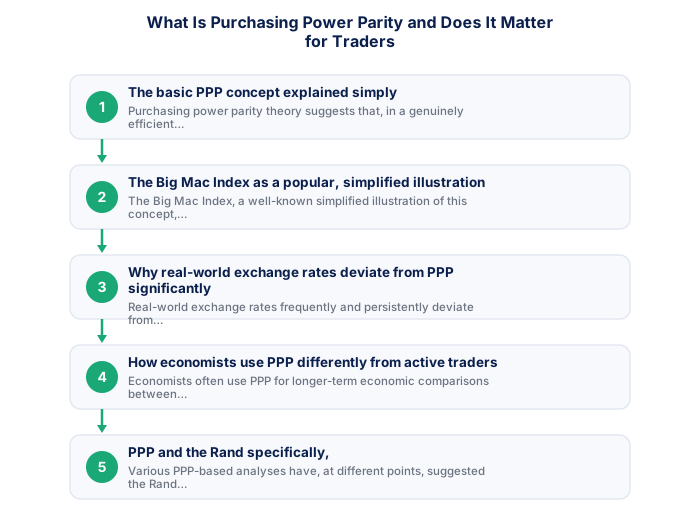
1. The basic PPP concept explained simply
Purchasing power parity theory suggests that, in a genuinely efficient market, identical goods should cost the same amount when their prices are converted into a common currency using the prevailing exchange rate. If this weren't true, theoretically unlimited arbitrage opportunities would exist, buying goods cheaply in one country and selling them in another, which should, in theory, push exchange rates toward this equalising equilibrium over time.
It's worth understanding this as a genuinely long-term, theoretical benchmark rather than a practical, tradeable prediction, discussed elsewhere on this site regarding the Rand's historical trend, purchasing power parity describes where exchange rates should theoretically settle over very long periods, not where they'll be next week or next month.
2. The Big Mac Index as a popular, simplified illustration
The Big Mac Index, a well-known simplified illustration of this concept, compares the price of an identical McDonald's Big Mac across different countries, converted into a common currency, as a rough, informal gauge of whether a specific currency appears overvalued or undervalued relative to this theoretical PPP benchmark.
It's worth appreciating why this simplified measure gained such popularity despite its genuine limitations, using a single, standardised product available globally makes the underlying purchasing power concept intuitively accessible, even though it necessarily oversimplifies the full basket of goods genuine PPP calculations would properly consider.
- FSCA-regulated broker verified at fsca.co.za
- Demo account tested for minimum 60 days
- Trading plan written: entry, exits, position sizing
- Risk per trade defined (1-2% of account)
- Backup internet connection tested for load shedding
- Tax implications understood
3. Why real-world exchange rates deviate from PPP significantly
Real-world exchange rates frequently and persistently deviate from PPP-implied levels, reflecting factors PPP theory doesn't fully account for: differing labour costs, local taxes and regulations, transportation costs, trade barriers, and crucially, the interest rate differential and capital flow dynamics that often dominate short-to-medium-term exchange rate movement far more than this longer-term theoretical equilibrium concept.
It's worth connecting this directly to the many other fundamental factors discussed throughout this site's economy content, interest rate differentials, capital flows, political risk, and commodity prices all pull actual exchange rates away from any theoretical PPP-implied value, often for extended periods.
4. How economists use PPP differently from active traders
Economists often use PPP for longer-term economic comparisons between countries, including adjusting GDP figures for genuine purchasing power comparison purposes, distinct from the shorter-term, more immediately actionable analysis active traders typically rely on for their trading decisions.
It's worth appreciating this different use case explicitly, economists use PPP primarily for cross-country economic comparisons, like comparing genuine living standards, a purpose considerably removed from the shorter-term, tradeable analysis this site's content generally focuses on.
| Item | Detail |
|---|---|
| Regulator | FSCA, fsca.co.za |
| Exchange control | SARB, resbank.co.za |
| Tax authority | SARS, sars.gov.za |
| JSE hours | 09:00-17:00 SAST Mon-Fri |
| Best forex session | 15:00-17:00 SAST |
| CGT annual exclusion | R50,000 (individuals) |
5. PPP and the Rand
Various PPP-based analyses have, at different points, suggested the Rand appears undervalued relative to this theoretical benchmark, though this kind of theoretical undervaluation can persist for extended periods without necessarily resolving through the kind of currency appreciation PPP theory might suggest, given the more dominant short-to-medium-term factors behind USD/ZAR's actual drivers.
It's worth treating any PPP-based Rand valuation assessment as background context at most, rather than a trading signal, a currency assessed as 'undervalued' by PPP standards can remain at that valuation, or become more undervalued still, for years, worth understanding this limitation clearly before acting on any such assessment.
6. The practical trading relevance of this concept overall
For most retail traders, PPP serves more as interesting, broader economic context than as a directly actionable trading signal, given how persistently and significantly real-world exchange rates can deviate from this theoretical benchmark over any practically relevant trading timeframe.
Purchasing power parity describes a theoretical long-run equilibrium rate. Market exchange rates can deviate from PPP for extended periods, making it useful as background context rather than a trading signal.
★ Why It Matters
Worth knowing as a limitation: PPP deviations for emerging-market currencies like the Rand have historically persisted for years at a time, making this framework considerably more useful for very long-term macro context than for any near-term trading decision.
✕ Common mistakes
- Treating PPP as a precise predictor rather than a long-run theoretical framework. It's more useful for long-term macro context than any specific trade decision.
- Ignoring how persistent deviation undermines this framework's near-term practical relevance. This is a genuine, well-documented limitation worth understanding.
- Assuming PPP applies equally reliably to all currency pairs. Emerging-market currencies like the Rand show particularly persistent deviations.
Key Takeaways
- Purchasing power parity suggests exchange rates should equalise the price of identical goods across countries, though real-world deviations can persist for years.
- Purchasing power parity suggests exchange rates should theoretically equalise the price of identical goods across countries.
- Real-world deviations from this theoretical equilibrium can persist for extended periods, limiting its direct practical relevance.
- The basic PPP concept explained simply.
- The Big Mac Index as a popular, simplified illustration.
See also: How Does South Africa Compare to Other Emerging Markets?.
Frequently asked follow-up questions
Is the Rand genuinely undervalued according to PPP measures?
Various PPP-based analyses have suggested this at different points, though this theoretical assessment doesn't reliably predict near-term currency movement.
Do any traders actually use PPP for trading decisions?
Some longer-term, macro-focused traders or analysts incorporate PPP as one input among many, though it's generally not a primary, standalone trading signal for most retail strategies.
How is PPP different from the Dollar Index?
PPP compares purchasing power across countries based on goods pricing, while the Dollar Index measures the Dollar's value against a specific currency basket, a genuinely different concept and calculation.
