i Short answer
Recognising that comparison-driven jealousy often relies on incomplete or selectively curated information about other traders' results helps redirect focus toward your own genuine progress.
📋 ON THIS PAGE
- Why this jealousy feels so natural and common
- The incomplete information problem underlying most comparisons
- Survivorship bias in what you actually see and hear about
- How this jealousy can actively harm your own trading
- Redirecting focus to your own measurable progress instead
- When comparison can actually be constructive rather than harmful
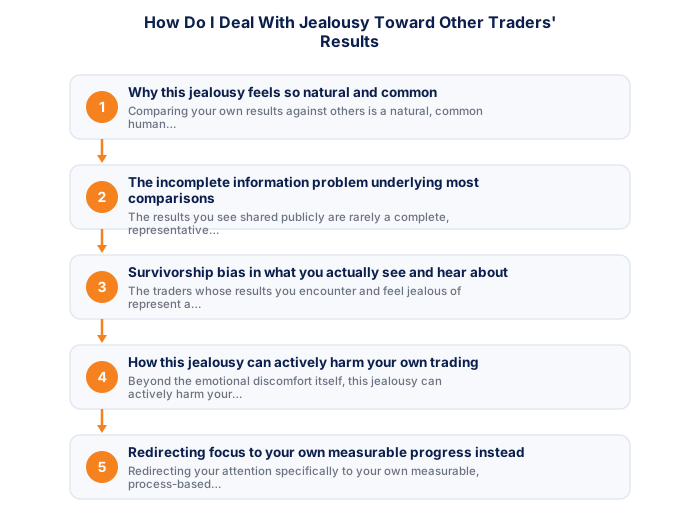
1. Why this jealousy feels so natural and common
Comparing your own results against others is a natural, common human tendency, not unique to trading, but it carries particular relevance here given how visibly and frequently trading results, whether genuine or exaggerated, are shared and discussed within trading communities and social media.
It's worth accepting this feeling without excessive self-judgement when it arises, treating it as a normal, human reaction rather than a character flaw, the goal isn't eliminating the feeling entirely but recognising it clearly enough that it doesn't translate into the kind of undisciplined decisions discussed further below.
2. The incomplete information problem underlying most comparisons
The results you see shared publicly are rarely a complete, representative picture, they typically omit the losing trades, the difficult periods, and the genuine struggles that even successful traders experienced, making any comparison based on this incomplete information fundamentally unfair to your own honest, complete self-assessment.
It's worth actively reminding yourself of this incompleteness specifically in the moment jealousy arises, rather than only understanding it abstractly, consciously thinking 'I'm seeing a curated highlight, not their full picture' when the feeling surfaces helps interrupt the comparison before it fully takes hold.
- FSCA-regulated broker verified at fsca.co.za
- Demo account tested for minimum 60 days
- Trading plan written: entry, exits, position sizing
- Risk per trade defined (1-2% of account)
- Backup internet connection tested for load shedding
- Tax implications understood
3. Survivorship bias in what you actually see and hear about
The traders whose results you encounter and feel jealous of represent a survivorship-biased sample, you're seeing the success stories specifically because they're being shared, while the considerably larger number of traders experiencing the more typical, less impressive results, creating a distorted impression of how common genuine, significant success actually is.
This pattern is worth recognising as structurally similar to survivorship bias in trading strategy marketing generally, discussed elsewhere on this site, the mechanism producing a skewed, overly positive impression is essentially the same whether it's a course selling success stories or an individual trader sharing only their wins.
4. How this jealousy can actively harm your own trading
Beyond the emotional discomfort itself, this jealousy can actively harm your own trading by tempting you toward the overtrading or strategy-abandonment, motivated by a desire to match or exceed someone else's apparent results, rather than continuing to follow your own tested, disciplined approach regardless of how it compares to others' visible, possibly exaggerated outcomes.
It's worth checking your own trading journal honestly for any entries that seem to have been influenced by this kind of comparison-driven urgency, rather than genuine strategy criteria, catching this pattern in your own documented history is often more persuasive for genuine change than simply acknowledging the risk in the abstract.
| Item | Detail |
|---|---|
| Regulator | FSCA, fsca.co.za |
| Exchange control | SARB, resbank.co.za |
| Tax authority | SARS, sars.gov.za |
| JSE hours | 09:00-17:00 SAST Mon-Fri |
| Best forex session | 15:00-17:00 SAST |
| CGT annual exclusion | R50,000 (individuals) |
5. Redirecting focus to your own measurable progress instead
Redirecting your attention specifically to your own measurable, process-based progress, improved discipline, more consistent criteria adherence, genuine skill development, provides a more accurate, controllable, and genuinely productive focus than comparison against others' uncertain, incomplete results.
This redirection is worth practising as an active, deliberate habit rather than a one-time mindset shift, specifically reviewing your own process metrics whenever you notice comparison-driven jealousy arising gives you a concrete, constructive action to take instead of simply sitting with the uncomfortable feeling.
6. When comparison can actually be constructive rather than harmful
Comparison can occasionally be constructive when it's based on genuine, detailed understanding of another trader's actual process and approach, allowing you to learn from specific, concrete techniques or insights, rather than the unproductive, envy-driven comparison based purely on visible outcomes without this deeper, more useful context.
Redirecting focus to your own process-based progress helps more.
Publicly shared results are rarely a complete picture, typically showing curated wins from a survivorship-biased sample. Redirecting attention to your own measurable progress helps more.
★ Why It Matters
Worth remembering when comparing yourself to a trader posting big wins online: you're seeing their best month, not their account's actual long-term equity curve, the selection bias in what gets shared publicly is enormous and almost never includes the losing months either side of it.
✕ Common mistakes
- Comparing your full track record to someone else's best month. Public results rarely show the losing periods around the highlighted win.
- Assuming online trading results are representative or verified. Selection bias in what gets shared publicly is substantial.
- Letting comparison influence your own risk-taking. Jealousy-driven decisions rarely align with your own tested strategy.
- Not redirecting focus back to your own journal and progress. Your own data is the only genuinely relevant benchmark.
Key Takeaways
- Recognising that comparison-driven jealousy often relies on incomplete or curated information helps redirect focus toward your own genuine, measurable progress.
- Recognising that comparison-driven jealousy often relies on incomplete or selectively curated information about other traders' results helps redirect focus toward your own genuine progress.
- Why this jealousy feels so natural and common.
- The incomplete information problem underlying most comparisons.
- Survivorship bias in what you actually see and hear about.
See also: How Do I Evaluate YouTube and Influencer Trading Content? and How Do I Stay Motivated During a Difficult Learning Period? and What Is Outcome Bias and How Does It Distort Self-Assessment?.
Frequently asked follow-up questions
Is it ever healthy to compare myself to other traders?
Comparison based on genuine, detailed process understanding, discussed in this piece, can be constructive; comparison based purely on visible outcomes tends to be less productive and potentially harmful.
Should I stop following other traders on social media if I feel jealous?
This is a personal choice. Some find limiting exposure to comparison-triggering content genuinely helpful.
Does this jealousy ever go away with more trading experience?
Many traders find this feeling diminishes as their own genuine confidence and measurable progress develops, though individual experience varies.
